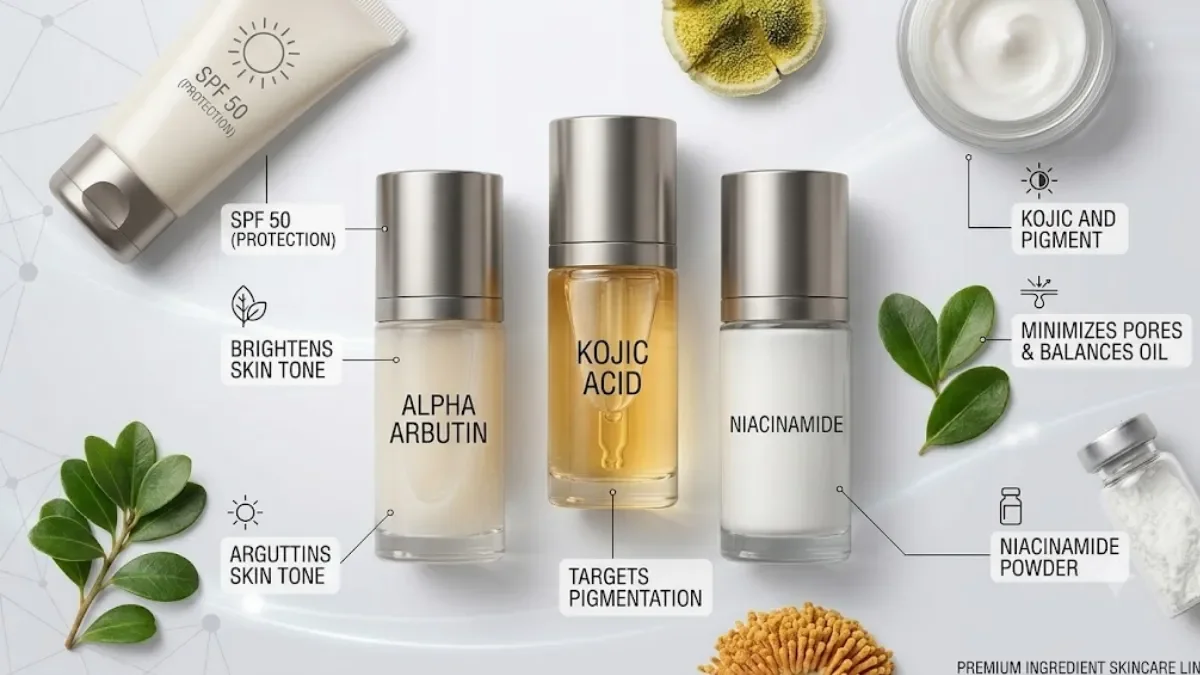
Quick Answer: Yes, kojic acid, alpha arbutin, and niacinamide all have clinical evidence supporting their effectiveness for hyperpigmentation — but they work through different mechanisms, and combining them doesn't automatically mean better results. Kojic acid and alpha arbutin inhibit tyrosinase (the enzyme needed for melanin production), while niacinamide inhibits melanosome transfer (preventing pigment from reaching skin cells). Sunscreen is more important than any "brightening" ingredient, and over-exfoliation can actually worsen pigmentation by causing irritation. Realistic timelines are 8-12 weeks for noticeable improvement, 3-6 months for significant improvement.
A recent Reddit skincare discussion highlighted how consumers are combining pigment-focused ingredients like kojic acid, alpha arbutin, and niacinamide in their routines — but personal experience, while valuable, isn't the same as clinical evidence. Whether you're dealing with post-acne marks, sun damage, melasma, or general uneven skin tone, here's what the science actually says about these ingredients, how to use them safely, and what to realistically expect.
Why Pigmentation Happens in the First Place
Before diving into ingredients, it's important to understand what causes pigmentation in the first place — because the cause affects how you should treat it.
Melanin and Melanocytes:
Melanocytes are specialized cells in your skin that produce melanin (the pigment that gives skin its color)
Melanin is transferred from melanocytes to keratinocytes (skin cells)
Hyperpigmentation occurs when there's excess melanin production or uneven distribution
Common Causes of Hyperpigmentation:
1. Post-Inflammatory Hyperpigmentation (PIH):
What it is: Dark marks left after inflammation (acne, irritation, injury, insect bites)
Why it happens: Inflammation triggers melanocytes to produce more melanin
Appearance: Brown or dark marks (flat, no texture change)
Common in: All skin types, but more common and persistent in darker skin tones
2. Post-Acne Marks:
PIH (brown/dark marks): Caused by excess melanin after acne inflammation
PIE (red/pink marks): Caused by dilated blood vessels after inflammation (different from PIH)
Important: Treating PIH requires different ingredients than treating PIE
3. Melasma:
What it is: Hormonally-influenced pigmentation (often triggered by pregnancy, birth control, sun exposure)
Appearance: Brown or gray-brown patches (typically on face)
Treatment: Often requires prescription treatments (topical skincare alone may not be enough)
4. Solar Lentigines (Sun/Age Spots):
What it is: Sun-induced pigmentation
Appearance: Brown spots (typically on sun-exposed areas: face, hands, arms)
Prevention: Sun protection is critical
5. Tanning:
What it is: Temporary increase in melanin production due to UV exposure
Appearance: Overall darkening of skin
Important: Tanning is a sign of skin damage; repeated tanning increases skin cancer risk
Key Point:
Different causes require different treatments: PIH from acne may respond well to topical ingredients; melasma may require prescription treatments; sun spots require aggressive sun protection
Treating the underlying cause is essential: If you have active acne, treating acne is priority (ongoing acne = ongoing PIH)
Kojic Acid for Pigmentation: What the Evidence Says
What is Kojic Acid?
A natural compound derived from fungi (mushrooms, fermented rice)
Mechanism: Tyrosinase inhibitor (blocks the enzyme needed for melanin production)
Typical concentration: 1-4% in skincare products
Clinical Evidence:
2022 Systematic Review and Meta-Analysis (Searle et al., Journal of Cosmetic Dermatology):
14 randomized controlled trials (RCTs), 1,247 participants
1-4% kojic acid produced mean MASI (Melasma Area and Severity Index) reduction of 38.2% over 12 weeks
Placebo: 12.4% reduction
Statistically significant (p < 0.001)
What This Means:
Kojic acid is effective for reducing hyperpigmentation (melasma, lentigo, post-inflammatory hyperpigmentation)
38.2% reduction is significant, but not "complete removal" — expect improvement, not perfection
12 weeks is the typical timeline for noticeable results
Limitations and Safety Considerations:
1. Irritation Risk:
Contact dermatitis: Can cause redness, itching, burning (especially at higher concentrations or prolonged use)
Sensitivity: Sensitive skin may not tolerate well
Recommendation: Start with lower concentration (1-2%), less frequent use (2-3x/week), increase as tolerated
2. Stability:
Limited formulation stability: Can oxidize, lose effectiveness over time
Recommendation: Store in cool, dark place; replace if product changes color or smell
3. Sun Sensitivity:
Increases sun sensitivity: Makes skin more susceptible to UV damage
Recommendation: Daily broad-spectrum sunscreen (SPF 30+) is essential
4. Not for Everyone:
Pregnancy/breastfeeding: Limited safety data; consult healthcare provider
Very sensitive skin: May not tolerate; consider gentler alternatives (alpha arbutin, niacinamide)
Bottom Line:
Kojic acid is effective for hyperpigmentation (clinical evidence supports this)
But it can cause irritation — start slowly, patch test, use sunscreen
Not a "miracle" ingredient: Expect improvement over 12 weeks, not overnight results
Alpha Arbutin for Dark Spots
What is Alpha Arbutin?
A natural compound derived from bearberry plant (also found in wheat, pears)
Mechanism: Tyrosinase inhibitor (similar to kojic acid, but more stable)
Typical concentration: 2% in skincare products
Clinical Evidence:
2021 Review (PMC8301119):
In vitro studies: Arbutin inhibited melanin production in B16 cells stimulated by α-MSH
UVR-induced hyperpigmentation: Reduced by 43.5% (arbutin alone); 63.3% when combined with aleosin (synergistic effect)
Human studies: Limited large-scale human clinical trials compared to kojic acid; clinical evidence suggests effectiveness for hyperpigmentation, but more human trials needed
What This Means:
Alpha arbutin is effective for reducing hyperpigmentation (in vitro and animal studies show strong depigmenting effects)
43.5% reduction in UVR-induced hyperpigmentation is significant
Synergistic effect with other ingredients (aleosin) suggests combination may be beneficial
Human clinical evidence is limited compared to kojic acid — more trials needed
Safety and Tolerability:
1. Lower Irritation Risk:
Generally well-tolerated: Lower irritation risk than kojic acid
Suitable for sensitive skin: At appropriate concentrations (2%)
Recommendation: Still patch test, but lower risk of irritation
2. Stability:
More stable than kojic acid: Less prone to oxidation
Recommendation: Still store in cool, dark place for best results
3. Concentration:
2% is typical: Higher concentrations may increase irritation without added benefit
Recommendation: Stick to 2% unless directed by dermatologist
Bottom Line:
Alpha arbutin is effective for hyperpigmentation (in vitro and animal studies; limited human trials)
Gentler than kojic acid: Better option for sensitive skin
More research needed: Human clinical trials are limited compared to kojic acid
What Niacinamide Adds to a Pigmentation Routine
What is Niacinamide?
Also known as nicotinamide (a form of vitamin B3)
Mechanism: Does NOT inhibit tyrosinase (different from kojic acid/arbutin)
Inhibits melanosome transfer from melanocytes to keratinocytes (prevents pigment from reaching skin cells)
Anti-inflammatory properties (reduces inflammation that triggers pigmentation)
Strengthens skin barrier (improves barrier function, reduces water loss)
Regulates oil production (beneficial for oily/acne-prone skin)
Clinical Evidence:
Hakozaki et al., 2002 (British Journal of Dermatology):
8-week randomized trial, n=18, 5% niacinamide vs. vehicle
35-68% melanosome transfer inhibition in vitro
Significant decrease in melanin index at week 4 and 8 (p < 0.05)
25% reduction in hyperpigmented spot area
2011 Head-to-Head Study (4% niacinamide vs. 4% hydroquinone for melasma):
Week 8: Hydroquinone achieved 55% reduction in MASI score
Niacinamide: 44% reduction in MASI score
Not statistically different (p = 0.12)
Conclusion: Niacinamide is a viable first-line brightening agent (nearly as effective as hydroquinone, but gentler)
Multiple Other Studies:
4-5% niacinamide significantly decreased hyperpigmentation after 4-8 weeks
Increased skin lightness compared to vehicle
Works for facial hyperpigmentation, axillary hyperpigmentation
Additional Benefits (Beyond Pigmentation):
1. Skin Barrier Support:
Improves barrier function: Reduces water loss, improves hydration
Beneficial for: Dry skin, sensitive skin, compromised barrier
2. Anti-Inflammatory:
Reduces inflammation: Helps prevent PIH (inflammation triggers melanin production)
Beneficial for: Acne-prone skin, sensitive skin, rosacea
3. Oil Regulation:
Helps control sebum production: Beneficial for oily/acne-prone skin
Beneficial for: Oily skin, acne-prone skin, enlarged pores
4. Pore Appearance:
Can minimize appearance of pores: By regulating oil and improving skin texture
Beneficial for: Oily skin, enlarged pores
Safety and Tolerability:
1. Very Well-Tolerated:
Low irritation risk: Suitable for sensitive skin
Can be used daily: No need to "build up" tolerance
4-5% concentration: Effective and well-tolerated
2. Compatible with Other Ingredients:
Works well with: Kojic acid, alpha arbutin, retinol, vitamin C (modern formulations)
No major conflicts: Unlike some ingredients (e.g., old concern about niacinamide + vitamin C was based on unstable formulations)
Bottom Line:
Niacinamide is effective for hyperpigmentation (clinical evidence supports this)
Gentler than kojic acid/arbutin: Excellent option for sensitive skin
Multiple benefits: Pigmentation + barrier support + oil regulation + anti-inflammatory
4-5% is the sweet spot: Effective and well-tolerated
Can You Use Kojic Acid, Alpha Arbutin and Niacinamide Together?
This is one of the most common questions — and the answer is more nuanced than "yes, more is better."
Theoretical Benefits:
1. Kojic Acid + Alpha Arbutin:
Both are tyrosinase inhibitors: Similar mechanism (blocking melanin production)
Theoretical benefit: May provide synergistic effect (targeting tyrosinase through slightly different pathways)
Limited direct clinical evidence: No large-scale human trials specifically testing this combination
Caution: Both can cause irritation; combining may increase irritation risk without proportional benefit
2. Niacinamide + Alpha Arbutin:
Different mechanisms: Niacinamide inhibits melanosome transfer; arbutin inhibits tyrosinase
Theoretical benefit: Targeting pigmentation through two different pathways
Limited direct clinical evidence: No large-scale human trials specifically testing this combination
Safety: Both are generally well-tolerated; combination likely safe
3. Kojic Acid + Niacinamide:
Different mechanisms: Kojic acid inhibits tyrosinase; niacinamide inhibits melanosome transfer
Some evidence: 2010 study showed niacinamide + NAG (N-acetyl glucosamine) reduced irregular pigmentation beyond SPF 15 sunscreen alone
Theoretical benefit: Targeting pigmentation through two different pathways
Caution: Kojic acid can cause irritation; niacinamide is well-tolerated
Key Point: More Actives ≠ Automatically Better Results
Why More Isn't Always Better:
1. Irritation Risk:
Combining multiple actives increases irritation risk: Especially for sensitive skin
Irritation triggers inflammation: Inflammation triggers melanin production → more pigmentation (PIH)
Result: You may end up with worse pigmentation, not better
2. Diminishing Returns:
Adding more ingredients doesn't necessarily mean better results: There's a point of diminishing returns
Example: If kojic acid alone gives you 38% improvement, adding alpha arbutin may give you 40-42% — not 76%
Cost vs. benefit: Is the marginal improvement worth the increased irritation risk and cost?
3. Formulation Compatibility:
Not all ingredients play well together: Some combinations can destabilize formulations or reduce effectiveness
Example: Old concern about niacinamide + vitamin C was based on unstable formulations (modern formulations are compatible)
Recommendation: Stick to well-formulated products from reputable brands
Practical Recommendations:
1. Start with Fewer Actives:
Begin with one or two ingredients: See how your skin tolerates them
Example: Start with niacinamide (gentle, well-tolerated) + sunscreen
Add gradually: If tolerated, add kojic acid or alpha arbutin
2. Patch Test:
Always patch test new products: Apply to small area (behind ear, inner arm) for 24-48 hours
Watch for reactions: Redness, itching, burning, swelling
If reaction occurs: Stop using product
3. Listen to Your Skin:
If irritation occurs: Reduce frequency, stop actives, focus on barrier repair
Signs of irritation: Redness, stinging, dryness, flaking, breakouts
Don't "push through" irritation: This can worsen pigmentation
4. Consider Your Skin Type:
Sensitive skin: Prioritize gentler ingredients (niacinamide, alpha arbutin); use kojic acid cautiously
Oily/acne-prone skin: Niacinamide is excellent (oil regulation + pigmentation); kojic acid can help but may cause irritation
Normal/resilient skin: May tolerate combination better, but still start slowly
Bottom Line:
Yes, you can use them together — but it doesn't automatically mean better results
Start with fewer actives: See how your skin tolerates them
More isn't always better: Irritation can worsen pigmentation
Listen to your skin: If irritation occurs, reduce or stop actives
Why Sunscreen Matters More Than Most "Brightening" Products
This is arguably the most important section — because without sun protection, no topical routine will work effectively.
Why Sunscreen is Critical:
1. UV Exposure is the Primary Trigger for Melanin Production:
UV radiation triggers melanocytes to produce more melanin
Without sun protection: Pigmentation will continue to worsen or return (even with the best topical routine)
Evidence: Multiple studies show sun protection is essential for any pigmentation treatment to work
2. Sunscreen Prevents Further Damage:
Broad-spectrum sunscreen: Protects against UVA (aging) and UVB (burning) rays
UVA penetrates windows: You need sunscreen even indoors (if near windows)
Daily use: Even on cloudy days (UV rays penetrate clouds)
3. Sunscreen Enhances Topical Treatment Effectiveness:
2010 Study (niacinamide + NAG): Combination reduced irregular pigmentation beyond SPF 15 sunscreen alone — but sunscreen was still essential
Key point: Sunscreen is the foundation; topical treatments build on that foundation
Recommendations:
1. Broad-Spectrum Sunscreen:
Protects against UVA and UVB: Look for "broad-spectrum" on label
SPF 30 or higher: Minimum for daily use (SPF 50+ for extended outdoor exposure)
Reapplication: Every 2 hours when outdoors (more frequently if swimming/sweating)
2. Daily Use:
Every day: Even on cloudy days, even indoors (UVA penetrates windows)
Amount: Use enough (most people under-apply; use about 1/4 teaspoon for face)
Don't skip: Even if you're "just running errands"
3. Formulation Matters:
Oily skin: Oil-free, non-comedogenic formulations (gel, fluid, matte finish)
Sensitive skin: Mineral sunscreens (zinc oxide, titanium dioxide) or gentle chemical sunscreens
Dry skin: Hydrating formulations (with hyaluronic acid, glycerin)
4. Additional Sun Protection:
Hats, sunglasses, clothing: Physical barriers complement sunscreen
Seek shade: Especially during peak sun hours (10am-4pm)
Avoid tanning: Tanning is skin damage; repeated tanning increases skin cancer risk
Bottom Line:
Sunscreen is more important than any "brightening" ingredient: Without it, your routine will struggle
Daily broad-spectrum SPF 30+: Non-negotiable for pigmentation treatment
Reapplication: Every 2 hours when outdoors
Think of sunscreen as the foundation: Topical treatments build on that foundation
AHA, BHA and PHA: Do You Really Need Them?
Exfoliating acids are often included in pigmentation routines — but they're not essential, and over-exfoliation can actually worsen pigmentation.
What Each Does:
AHA (Alpha Hydroxy Acids):
Examples: Glycolic acid, lactic acid, mandelic acid
Mechanism: Exfoliates surface skin cells (water-soluble)
Benefits:
Improves skin texture
Can help fade superficial pigmentation (by removing pigmented surface cells)
Enhances penetration of other ingredients
Limitations:
Can cause irritation (especially at high concentrations)
Increases sun sensitivity (sunscreen is essential)
May not be suitable for sensitive skin
BHA (Beta Hydroxy Acid):
Example: Salicylic acid
Mechanism: Exfoliates inside pores (oil-soluble)
Benefits:
Good for acne, clogged pores, oily skin
Anti-inflammatory properties
Penetrates pores (unlike AHA)
Limitations:
Can cause dryness, irritation
May not be as effective for pigmentation as AHA
Not suitable for very dry or sensitive skin
PHA (Polyhydroxy Acids):
Examples: Gluconolactone, lactobionic acid
Mechanism: Gentle exfoliation (larger molecules, penetrate more slowly)
Benefits:
Less irritating than AHA/BHA
Suitable for sensitive skin
Hydrating properties
Limitations:
May be less effective for severe pigmentation
Slower results than AHA/BHA
Do You Need Them for Pigmentation?
Short Answer: No, they're not essential — but they can help some people.
When They Help:
Superficial pigmentation: Exfoliation can help fade surface-level pigmentation
Dull skin: Exfoliation can improve skin radiance
Clogged pores: BHA is excellent for acne, clogged pores
Texture concerns: Exfoliation can improve skin texture
When They May Not Help (or May Harm):
Deep pigmentation: Exfoliation won't reach deep pigmentation (melasma, deep PIH)
Sensitive skin: May cause irritation, worsening pigmentation
Active acne: Over-exfoliation can worsen acne
Compromised barrier: Exfoliation can further damage barrier
Key Point: Exfoliation Can Help SOME People, But Over-Exfoliation Can Make Pigmentation WORSE
Why Over-Exfoliation is a Problem:
1. Irritation Triggers Inflammation:
Inflammation triggers melanin production: More pigmentation (PIH)
Result: You may end up with worse pigmentation, not better
2. Damaged Skin Barrier:
Compromised barrier: Increased sensitivity, more irritation, more pigmentation
Result: Skin becomes more reactive, harder to treat
3. Acne Flare-Ups:
Over-exfoliation can cause breakouts: More acne = more post-acne marks
Result: Ongoing cycle of acne and pigmentation
Signs of Over-Exfoliation:
Redness, irritation, stinging
Dryness, flaking
Increased sensitivity
Breakouts
Worsening pigmentation
Recommendations:
1. Conservative Approach:
Start with lower concentrations: 5-10% AHA, 0.5-2% BHA, 5-10% PHA
Less frequent use: 1-2x/week initially, increase as tolerated
Listen to your skin: If irritation occurs, reduce frequency or stop
2. Sensitive Skin:
Prioritize PHA: Gentler than AHA/BHA
Avoid high-strength peels: 25% AHA + 2% BHA + 5% PHA is a high-strength at-home peel; not suitable for everyone
Patch test: Always patch test new products
3. Oily/Acne-Prone Skin:
BHA is excellent: Salicylic acid penetrates pores, helps with acne
AHA can help: Glycolic or lactic acid can improve texture, fade superficial pigmentation
Don't overdo it: 2-3x/week is typically enough
4. Sun Protection:
Exfoliation increases sun sensitivity: Sunscreen is essential
Daily broad-spectrum SPF 30+: Non-negotiable
Bottom Line:
Exfoliating acids can help with superficial pigmentation, texture, acne
But they're not essential: You can treat pigmentation without them
Over-exfoliation can worsen pigmentation: Conservative approach is key
Listen to your skin: If irritation occurs, reduce or stop
Can Over-Exfoliation Make Pigmentation Worse?
Yes — and this is a major practical takeaway.
How Over-Exfoliation Worsens Pigmentation:
1. Irritation → Inflammation → PIH:
Over-exfoliation causes irritation: Redness, stinging, dryness
Irritation triggers inflammation: Inflammation triggers melanocytes to produce more melanin
Result: More pigmentation (PIH)
2. Damaged Skin Barrier:
Over-exfoliation damages barrier: Skin becomes more sensitive, reactive
Compromised barrier: More irritation, more inflammation, more pigmentation
Result: Vicious cycle of irritation and pigmentation
3. Acne Flare-Ups:
Over-exfoliation can cause breakouts: Skin becomes irritated, produces more oil to compensate
More acne: More post-acne marks (PIH)
Result: Ongoing cycle of acne and pigmentation
Evidence:
Dermatology Guidance:
Multiple dermatology sources warn: Over-exfoliation can worsen pigmentation, especially in darker skin tones
PIH is more common in darker skin: Over-exfoliation is a common trigger
Recommendation: Conservative approach, especially for pigmentation-prone skin
Signs You're Over-Exfoliating:
Redness, irritation, stinging (especially after applying products)
Dryness, flaking, tightness
Increased sensitivity (products that didn't sting before now sting)
Breakouts (especially if you don't typically break out)
Worsening pigmentation (dark marks getting darker or more numerous)
What to Do If You're Over-Exfoliating:
1. Stop Actives:
Stop exfoliants: AHA, BHA, PHA, retinol, vitamin C, etc.
Focus on barrier repair: Gentle cleanser, barrier-repair moisturizer, sunscreen
2. Barrier Repair:
Ingredients to look for: Ceramides, fatty acids, cholesterol, hyaluronic acid, glycerin
Avoid: Fragrance, essential oils, alcohol (can further irritate)
Give it time: Barrier repair takes 2-4 weeks (sometimes longer)
3. Reintroduce Slowly:
Once barrier is repaired: Reintroduce actives one at a time
Start with lower concentrations: Less than before
Less frequent: 1x/week initially, increase as tolerated
Listen to your skin: If irritation returns, stop or reduce
Prevention:
1. Conservative Approach:
Start with lower concentrations: 5-10% AHA, 0.5-2% BHA, 5-10% PHA
Less frequent: 1-2x/week initially
Increase gradually: As tolerated
2. Don't Layer Too Many Actives:
Avoid: AHA + BHA + retinol + vitamin C all in one routine
Space them out: Use different actives on different nights
Simplify: Less is often more
3. Listen to Your Skin:
If irritation occurs: Reduce frequency or stop
Don't "push through" irritation: This can worsen pigmentation
Prioritize barrier health: Healthy barrier = less irritation, less pigmentation
Bottom Line:
Over-exfoliation can worsen pigmentation: This is a major risk
Conservative approach is key: Start slowly, listen to your skin
Barrier health is priority: Healthy barrier = less irritation, less pigmentation
If over-exfoliating: Stop actives, focus on barrier repair, reintroduce slowly
A Simple Routine for Oily, Sensitive Skin
Building a routine for oily + sensitive skin is a balancing act — you need to control oil without compromising the barrier.
Key Principles:
1. Gentle Cleansing:
Avoid harsh, stripping cleansers: These can trigger more oil production
Look for: Gentle, pH-balanced cleansers (cream, gel, or foaming — depending on preference)
Frequency: 2x/day (morning and night)
2. Lightweight Moisturizer:
Oil-free, non-comedogenic: Won't clog pores
Lightweight texture: Gel, fluid, or lightweight lotion
Barrier-supporting ingredients: Ceramides, fatty acids, cholesterol, hyaluronic acid, glycerin
3. Sunscreen:
Oil-free, non-comedogenic: Won't clog pores
Lightweight texture: Gel, fluid, or matte finish
SPF 30+: Daily use, reapplication every 2 hours when outdoors
4. Pigmentation Actives:
Niacinamide: Excellent for oily + sensitive skin (oil regulation + barrier support + pigmentation)
Alpha Arbutin: Well-tolerated, effective for pigmentation
Kojic Acid: Use cautiously (can cause irritation); start with lower concentration, less frequent
5. Exfoliation:
Conservative approach: Lower concentrations, less frequent
PHA preferred: Gentler than AHA/BHA
BHA for acne: Salicylic acid is excellent for acne, clogged pores
Sample Routine Framework:
MORNING:
Gentle cleanse: pH-balanced cleanser
Optional pigment-supporting active: Niacinamide serum (4-5%) or alpha arbutin serum (2%)
Lightweight moisturizer: Oil-free, non-comedogenic
Sunscreen: Oil-free, SPF 30+
NIGHT:
Gentle cleanse: pH-balanced cleanser
One appropriate active:
Option 1: Niacinamide serum (4-5%)
Option 2: Alpha arbutin serum (2%)
Option 3: Kojic acid serum (1-2%, 2-3x/week initially)
Option 4: BHA (0.5-2%, 1-2x/week for acne/clogged pores)
Lightweight moisturizer: Oil-free, non-comedogenic
EXFOLIATION (Optional):
1x/week: PHA (5-10%) or low-strength AHA/BHA
Listen to your skin: If irritation occurs, reduce or stop
Important Notes:
1. This is a General Framework, Not a Prescription:
Individual skin varies: What works for one person may not work for another
Patch test: Always patch test new products
Introduce one at a time: Don't add multiple new products at once
2. Adjust Based on Tolerance:
If irritation occurs: Reduce frequency, stop actives, focus on barrier repair
If skin is dry: Add more hydration (hyaluronic acid, glycerin)
If skin is oily: Ensure moisturizer is lightweight, oil-free
3. Treat Underlying Acne:
If you have active acne: Treating acne is priority (ongoing acne = ongoing PIH)
BHA can help: Salicylic acid is excellent for acne
Consider dermatologist: For severe acne, prescription treatments may be needed
Bottom Line:
Balance oil control with barrier protection: Don't strip skin
Niacinamide is excellent: Oil regulation + barrier support + pigmentation
Conservative exfoliation: Lower concentrations, less frequent
Sunscreen is essential: Daily broad-spectrum SPF 30+
How Long Does Pigmentation Take to Fade?
Realistic Timelines (Based on Clinical Evidence):
Niacinamide:
4-8 weeks: Visible improvement (Hakozaki et al., 2002)
8 weeks: 25% reduction in hyperpigmented spot area (5% niacinamide)
Kojic Acid:
12 weeks: Significant improvement (Searle et al., 2022 systematic review)
12 weeks: 38.2% MASI reduction (1-4% kojic acid)
Alpha Arbutin:
8-12 weeks: Noticeable improvement (based on clinical studies)
Limited human trials: More research needed for precise timelines
Factors Affecting Timeline:
1. Cause of Pigmentation:
PIH (post-acne marks): Fades faster (weeks to months)
Melasma: Slower to fade (months to years; often requires prescription treatments)
Sun spots: Variable (depends on depth, sun exposure)
2. Depth of Pigmentation:
Superficial: Fades faster (weeks to months)
Deep: Slower to fade (months to years)
3. Skin Type:
Lighter skin: May fade faster
Darker skin: More prone to PIH; may take longer to fade
4. Ongoing Inflammation:
Active acne: Ongoing inflammation = ongoing PIH
Irritation: Ongoing irritation = ongoing pigmentation
5. Sun Exposure:
UV exposure: Worsens pigmentation, slows fading
Sun protection: Essential for fading
6. Treatment Consistency:
Consistent use: Faster results
Inconsistent use: Slower results
Realistic Expectations:
2-4 Weeks:
May see slight improvement: Skin may look slightly brighter, more even
Don't expect dramatic changes: Pigmentation takes time to fade
8-12 Weeks:
More noticeable improvement: Dark marks should be visibly lighter
Continue treatment: Don't stop too early
3-6 Months:
Significant improvement: Most people see substantial improvement by this point
Continue treatment: Stubborn pigmentation may take longer
6+ Months:
Continued improvement: Stubborn pigmentation (melasma, deep PIH) may take 6+ months
Maintenance: Once pigmentation fades, continue sunscreen and gentle skincare to prevent recurrence
Important:
No "instant" results: Pigmentation takes time to fade
Consistency is key: Inconsistent use = slower results
Sun protection is essential: Without it, pigmentation will continue
Bottom Line:
8-12 weeks: Noticeable improvement for most people
3-6 months: Significant improvement for most people
6+ months: Stubborn pigmentation may take longer
Consistency + sun protection: Essential for results
Dark Spots vs Acne Scars: They're Not the Same
This is a critical distinction — because topical pigmentation ingredients cannot treat true textural acne scars.
Post-Inflammatory Hyperpigmentation (PIH):
What it is: Brown or dark marks left after acne heals
Appearance: Flat (no texture change), brown or dark
Cause: Excess melanin production after inflammation
Treatment: Topical pigmentation ingredients (kojic acid, arbutin, niacinamide, vitamin C, retinol, etc.)
Timeline: Fades over weeks to months (with treatment)
Post-Inflammatory Erythema (PIE):
What it is: Red or pink marks left after acne heals
Appearance: Flat (no texture change), red or pink
Cause: Dilated blood vessels after inflammation
Treatment: Different from PIH (vascular lasers, azelaic acid, niacinamide, etc.)
Timeline: Fades over weeks to months (with treatment)
Acne Scars:
What it is: Textural changes (indentations or raised areas)
Appearance: Indentations (icepick, boxcar, rolling scars) or raised areas (hypertrophic, keloid scars)
Cause: Damage to collagen during acne healing
Treatment: Topical ingredients have LIMITED effect; procedures needed (lasers, microneedling, fillers, subcision, etc.)
Timeline: Permanent without treatment; procedures can improve but may not completely remove
Key Point:
Topical pigmentation ingredients can fade PIH (brown marks) — but they cannot treat true textural acne scars
If you have indentations or raised areas: Topical ingredients won't fix these; see a dermatologist for procedure options
How to Tell the Difference:
PIH (Brown/Dark Marks):
Flat: No texture change (run your finger over it — it feels smooth)
Brown or dark: Color is brown, dark brown, or black
Fades over time: With treatment, fades over weeks to months
PIE (Red/Pink Marks):
Flat: No texture change (run your finger over it — it feels smooth)
Red or pink: Color is red, pink, or purple
Fades over time: With treatment, fades over weeks to months
Acne Scars (Textural Changes):
Indentations: Feels like small pits or depressions (icepick, boxcar, rolling scars)
Raised areas: Feels like raised bumps (hypertrophic, keloid scars)
Permanent without treatment: Won't fade on their own; procedures needed
Bottom Line:
PIH (brown marks): Topical ingredients can help fade
PIE (red marks): Different treatment approach (vascular lasers, azelaic acid, etc.)
Acne scars (textural): Topical ingredients have limited effect; procedures needed
When You Should See a Dermatologist
While topical skincare can help many people with pigmentation, there are situations where professional help is needed.
Red Flags:
1. Rapidly Changing Pigmentation:
What it means: Pigmentation that changes quickly (days to weeks)
Why it matters: Could indicate underlying medical condition (hormonal, metabolic, etc.)
Action: See a dermatologist promptly
2. Persistent Melasma:
What it means: Melasma that doesn't respond to topical treatments after 3-6 months
Why it matters: Melasma often requires prescription treatments (hydroquinone, tretinoin, combination creams, oral tranexamic acid)
Action: See a dermatologist for prescription options
3. Widespread Pigmentation:
What it means: Pigmentation covering large areas (not just isolated spots)
Why it matters: Could indicate systemic issue (hormonal, metabolic, medication side effect)
Action: See a dermatologist for evaluation
4. Severe Acne:
What it means: Painful, cystic, widespread acne
Why it matters: Ongoing acne = ongoing PIH; treating acne is priority
Action: See a dermatologist for acne treatment (prescription topicals, oral medications, etc.)
5. Pigmentation That Keeps Worsening:
What it means: Pigmentation that gets darker or more numerous despite consistent skincare
Why it matters: Could indicate ongoing inflammation, sun exposure, or underlying issue
Action: See a dermatologist for evaluation
6. Irritation from Products:
What it means: Severe redness, burning, swelling, blistering from skincare products
Why it matters: Could indicate allergic reaction, contact dermatitis
Action: Stop products, see a dermatologist
7. Suspected Allergic Reaction:
What it means: Itching, hives, swelling, difficulty breathing (severe)
Why it matters: Could be serious allergic reaction
Action: Stop products, seek medical attention (emergency if severe)
8. No Improvement After 3-6 Months:
What it means: Consistent, appropriate skincare for 3-6 months with no improvement
Why it matters: May need prescription treatments or procedures
Action: See a dermatologist for evaluation
Professional Treatments:
1. Prescription-Strength Topicals:
Hydroquinone: More potent than over-the-counter ingredients (but has safety concerns; use under supervision)
Tretinoin: Retinoid that improves cell turnover, helps fade pigmentation
Combination creams: Hydroquinone + tretinoin + corticosteroid (e.g., Tri-Luma)
2. Chemical Peels:
Professional-strength peels: Higher concentrations than at-home peels
Types: Glycolic acid, salicylic acid, TCA, Jessner's, etc.
Benefits: Can improve pigmentation, texture, acne
Risks: Irritation, PIH (especially in darker skin); professional supervision recommended
3. Lasers:
Pigment-specific lasers: Q-switched, picosecond, etc.
Benefits: Can target pigmentation directly
Risks: PIH (especially in darker skin); professional supervision essential
4. Microneedling:
Benefits: Can improve acne scars, some pigmentation
Risks: PIH (especially in darker skin); professional supervision recommended
5. Oral Medications:
Tranexamic acid: For melasma (oral or topical)
Antibiotics: For acne (oral or topical)
Hormonal treatments: For hormonally-influenced acne/pigmentation (birth control, spironolactone)
Bottom Line:
Topical skincare can help many people — but not everyone
See a dermatologist if: Rapidly changing pigmentation, persistent melasma, widespread pigmentation, severe acne, worsening pigmentation, severe irritation, no improvement after 3-6 months
Professional treatments can help: Prescription topicals, chemical peels, lasers, microneedling, oral medications
Frequently Asked Questions
Does kojic acid remove pigmentation?
Yes, clinical evidence supports kojic acid's effectiveness for hyperpigmentation. A 2022 systematic review found 1-4% kojic acid produced 38.2% reduction in MASI score over 12 weeks. However, it can cause irritation (especially at higher concentrations), so start slowly and use sunscreen.
Is alpha arbutin better than kojic acid?
It depends on your skin type. Alpha arbutin is gentler and better tolerated (especially for sensitive skin), but kojic acid has more robust human clinical evidence. If you have sensitive skin, alpha arbutin may be a better choice. If you have resilient skin and want maximum evidence, kojic acid may be better.
Can I use kojic acid and niacinamide together?
Yes, they work through different mechanisms (kojic acid inhibits tyrosinase; niacinamide inhibits melanosome transfer). However, kojic acid can cause irritation, so start with less frequent use and monitor your skin. If irritation occurs, reduce frequency or stop.
Can I use alpha arbutin every day?
Yes, alpha arbutin is generally well-tolerated for daily use at 2% concentration. It's gentler than kojic acid and suitable for sensitive skin. Still patch test new products and monitor for any reactions.
Does niacinamide fade acne marks?
Yes, clinical evidence supports niacinamide's effectiveness for post-inflammatory hyperpigmentation (PIH). Studies show 4-5% niacinamide significantly decreased hyperpigmentation after 4-8 weeks. It's also anti-inflammatory and helps regulate oil production, making it excellent for acne-prone skin.
Can AHA BHA remove pigmentation?
They can help with superficial pigmentation (by exfoliating pigmented surface cells), but they're not as effective as tyrosinase inhibitors (kojic acid, arbutin) or melanosome transfer inhibitors (niacinamide). Over-exfoliation can actually worsen pigmentation by causing irritation, so use conservatively.
Can exfoliating make pigmentation worse?
Yes, over-exfoliation can worsen pigmentation. Irritation from over-exfoliation triggers inflammation, which triggers melanin production — leading to more pigmentation (PIH). Use exfoliants conservatively (lower concentrations, less frequent), and stop if irritation occurs.
What is the best routine for pigmentation?
There's no one-size-fits-all routine, but a general framework is:
Morning: Gentle cleanse → optional pigment-supporting active (niacinamide, alpha arbutin) → moisturizer → sunscreen (SPF 30+)
Night: Gentle cleanse → one appropriate active (niacinamide, alpha arbutin, kojic acid) → moisturizer
Exfoliation (optional): 1x/week (PHA or low-strength AHA/BHA)
Adjust based on your skin type, tolerance, and specific concerns.
How long does hyperpigmentation take to fade?
Realistic timelines are 8-12 weeks for noticeable improvement, 3-6 months for significant improvement. Factors affecting timeline include cause of pigmentation (PIH fades faster than melasma), depth (superficial fades faster than deep), skin type, ongoing inflammation, sun exposure, and treatment consistency.
Does sunscreen prevent pigmentation?
Yes, sunscreen is essential for preventing further pigmentation. UV exposure is the primary trigger for melanin production — without sun protection, pigmentation will continue to worsen or return. Daily broad-spectrum SPF 30+ is non-negotiable for any pigmentation treatment.
Can oily sensitive skin use chemical exfoliants?
Yes, but with caution. Use lower concentrations (5-10% AHA, 0.5-2% BHA, 5-10% PHA), less frequent (1-2x/week initially), and PHA is preferred (gentler than AHA/BHA). Listen to your skin — if irritation occurs, reduce frequency or stop.
What's the difference between acne scars and dark spots?
Dark spots (PIH) are flat, brown marks caused by excess melanin after inflammation. Acne scars are textural changes (indentations or raised areas) caused by collagen damage during acne healing. Topical pigmentation ingredients can fade PIH, but they cannot treat true textural acne scars — procedures (lasers, microneedling, etc.) are needed for scars.
Is kojic acid safe for sensitive skin?
Use with caution. Kojic acid can cause irritation (contact dermatitis, sensitivity), especially at higher concentrations or prolonged use. If you have sensitive skin, consider gentler alternatives (alpha arbutin, niacinamide). If you do use kojic acid, start with lower concentration (1-2%), less frequent (2-3x/week), and patch test.
How much niacinamide should I use for pigmentation?
4-5% is the sweet spot — effective and well-tolerated. Clinical studies show 4-5% niacinamide significantly decreased hyperpigmentation after 4-8 weeks. Higher concentrations (10%+) are available but may not provide additional benefit and could increase irritation risk.
Can I use kojic acid every day?
It depends on your tolerance. Some people can use kojic acid daily without issues; others experience irritation. Start with less frequent use (2-3x/week), monitor your skin, and increase frequency as tolerated. If irritation occurs, reduce frequency or stop.
Does alpha arbutin work on melasma?
Yes, clinical evidence suggests alpha arbutin is effective for hyperpigmentation including melasma. However, melasma is often stubborn and may require prescription treatments (hydroquinone, tretinoin, oral tranexamic acid) in addition to topical skincare.
What causes post-inflammatory hyperpigmentation?
Inflammation (from acne, irritation, injury, insect bites) triggers melanocytes to produce more melanin. This excess melanin is transferred to skin cells, creating brown or dark marks (PIH). PIH is more common and persistent in darker skin tones.
Can I use vitamin C with niacinamide?
Yes, modern formulations are compatible. The old concern about niacinamide + vitamin C was based on unstable formulations (niacinamide could convert to niacin, causing flushing). Modern formulations are stable and compatible.
Is 25% AHA peel safe for home use?
It's a high-strength at-home peel — use with caution, especially for sensitive skin. 25% AHA + 2% BHA + 5% PHA is a high concentration; professional supervision may be more appropriate for some individuals (especially darker skin tones, sensitive skin, history of PIH). Patch test, follow manufacturer instructions, and start with less frequent use.
How do I know if my pigmentation is getting worse?
Signs include: darker marks, more marks, spreading pigmentation, pigmentation that doesn't fade after 3-6 months of consistent treatment. This may indicate ongoing inflammation, sun exposure, or underlying issue — see a dermatologist for evaluation.
Should I stop using actives if my skin is irritated?
Yes, stop actives (exfoliants, retinol, vitamin C, kojic acid, etc.) and focus on barrier repair (gentle cleanser, barrier-repair moisturizer, sunscreen). Once barrier is repaired (2-4 weeks), reintroduce actives slowly (one at a time, lower concentrations, less frequent).
Can hormonal pigmentation be treated with topical skincare?
Topicals can help, but hormonal pigmentation (melasma) often requires prescription treatments (hydroquinone, tretinoin, oral tranexamic acid) in addition to topical skincare. Sun protection is essential (UV exposure worsens melasma).
What's the difference between PIH and PIE?
PIH (post-inflammatory hyperpigmentation) is brown or dark marks caused by excess melanin. PIE (post-inflammatory erythema) is red or pink marks caused by dilated blood vessels. They require different treatments (PIH: tyrosinase inhibitors, melanosome transfer inhibitors; PIE: vascular lasers, azelaic acid, niacinamide).
Can I treat pigmentation if I still have active acne?
Yes, but treating acne is priority — ongoing acne = ongoing PIH. Use gentle, non-irritating pigmentation ingredients (niacinamide is excellent for acne + pigmentation). Consider seeing a dermatologist for acne treatment (prescription topicals, oral medications).
When should I see a dermatologist for pigmentation?
See a dermatologist if: rapidly changing pigmentation, persistent melasma (not responding to topicals after 3-6 months), widespread pigmentation, severe acne, pigmentation that keeps worsening despite consistent skincare, severe irritation from products, suspected allergic reaction, no improvement after 3-6 months of consistent, appropriate skincare.