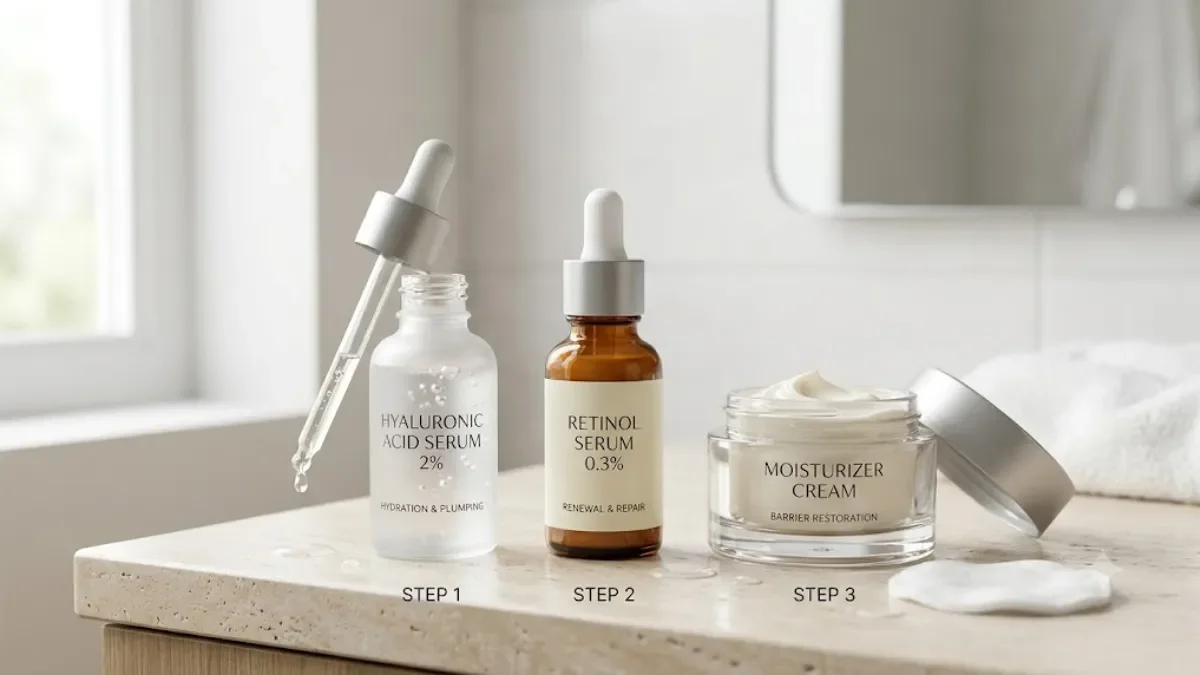
If you're using hyaluronic acid, retinol and moisturizer together, the usual nighttime order is cleanser → hyaluronic acid → retinol → moisturizer. However, retinol can cause dryness and irritation, so beginners or people with sensitive skin may benefit from applying moisturizer before retinol or using a moisturizer-retinol-moisturizer “sandwich” approach.
What does each ingredient do?
Hyaluronic acid is a hydrating ingredient that helps the skin retain moisture. It can be used in both morning and evening routines and is often available as a serum or included in moisturizers.
Retinol is a form of vitamin A used in skincare for concerns including acne, fine lines and uneven pigmentation. It can also cause dryness, redness, peeling or irritation, particularly when someone is new to it.
Moisturizer helps reduce water loss from the skin and can be particularly useful when using potentially drying ingredients such as retinol.
What order should you apply hyaluronic acid, retinol and moisturizer?
For a typical nighttime routine, use the products in this order:
- Cleanser
- Hyaluronic acid serum
- Retinol
- Moisturizer
The general skincare principle is to apply products from lighter to heavier textures, although the exact order can vary depending on the formulation. Cleveland Clinic's dermatologist guidance places retinol after cleansing and moisturizer afterward, while hyaluronic acid can be used to help counteract some of retinol's drying effects.
Should hyaluronic acid go before or after retinol?
For a simple routine, hyaluronic acid can go before retinol when it is being used as a separate serum.
Hyaluronic acid is primarily a hydrating ingredient, and Cleveland Clinic notes that it can help soothe and hydrate skin when used alongside retinol.
However, there isn't a universal requirement that hyaluronic acid must always be applied before retinol. The formulation and instructions on the individual products matter, so follow the manufacturer's directions if they specify a different application method.
Should moisturizer go before or after retinol?
For most people following a standard retinol routine, moisturizer goes after retinol.
Cleveland Clinic recommends cleansing, applying a thin layer of retinol and then finishing with a noncomedogenic facial moisturizer.
But there is an important exception: if retinol is making your skin excessively dry or irritated, applying moisturizer before retinol can help create a buffer. The American Academy of Dermatology also notes that dermatologists may recommend moisturizer first when a retinoid is causing irritation.
What is the retinol sandwich method?
The retinol sandwich method is a gentler approach in which moisturizer is applied before and after retinol.
A simple version looks like this:
Cleanser → moisturizer → retinol → moisturizer
This approach can be useful for people who find retinol irritating. However, it is not necessary for everyone, and the best routine depends on the individual's skin and the specific retinol product being used.
Can you use hyaluronic acid and retinol together?
Yes. Hyaluronic acid and retinol can generally be used in the same skincare routine.
In fact, hydration can be useful when introducing retinol because retinol may cause dryness and irritation. Cleveland Clinic specifically identifies hyaluronic acid as an ingredient that can help counteract some of retinol's drying effects.
That does not mean hyaluronic acid completely prevents retinol irritation. Starting slowly and adjusting the frequency of retinol use may still be necessary.
Should you use retinol in the morning or at night?
Nighttime is generally preferred for retinol.
Dermatology guidance commonly recommends applying topical retinoids in the evening. Retinoids can also increase sensitivity to sunlight, making daytime sun protection particularly important.
A simple morning routine can instead be:
Cleanser → hyaluronic acid → moisturizer → broad-spectrum sunscreen
Sunscreen should be the final skincare step in the morning. Mayo Clinic recommends broad-spectrum sunscreen with an SPF of at least 30 for sun protection.
How should beginners introduce retinol?
If you're new to retinol, using it every night immediately may increase the chance of irritation.
A more cautious approach is:
- Patch test the product according to its instructions.
- Start with a small amount. Cleveland Clinic recommends approximately a pea-sized amount for the face.
- Use it less frequently at first, such as every other night or as directed on the product.
- Follow with moisturizer to help reduce dryness.
- Increase frequency gradually only if your skin tolerates it.
If you experience significant burning, persistent redness or severe irritation, stop using the product and consider speaking with a dermatologist.
What if your skin is sensitive or very dry?
If retinol regularly leaves your skin uncomfortable, the answer isn't necessarily to add more skincare products.
You could reduce how often you use retinol, use moisturizer before applying it, or discuss alternatives with a dermatologist. The American Academy of Dermatology notes that starting slowly and using moisturizer can help reduce irritation from retinoids.
People with particularly sensitive skin should also be careful about combining retinol with other potentially irritating active ingredients without professional guidance.
What skincare ingredients should you be careful about combining with retinol?
Retinol is already capable of irritating the skin, so adding several other active ingredients at the same time can make a routine unnecessarily harsh.
For example, Cleveland Clinic notes that combining retinol with exfoliating acids such as glycolic acid can increase irritation, and alternating them may be preferable for some people.
Rather than building a complicated routine, it is usually better to introduce one active ingredient at a time and see how your skin responds.
What is the simplest routine to follow?
If you don't want a complicated 10-step routine, keep it simple.
| Time | Routine |
|---|---|
| Morning | Cleanser → Hyaluronic acid → Moisturizer → Sunscreen |
| Retinol night | Cleanser → Hyaluronic acid → Retinol → Moisturizer |
| Sensitive-skin retinol night | Cleanser → Moisturizer → Retinol → Moisturizer |
The exact routine can change depending on the products you own and your skin's tolerance. [NEEDS SOURCE]
Does everyone need hyaluronic acid, retinol and moisturizer?
No. A longer skincare routine isn't automatically a better one.
A basic routine can consist of a gentle cleanser, moisturizer and sunscreen, with ingredients such as retinol added when they are appropriate for a particular skincare goal. Cleveland Clinic specifically recommends keeping skincare routines relatively simple rather than continually adding products.
Who should avoid retinol?
People who are pregnant should not use retinoids, according to the American Academy of Dermatology and Mayo Clinic.
If you're pregnant, breastfeeding, have a skin condition or are using prescription skincare or medications, it's best to ask a healthcare professional whether a particular retinol product is appropriate for you.
Editorial take: Don't make your skincare routine more complicated than it needs to be
The biggest mistake beginners can make is thinking that adding more products will automatically produce better skin. If you're starting with these three ingredients, hyaluronic acid → retinol → moisturizer at night is a straightforward place to begin, while sensitive skin may do better with moisturizer before retinol. Consistency and tolerability matter more than building an elaborate routine with every trending skincare ingredient.
FAQ
Can I use hyaluronic acid before retinol?
Yes. Hyaluronic acid can be used before retinol as a hydrating step and may help counteract some of retinol's drying effects.
Should I apply moisturizer before or after retinol?
Usually, moisturizer is applied after retinol. If retinol causes irritation, moisturizer can instead be applied before retinol as a buffering step.
Can I use retinol every night?
Not necessarily. Beginners are often advised to start slowly and increase frequency as their skin tolerates it.
Should retinol be used in the morning?
Retinol is generally recommended for nighttime use, and daytime skincare should include sun protection.