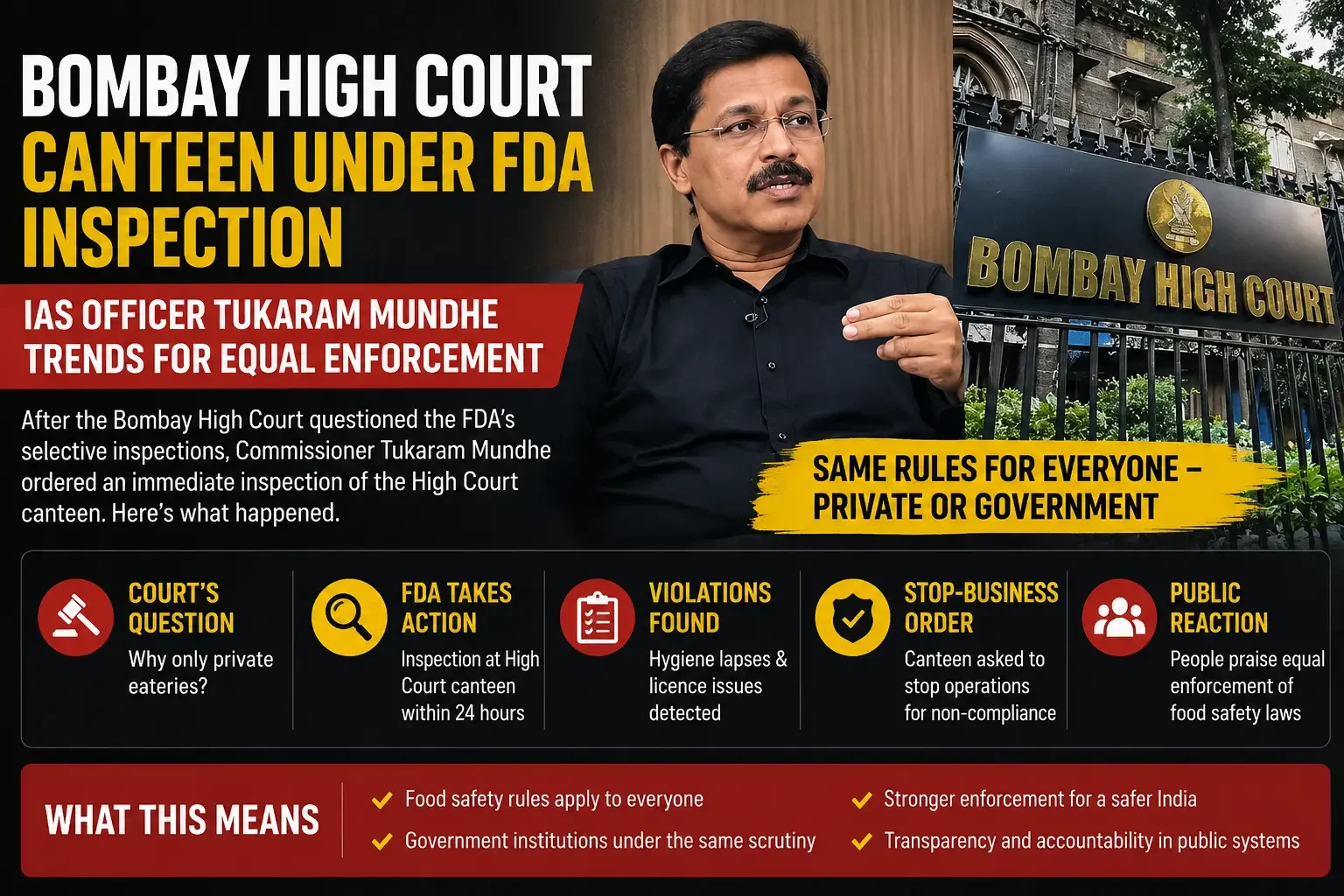
A routine food safety drive in Maharashtra has turned into one of the country's most discussed administrative stories after the Bombay High Court questioned whether the Maharashtra Food and Drug Administration (FDA) was inspecting only private establishments while leaving government-run canteens unchecked. The observation prompted the FDA, led by Commissioner IAS Tukaram Mundhe, to inspect food facilities inside the Bombay High Court premises within a day.
The incident has generated widespread discussion across social media, with many praising the principle that food safety rules should apply equally to both private businesses and government institutions.
What Triggered the Inspection?
The controversy began during a hearing related to Maharashtra FDA's ongoing crackdown on food safety violations across restaurants, hotels, bakeries and other food establishments.
During the proceedings, the Bombay High Court reportedly asked whether the inspection campaign also covered:
- Government canteens
- Semi-government institutions
- Mantralaya canteen
- High Court canteens
The court questioned whether enforcement was being applied uniformly instead of focusing mainly on private eateries.
FDA Reaches the Bombay High Court Canteens
Following the court's observations, FDA Commissioner Tukaram Mundhe and his team inspected the canteens located within the Bombay High Court premises.
According to reports, officials examined hygiene practices, licensing compliance, food storage and sanitation as part of the inspection, bringing government-operated food facilities under the same regulatory lens as private establishments.
What Happened During the Inspection?
Reports indicate that one of the canteens had already stopped operations before the inspection. The FDA subsequently issued a stop-business order, while officials reviewed licensing and compliance requirements.
The Bombay High Court Bar Association later stated that the operator had obtained the required licence on the day of the inspection and expected the canteen to resume operations after meeting regulatory requirements.
Why Is Tukaram Mundhe Trending?
IAS officer Tukaram Mundhe, Maharashtra's FDA Commissioner, has been leading an aggressive campaign against food safety violations across the state.
In recent weeks, the FDA has taken action against several food establishments over hygiene and licensing issues, including:
- Restaurants
- Bakeries
- Hospital canteens
- Civic body canteens
- Food manufacturers
Earlier inspections also resulted in action against the KEM Hospital canteen and the BMC headquarters canteen, where hygiene violations were reported.
Because of these actions, many users on X have described Mundhe as an officer applying regulations without regard to whether an establishment is privately owned or government-run.
Why the High Court's Observation Matters
The court's remarks are significant because they reinforce an important principle of public administration:
Food safety regulations should be enforced consistently across all institutions.
Whether food is served at:
- A five-star restaurant
- A local eatery
- A government office
- A hospital
- A court canteen
the same hygiene and safety standards are expected to apply.
The High Court also questioned the consistency of FDA enforcement, emphasizing that regulatory action should be transparent and based on uniform standards.
Maharashtra's Larger Food Safety Crackdown
The inspection of the High Court canteen is part of a broader statewide campaign aimed at improving food hygiene.
Recent FDA actions have included inspections of:
- Hotels
- Street food establishments
- Ice cream outlets
- Milk suppliers
- Hospital canteens
- Municipal canteens
- Government food facilities
The campaign focuses on:
- Food safety
- Licensing compliance
- Clean kitchens
- Safe food handling
- Consumer protection
Public Reaction on Social Media
The incident quickly began trending on X and other social platforms.
Many users viewed the inspection as an example of equal enforcement, arguing that government institutions should meet the same standards expected of private businesses. Others discussed the broader need for transparent and consistent food safety inspections across all public-facing kitchens.
While social media reactions have been largely supportive, opinions expressed online represent individual viewpoints and should not be treated as official findings.
What This Means for Consumers
For consumers, the development sends an important message:
- Food safety inspections are expanding.
- Government institutions are also subject to scrutiny.
- Hygiene compliance is becoming a larger regulatory priority.
- Licensing requirements are receiving increased attention.
This could encourage better food safety practices across both public and private establishments.
FAQs
Why did the Bombay High Court canteen come under inspection?
The inspection followed the High Court's question about whether Maharashtra FDA's food safety drive also included government and semi-government canteens, not just private eateries.
Was the High Court canteen permanently closed?
No. Reports indicate a stop-business order was issued during the inspection process, and the Bar Association later said the operator had obtained the required licence and expected operations to resume after compliance.
Who is Tukaram Mundhe?
Tukaram Mundhe is an IAS officer serving as Maharashtra's Food and Drug Administration Commissioner. He has recently led a statewide enforcement drive focused on food hygiene, licensing and consumer safety.
Why is this story trending?
The story gained attention because it highlights the principle that food safety laws should be enforced equally across private businesses and government institutions, following the High Court's observations and the FDA's subsequent inspections.
Final Thoughts
The Bombay High Court canteen inspection has become more than a routine regulatory action—it has sparked a broader conversation about fairness, accountability and consistent enforcement of food safety laws. As Maharashtra continues its inspection drive, the focus is increasingly shifting toward ensuring that every food-serving establishment, whether public or private, adheres to the same hygiene and licensing standards.
Source - The Times Of India