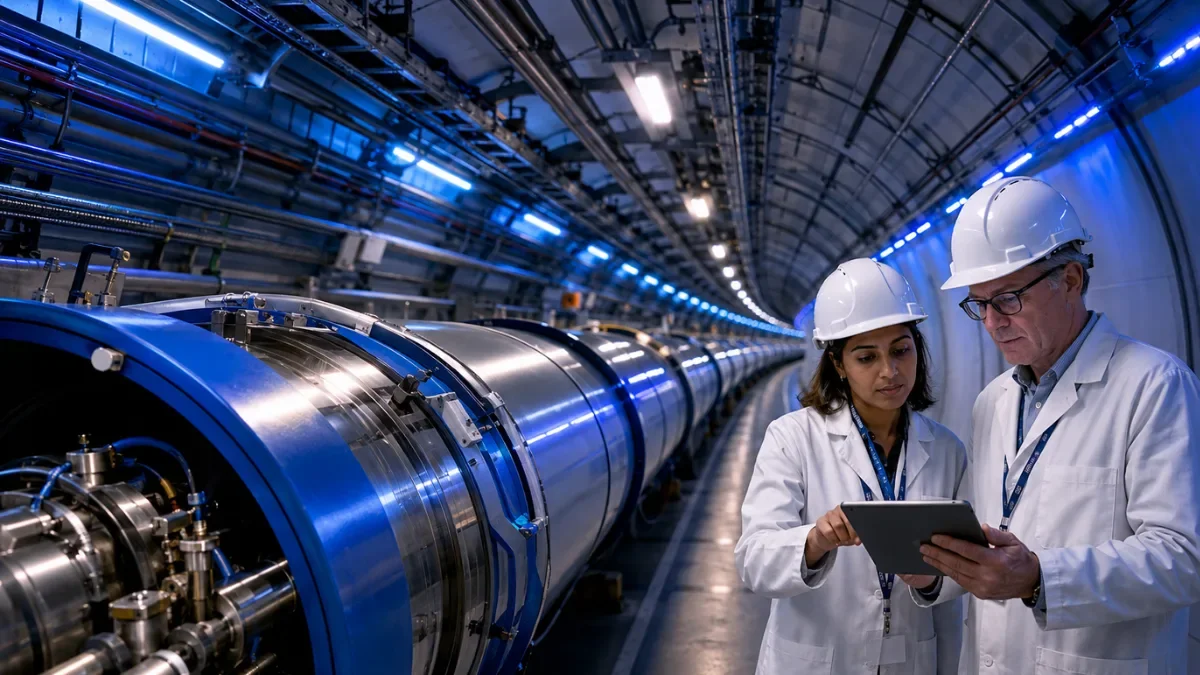
The Director-General of CERN (European Organization for Nuclear Research), Mark Thomson, has made a strong pitch for expanding international "mega-science" initiatives. Addressing the broader scientific community, the CERN chief argued that massive, multi-nation scientific projects are indispensable for stretching the limits of human knowledge, solving complex global challenges, and pushing the boundaries of innovation.
Mega-science projects are large-scale research setups requiring billions of dollars, advanced engineering, and deep international cooperation. Prime examples include the Large Hadron Collider (LHC) at CERN, the Square Kilometre Array (SKA) radio telescope, and the International Thermonuclear Experimental Reactor (ITER).
Why Do Large-Scale Experiments Matter?
Modern scientific questions—such as understanding dark matter, discovering the origin of the universe, or mastering fusion energy—are far too massive and expensive for any single nation to tackle alone. According to Thomson, bold initiatives like CERN's proposed Future Circular Collider (FCC) are necessary to succeed the High-Luminosity LHC.
Beyond pure physics, these ventures create enormous technological spillover benefits. Breakthroughs at facilities like CERN have historically given rise to life-changing innovations, including the World Wide Web, advanced medical imaging techniques like PET scans, and cutting-edge superconducting magnets.
What Is India’s Role in Global Science?
India continues to play an essential role in these global initiatives. As an associate member state of CERN, Indian scientists, engineers, and institutions have contributed significantly to the hardware development, software architecture, and data analysis of the LHC. India is also actively involved in other flagship efforts, such as ITER and the Thirty Meter Telescope.
Expanding participation in mega-science equips domestic research labs with advanced technical expertise, elevates the nation's global diplomatic standing, and inspires young students to pursue careers in STEM (Science, Technology, Engineering, and Mathematics).
Looking Ahead
While securing international funding and managing complex political alignments pose ongoing challenges, the consensus among scientific leaders is clear: sustained investment in fundamental science is essential. As CERN works toward upgrading its current systems and seeking approvals for next-generation colliders, the call for unified, multi-national scientific research will shape the trajectory of global technological progress for decades to come.