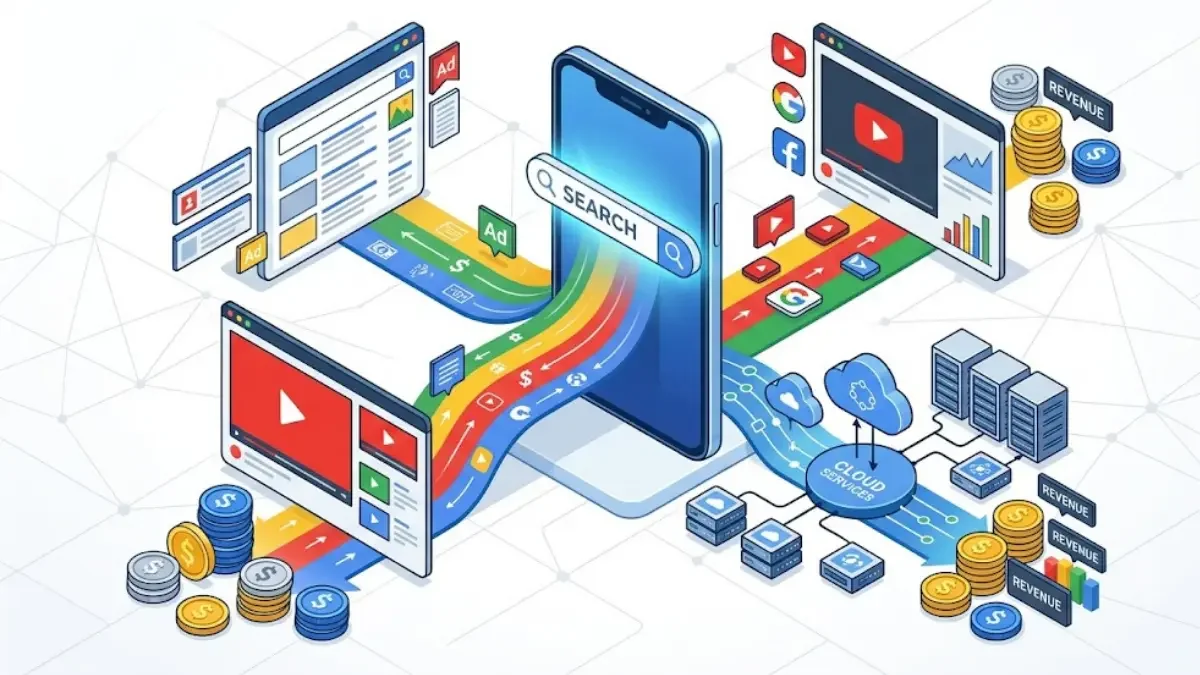
Every single day, billions of people type questions into Google. Whether checking the weather, researching a phone, or searching for nearby restaurants, the search engine delivers answers in milliseconds without charging a single rupee. Yet, Google’s parent company, Alphabet, reported over $400 billion in total revenue in fiscal year 2025.
If the service is completely free, how does the internet giant build one of the most profitable businesses on earth? The secret lies in intent-based advertising, high-tech corporate infrastructure, and consumer subscriptions.
┌─────────────────────────────────────────────────────────┐
│ ALPHABET ANNUAL REVENUE MIX │
├──────────────────────────┬──────────────────────────────┤
│ Google Search & Other │ ~55% - 57% │
│ Google Cloud │ ~14% - 15% │
│ YouTube Advertising │ ~10% │
│ Subscriptions & Hardware │ ~11% - 12% │
│ Google Network │ ~7% - 8% │
└──────────────────────────┴──────────────────────────────┘
1. Google Search Ads: Turning Intent Into Revenue
The primary core of Google’s financial machine is digital advertising. Search advertising accounts for roughly 55% to 57% of Alphabet’s entire annual revenue.
When you search for something commercial—like "best running shoes" or "car insurance"—the top results are often labeled Sponsored.
The Pay-Per-Click (PPC) Model: Advertisers bid on specific keywords. They do not pay Google merely to show the ad; they pay only when a user actively clicks on it.
Real-Time Auctions: Every time a search query is submitted, an instant, automated auction calculates which ads appear based on bid amount and ad relevance.
User Intent Value: Because users explicitly state what they want, advertisers are willing to pay anywhere from a few rupees to several dollars per click for targeted traffic.
2. YouTube & Google Network Ads
Google’s ad reach extends far beyond its own search bar:
YouTube Advertising: Ads played before or during YouTube videos generate tens of billions in annual revenue.
Google Network (AdSense): Third-party websites and mobile apps display Google-served ads. Google collects payment from advertisers and shares a portion with website owners, monetizing traffic across the wider internet.
3. Beyond Ads: Cloud Services and Consumer Subscriptions
While advertising remains its largest engine, Google has aggressively expanded into non-advertising business lines.
Google Cloud: Cloud infrastructure and enterprise AI services cater to corporations, making up nearly 15% of total revenue.
Subscriptions & Platforms: Subscriptions like YouTube Premium, YouTube TV, and Google One storage plans provide reliable, recurring monthly cash flow.
Hardware & App Stores: Hardware products (Pixel smartphones, Nest smart home devices) along with Play Store transaction fees further diversify earnings.