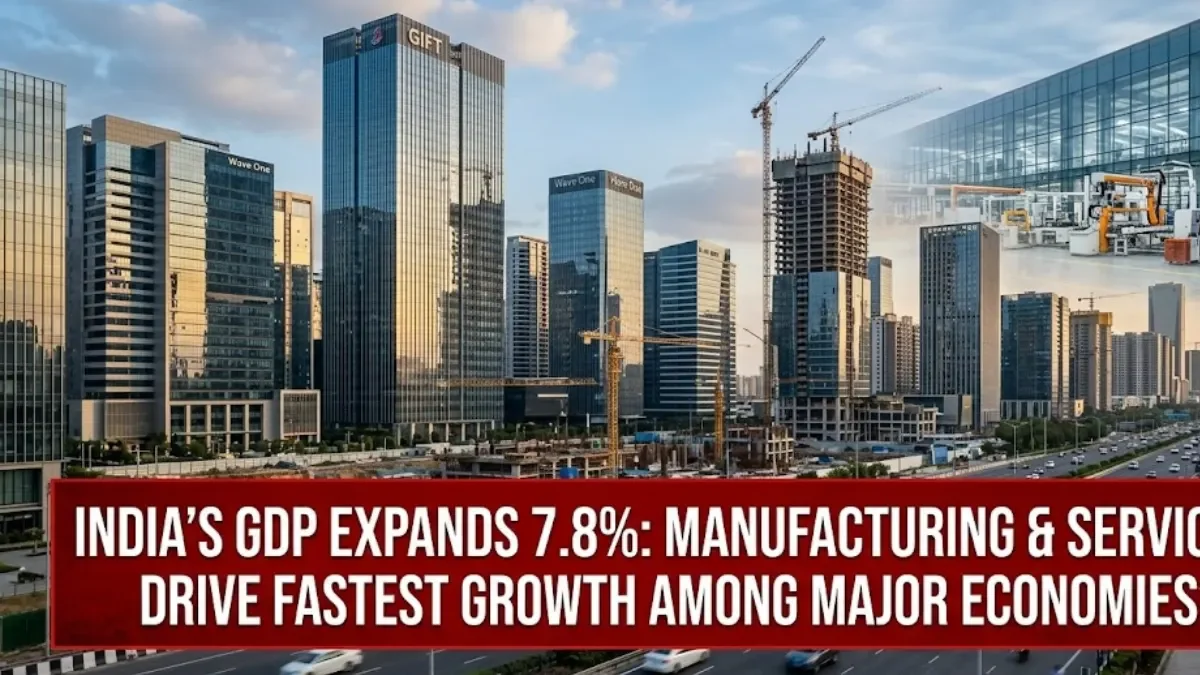
India’s economic momentum has surprised analysts once again. Official data released by the Ministry of Statistics and Programme Implementation (MoSPI) reveals that India's real Gross Domestic Product (GDP) grew by 7.8% in the first quarter (April–June) of FY 2026-27.
This acceleration surpasses the Reserve Bank of India’s (RBI) initial projection of 7% and outpaces the 6.9% growth recorded in the same period last financial year. While global central banks grapple with sticky inflation and trade uncertainties, India continues to maintain its status as the world’s fastest-growing major economy.
Key Pillars Driving the Surge
The primary growth engines behind this performance are manufacturing, utilities, and a sharp rebound in key services sectors.
Services Expansion: The financial, real estate, professional, and IT services category posted double-digit growth of 12.1%, up from 8.8% in the corresponding period of the previous year.
Industrial & Infrastructure Momentum: Manufacturing activity showed strong resilience, supported by capacity utilization, government capital expenditure, and private corporate investments. Utility services like electricity, gas, and water supply expanded by 8.9%, while the construction sector recorded a 7.7% gain.
Nominal Growth: Nominal GDP, which accounts for current prices without adjusting for inflation, grew by 10.3%, reaching ₹88.27 lakh crore.
Where the Economy Faced Resistance
Despite headline strength, recovery across all sectors remains uneven. Agricultural output moderated to 3.6% growth in Q1, compared to 4.4% in the year-ago period, reflecting weather-related disruptions. Meanwhile, the mining and quarrying sector contracted by 2.4%, partly due to a high statistical base effect from last year.
Economists also highlight that global oil market volatility and elevated international commodity prices present ongoing risks to domestic input costs.
What This Means for Everyday Citizens
For everyday households and working professionals, a sustained 7.8% GDP rate provides macroeconomic stability. Strong economic activity typically feeds into steady job creation across financial services, technology, and construction. However, the broader economic impact on rural income will largely depend on the performance of the remaining agricultural season and broader food inflation trends.
Future Outlook: What Happens Next?
Following the Q1 output, the RBI adjusted its full-year GDP forecast for FY 2026-27 upward to 6.7%. Market analysts expect private consumption to remain key to maintaining this pace over subsequent quarters. The official Q2 GDP data covering July to September is scheduled for release on November 30, 2026, offering clearer visibility into mid-year demand.