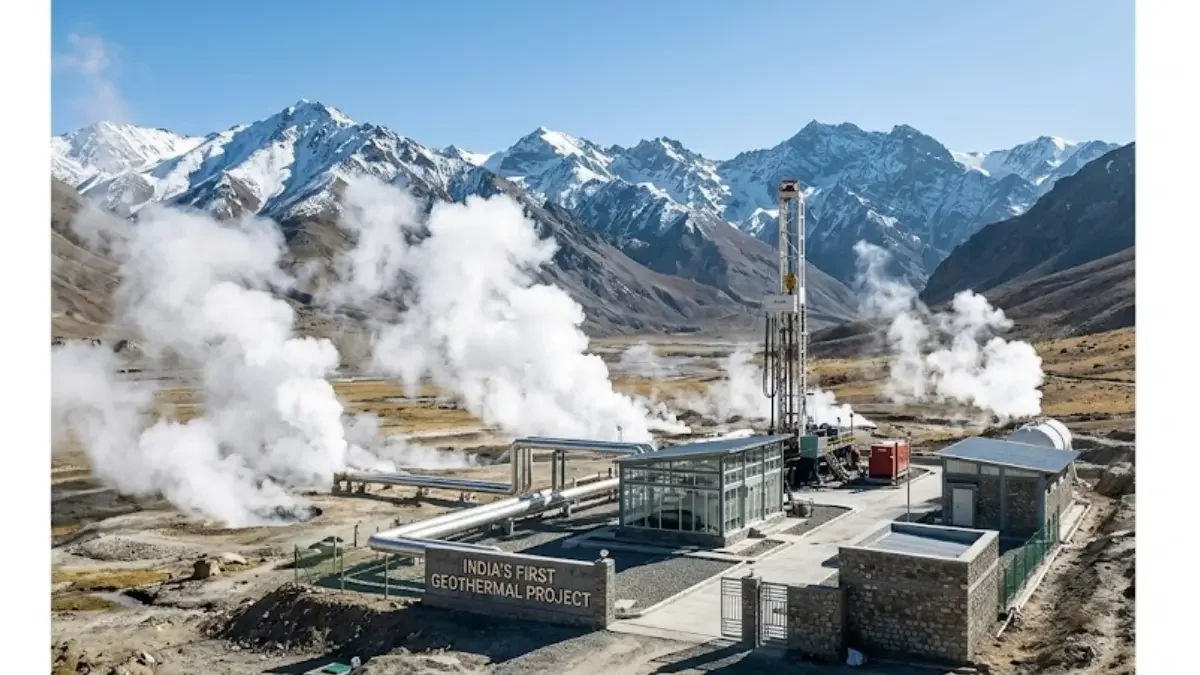
In its ambitious quest to transition toward clean power, India is expanding its horizon beyond massive solar and wind projects. Deep in the high-altitude desert of Ladakh, engineers and geologists are looking straight down—tapping into the Earth’s crust to harness natural subterranean heat as a continuous source of renewable energy.
The Oil and Natural Gas Corporation (ONGC) via its research unit, the ONGC Energy Centre, recently hit a major milestone in Puga Valley by completing and commissioning two 1,000-metre-deep geothermal wells. Located at an elevation exceeding 14,000 feet above sea level, these are the deepest geothermal wells ever drilled in India.
This technical breakthrough sets the foundation for India’s first 1-Megawatt electric (MWe) pilot geothermal power plant. While solar panels depend on clear skies and daylight, geothermal energy harnesses natural subterranean heat to deliver stable, 24/7 clean electricity regardless of weather conditions.
Why Puga Valley? The Science of Earth’s Natural Furnace
Puga Valley, situated in the Changthang region of south-eastern Ladakh, has long been recognized by geologists as one of India's most potential-rich geothermal hotspots. The region is known for its natural sulphur hot springs and high underground pressure.
Geothermal energy works by accessing deep underground reservoirs where magma or tectonic activity heats trapped fluids. In Puga Valley, subsurface temperatures reach up to 135°C to 240°C.
The process operates through simple thermal mechanics:
High-pressure hot water and steam are brought up through deep boreholes.
The high-temperature steam drives ground-level turbines to generate electricity.
The water is condensed and reinjected underground, maintaining a closed, sustainable cycle.
[ Subterranean Heat Reservoir ]
│
▼
[ Deep Geothermal Well (1,000m) ]
│
▼
[ High-Pressure Steam Drives Turbine ]
│
▼
[ Continuous 24/7 Clean Electricity ]
What Makes Geothermal Power a Game-Changer for India?
While India boasts one of the world's largest solar power capacities, solar energy faces seasonal and diurnal constraints—particularly during harsh Himalayan winters when snow covers solar panels and daylight hours shrink.
Geothermal power offers several key advantages for high-altitude regions:
Always-On Baseload Power: Unlike solar and wind energy, Earth’s interior heat remains constant, allowing plants to run continuously without battery storage.Minimal Land Footprint: Geothermal facilities require a fraction of the surface area needed for solar arrays or wind farms.
Fossil Fuel Reduction: Ladakh traditionally relies on diesel generators transported over long distances at high cost and environmental risk. Local earth-heat power cuts diesel dependence directly.
Scoreclever Current AffairsHeating Potential: Beyond electricity generation, thermal fluid can provide direct space heating for homes, greenhouses, and public buildings during severe sub-zero winters.
Impact: What This Development Means for Local Communities and National Goals
The Puga Valley pilot plant is part of a broader vision to transform Ladakh into a carbon-neutral Union Territory. With the Ladakh administration extending its partnership with ONGC for five years, the project aims to scale from the 1 MW demonstration project to a commercial capacity of 10 MW or higher.
According to recent studies by research groups like Project InnerSpace and the Council on Energy, Environment and Water (CEEW), India holds over 10,000 MW of geothermal electricity potential across 10 identified provinces, alongside massive technical potential for industrial heating and cooling. Successfully proving the technology in Ladakh creates a roadmap for similar installations in Himachal Pradesh, Uttarakhand, Chhattisgarh, and Gujarat.
also read : When Will the Wars End? US-Iran & Russia-Ukraine Timelines (2026)