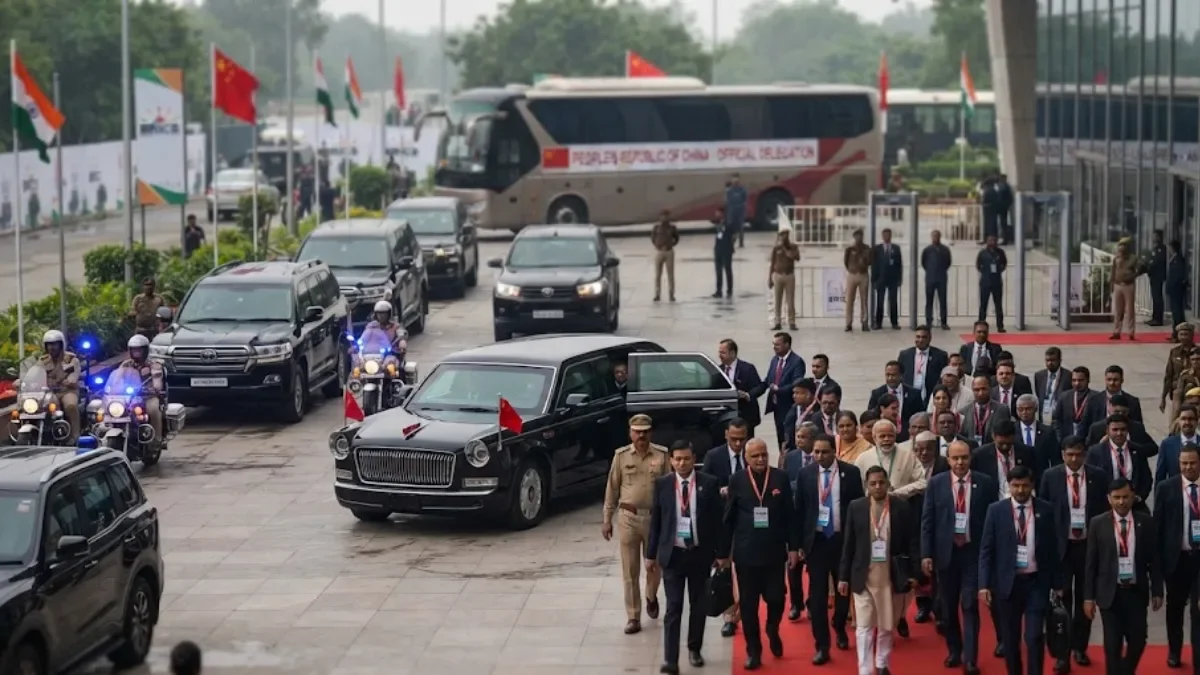
The arrival of Chinese President Xi Jinping in New Delhi for the BRICS summit marked his first visit to India in seven years. Beyond the diplomatic significance of the meeting, one detail caught global attention: the massive size of his accompanying entourage. Reports confirmed that Xi traveled with a delegation of around 400 people, more than double the size of the team that accompanied him during his previous visit in 2019.
Why does a head of state travel with hundreds of officials, and who exactly is included in this large group?
Who Is Inside the 400-Member Delegation?
A presidential delegation of this scale is not just a single group of politicians; it is structured into various specialized tiers. While core government officials and diplomats form the primary administrative layer, the 400-member contingent broadly spans several critical sectors:
High-Level Political Leadership & Diplomats: This core group features top-ranking Communist Party officials, including Foreign Minister Wang Yi and Cai Qi, a key member of the Politburo Standing Committee.
Security and Protection Details: A significant portion of the entourage comprises elite security personnel tasked with managing multi-layered protocols, counter-terrorism measures, and specialized logistical checks.
Technical and Support Staff: Advance teams typically include secure communication technicians, medical professionals, and personal culinary staff to manage dietary and operational preferences.
Business and Economic Representatives: Alongside the official government wing, separate trade and corporate delegations frequently travel during such high-level state visits to coordinate commercial, supply-chain, and market discussions.
Why Is the Delegation So Large?
The sheer scale of the delegation reflects a mix of intensive logistical requirements, complex security protocols, and strategic signaling. Traveling for a multilateral summit like BRICS requires round-the-clock coordination across media management, translation services, and bilateral scheduling. Furthermore, given the historic sensitivity and recent efforts to stabilize India-China ties following years of border friction, Beijing ensured that every domain—from trade and foreign policy to technical communication—was heavily represented.
What Does This Mean for India-China Relations?
The high-profile visit and comprehensive team deployment underline a mutual desire to rebuild strategic communication. As Prime Minister Narendra Modi and President Xi held bilateral talks to navigate trade imbalances, market access, and regional stability, the presence of a fully-staffed administrative machinery enabled simultaneous working-level negotiations. For ordinary citizens and industries, this high-level engagement serves as a vital step toward long-term border stability and normalized economic cooperation.