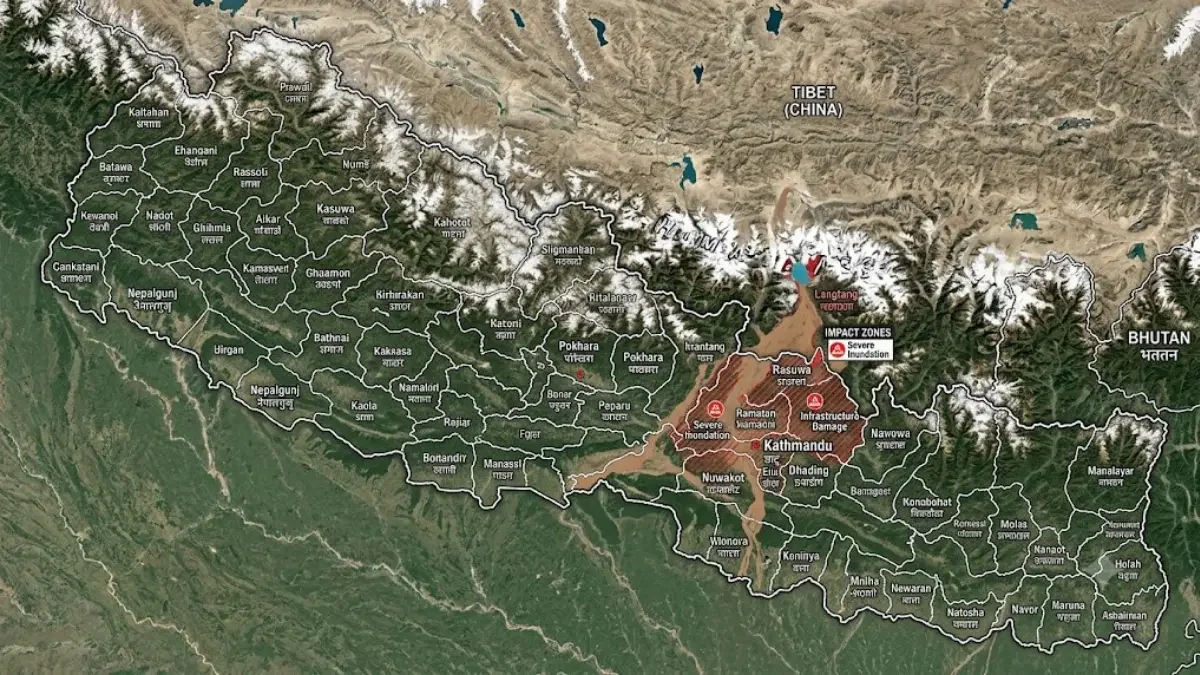
A sudden and catastrophic disaster struck northern Nepal on August 26, 2026, when violent flash floods surged down Himalayan river valleys. The fast-moving deluge swept away homes, bridges, and key road networks along the Nepal-China border, severely impacting tens of thousands of families. Search and rescue teams continue to work through layers of mud and debris as humanitarian organizations rush to provide shelter, food, and clean water.
+-------------------------------------------------------------------------+
| NEPAL FLOOD DISASTER AT A GLANCE |
+-------------------------------------------------------------------------+
| Event Date: | August 26, 2026 |
| Primary Cause: | Massive rock and glacial ice collapse (5,000m) |
| Impacted Districts: | Rasuwa, Nuwakot, Dhading, Gorkha, Tanahun |
| Affected Population:| Over 65,000 people (including 22,000+ children) |
| Disrupted Sectors: | 30+ bridges, 12 hydropower plants, major highways |
+-------------------------------------------------------------------------+
What Happened and the Scale of Destruction
During the early morning hours of August 26, 2026, a surge of water, mud, and heavy boulders coursed through the Lende Khola, Bhote Koshi, and Trishuli rivers. Within minutes, entire settlements were inundated. According to disaster agencies, the disaster has directly affected more than 65,000 people, including over 22,000 children.
The casualties continue to rise as rescue workers uncover cut-off communities. Official reports confirm hundreds of confirmed deaths, with thousands still reported missing or stranded in hard-to-reach areas. High-velocity floodwaters destroyed over 30 bridges, washed away sections of essential highways, and damaged at least 12 hydropower projects, cutting off electricity to vast regions.
Which Places and Districts Are Most Affected?
The devastation concentrated heavily along the river basins near the border with Tibet (China):
Rasuwa District: The primary impact zone. Border towns such as Timure, Syabrubesi, and the Rasuwagadhi border post suffered extreme damage, destroying commercial infrastructure and border facilities.
Nuwakot District: Residential settlements along the Trishuli River were deeply inundated, leaving homes completely submerged under meters of mud.
Dhading District: Critical road connections were severed, leaving local towns inaccessible by land.
Gorkha and Tanahun Districts: Swollen riverbanks destroyed farmlands, local suspension bridges, and low-lying homes downstream.
The Cause: How Did the Flash Flood Happen?
Initial theories pointed toward heavy monsoonal rain or a potential earthquake, as ground vibrations were detected. However, scientific analysis by geological institutions confirmed that the flood was triggered by a massive rock and glacial collapse high in Langtang National Park near the Tibet border.
[ High Elevation Glacier (5,000m) ]
|
(Ice & Rock Mass Collapse)
|
v
[ Debris Flow & Rapid Ice Melt ]
|
v
[ Surge Down Lende Khola & Trishuli Rivers ]
|
v
[ Severe Inundation in Rasuwa, Nuwakot & Dhading ]
At an elevation near 5,000 meters, millions of cubic meters of unstable ice and mountain rock collapsed and fell nearly 1,900 meters. The immense force generated a seismic signal equivalent to a magnitude 5.2 event. As the frozen mass fell, frictional heat rapidly melted the ice, creating a high-speed, debris-laden torrent that traveled roughly 100 kilometers downstream within hours.
What the Prime Minister and Government Statements Say
Nepal's leadership mobilized the nation's security forces—including the Nepal Army, Armed Police Force, and Nepal Police—to lead emergency operations using search dogs, drones, and heavy transport helicopters.
Prime Minister Balendra Shah and government authorities issued statements emphasizing that saving lives and restoring road connectivity remain top priorities. The government called on international partners and relief organizations for urgent logistical support, highlighting the extreme difficulty of delivering medical aid and temporary shelters to communities cut off by destroyed bridges.
International Aid: How Are Other Countries Helping Nepal?
Following official calls for assistance, neighboring nations and international organizations responded with immediate emergency support:
1. India
Indian Prime Minister Narendra Modi spoke directly with Nepal's Prime Minister to offer immediate assistance and express solidarity. India dispatched several Indian Air Force (IAF) aircraft—including C-130J and C-17 Globemaster flights—carrying over 57 tonnes of disaster relief materials. The shipments included:
Heavy-duty tents, tarpaulins, and temporary shelters
Water purification tablets, dewatering pumps, and electric generators
Essential medicines, medical field teams, and specialized tunnel rescue personnel
Bailey bridge units to temporarily restore severed highway routes
2. International Agencies and Humanitarian Groups
UNICEF: Pre-positioned and delivered thousands of hygiene kits, medical tents, therapeutic food supplies, and safe drinking water kits for affected children and families.
Direct Relief: Deployed specialized medical personnel and mobile surgical units in collaboration with local centers, such as Dhulikhel Hospital, flying doctors into remote zones via helicopter.
What Happens Next?
Nepal faces a double challenge: maintaining active search operations while preventing disease outbreaks caused by contaminated water sources. Over the coming weeks, key actions will focus on:
Re-establishing physical access across river crossings using temporary steel Bailey bridges.
Restoring damaged power infrastructure to return electricity to the national grid.
Rehabilitating over 10,000 displaced households and helping affected children return to temporary learning centers.
Direct Relief