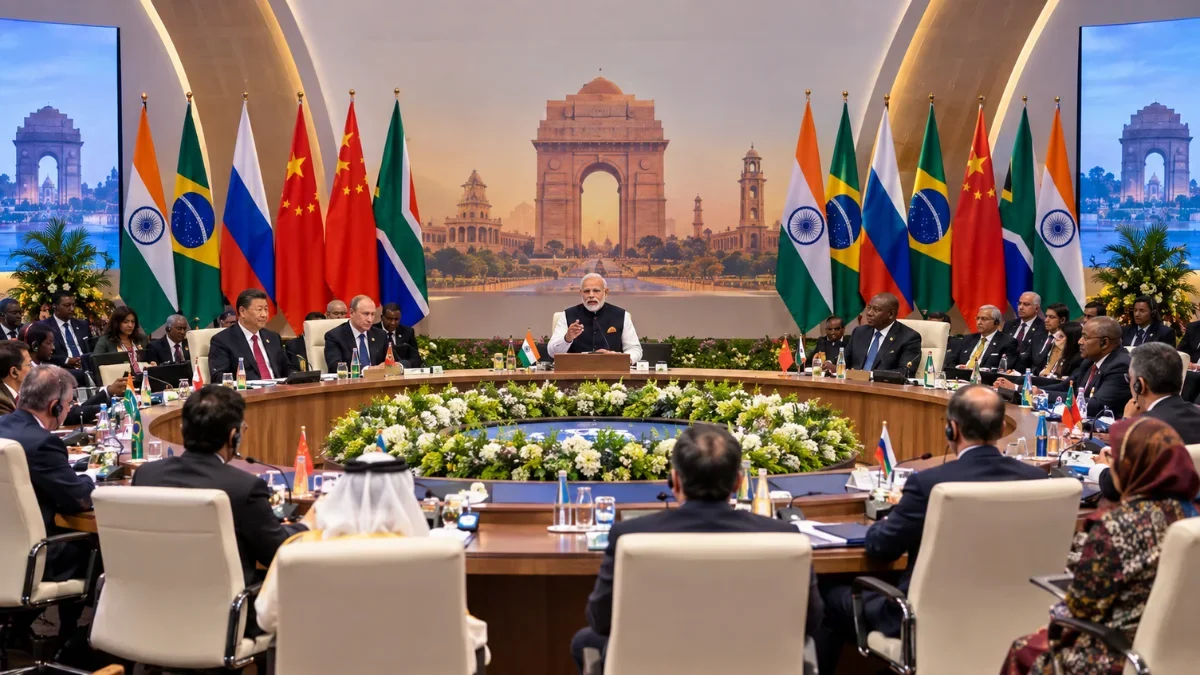
The 18th BRICS Summit concluded in the national capital with Prime Minister Narendra Modi announcing the historic and unanimous adoption of the New Delhi Declaration 2026. Bringing together major emerging economies despite complex geopolitical differences, the 140-point document sets a unified agenda for international cooperation, economic resilience, and institutional reform.
What Is the New Delhi Declaration?
The New Delhi Declaration is the comprehensive joint statement agreed upon by all member states at the conclusion of the BRICS Summit. Navigating sharp divergences among members, intensive negotiations continued until the early hours of Saturday before India successfully bridged competing positions to secure consensus. Prime Minister Modi confirmed that no member raised any objections, marking a major diplomatic success for India's presidency under the theme “Building for Resilience, Innovation, Cooperation and Sustainability”.
Counter-Terrorism and Regional Security
The declaration delivers a strong stance on global security by condemning terrorism in all its forms and manifestations, explicitly calling out cross-border movements, safe havens, and terrorism financing. In a significant diplomatic outcome for India, the text strongly denounces the April 2025 terror attack in Pahalgam, Jammu and Kashmir, emphasizing zero tolerance for double standards in counter-terrorism efforts.
Global Trade and Tariff Concerns
Addressing rising protectionism, the member states voiced serious concerns over unilateral tariff and non-tariff measures that distort global trade and violate World Trade Organization (WTO) rules. The declaration advocates for a rules-based, transparent multilateral trading system and urges the immediate restoration of a fully functioning WTO dispute settlement mechanism.
Reforming Global Institutions
A core focus of the summit was amplifying the voice of the Global South. The declaration calls for comprehensive reforms of the United Nations, including the Security Council, to make it more representative and democratic. Notably, permanent members China and Russia reiterated their support for India and Brazil to play a greater role within the UN Security Council. Furthermore, the text highlights the urgent need to restructure Bretton Woods institutions like the IMF and the World Bank to better reflect current economic realities.
Why It Matters and What Happens Next
For ordinary citizens and developing economies, the declaration targets pressing challenges such as equitable access to digital public infrastructure, artificial intelligence governance, and energy security. By outlining a framework that prioritizes local currency trade settlements and cooperative economic growth, the bloc aims to cushion emerging markets against external financial shocks. Moving forward, the proposed ten-point global governance reform roadmap will serve as a foundational blueprint leading into the next summit, driving the transition of the Global South from rule-takers to rule-shapers.
Frequently Asked Questions (FAQ)
Q: What is the New Delhi Declaration?
A: It is the official 140-point joint declaration adopted unanimously by BRICS member countries at the 18th BRICS Summit in New Delhi, outlining collective stances on trade, security, and global governance.
Q: Did all BRICS nations agree to the declaration?
A: Yes. Despite complex negotiations over various geopolitical differences, Prime Minister Modi confirmed that the declaration was adopted unanimously without any member raising objections.
Q: What does the declaration say about terrorism?
A: The text condemns terrorism in all its forms, targets cross-border financing and safe havens, and specifically denounces the April 2025 terror attack in Pahalgam, Jammu and Kashmir.
Q: How does the declaration address global trade issues?
A: It expresses serious concern over unilateral tariff and non-tariff barriers that violate WTO rules, calling for the restoration of a fully functional WTO dispute settlement mechanism.