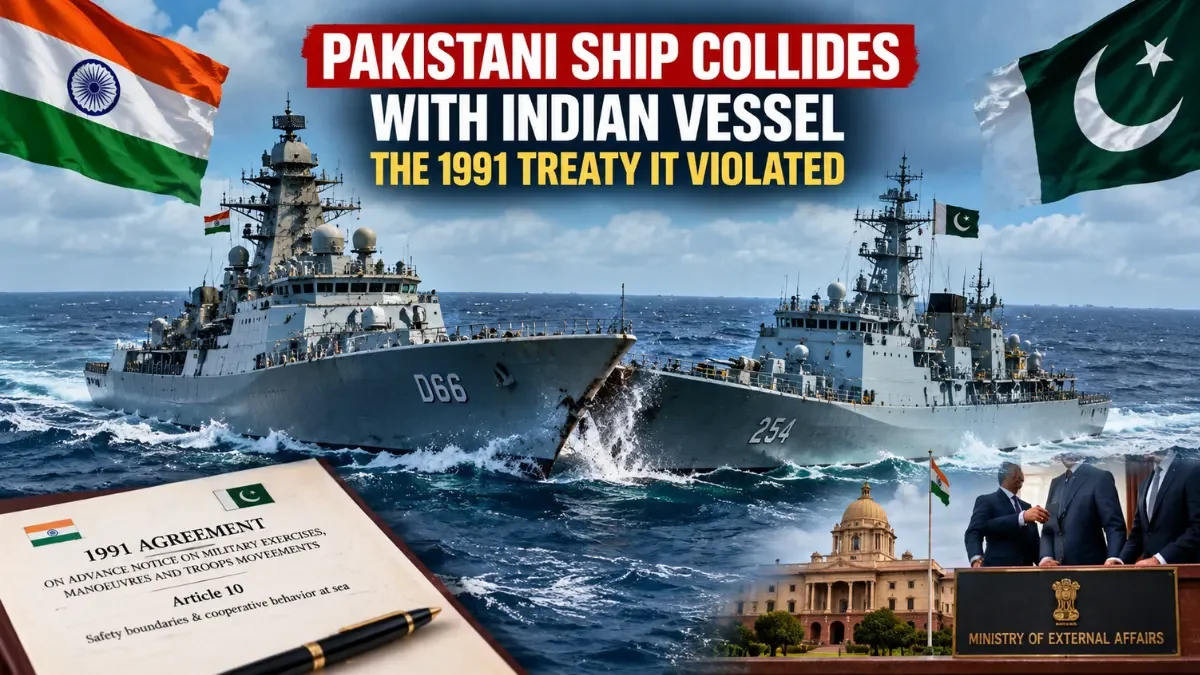
Tensions between India and Pakistan have entered the maritime domain following an accidental collision between naval assets in international waters. On the evening of September 15, 2026, a Pakistan Navy ship came close to a frontline Indian Navy warship on routine surveillance duty in the North Arabian Sea and collided with it. While no major damage or casualties were reported, New Delhi swiftly took serious diplomatic note of the episode, terming the maneuver aggressive and unprofessional.
What Happened During the Collision?
According to details shared by government sources, the Indian warship was carrying out routine patrols in international waters approximately 220 kilometers east of Oman. A Pakistani naval vessel approached at high speed, executing maneuvers that Indian authorities described as unsafe and contrary to standard maritime protocol. Due to the high speed and close proximity in rough seas, the ships came into physical contact before moving away.
Following the incident, India’s Ministry of External Affairs (MEA) summoned Pakistan’s Charge d’Affaires to South Block in New Delhi to lodge a formal and strong protest. Simultaneously, Indian authorities instructed their diplomatic mission in Islamabad to register a parallel protest with Pakistan’s Ministry of Foreign Affairs.
The 1991 Agreement and Article 10 Violations
New Delhi emphasized that the Pakistani ship’s conduct was in direct contravention of Article 10 of the 1991 Agreement between India and Pakistan on Advance Notice on Military Exercises, Manoeuvres and Troops Movements.
Signed in April 1991, this bilateral treaty is a crucial confidence-building measure designed to prevent misunderstandings, accidental conflicts, and military escalations between the two nuclear-armed neighbors. The pact outlines clear protocols regarding advance notifications for military drills, movement of troops, and naval operations near international boundaries or shared maritime zones. Article 10 specifically governs safety boundaries and cooperative behavior at sea, requiring naval units to maintain safe operational distances—traditionally kept at least three nautical miles apart in international waters—to avoid close-range hazards.