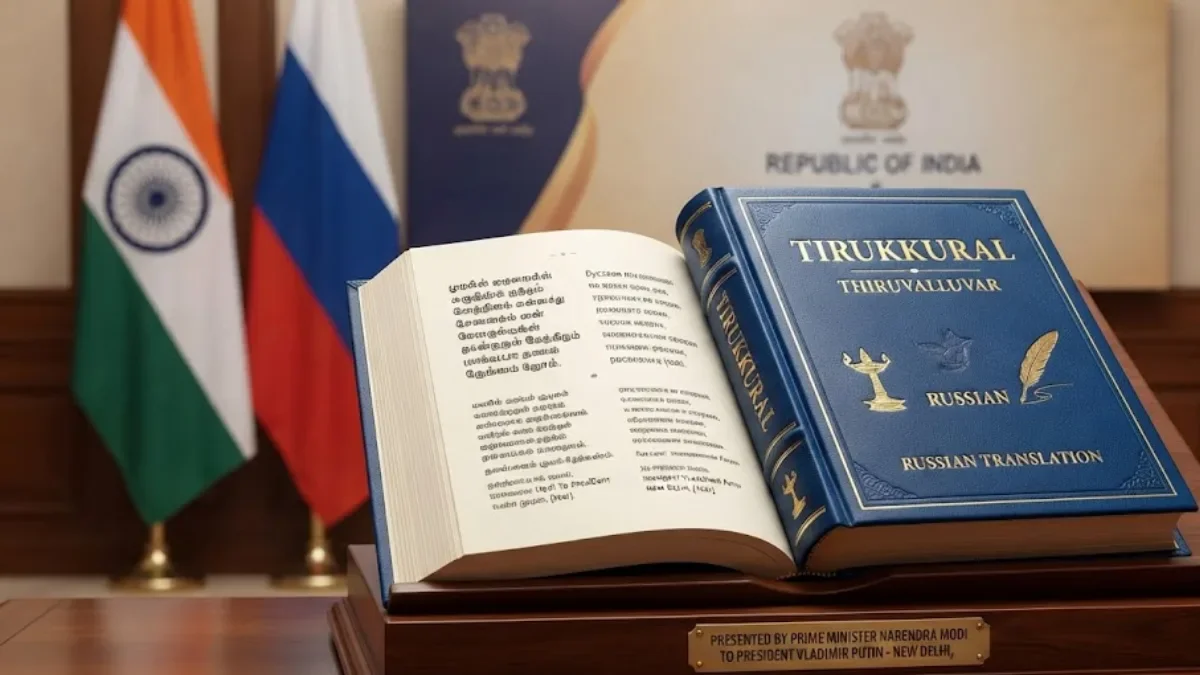
In a powerful gesture of cultural diplomacy, Prime Minister Narendra Modi presented Russian President Vladimir Putin with a specially crafted Russian translation of the ancient Tamil literary masterpiece, the Thirukkural, during their bilateral talks in New Delhi. The high-profile meeting took place on the sidelines of the major international engagements hosted in the capital, drawing global attention not only to geopolitical ties but also to shared philosophical values.
What is the Thirukkural and Where Does It Belong?
The Thirukkural is one of the most revered and ancient works in Tamil literature, originating from South India. Attributed to the celebrated ancient poet and philosopher Thiruvalluvar, the text dates back over two millennia, with historical estimates placing its creation between 300 BCE and 500 CE.
Unlike many classical religious texts tied to specific dogmas, the Thirukkural is celebrated for its secular, universal nature. It is structured as a collection of 1,330 short, two-line couplets (known as Kurals), where each couplet consists of precisely seven words. The entire composition is divided into three major sections:
Aram (Virtue): Focuses on personal morality, righteousness, and domestic ethics.
Porul (Wealth): Explores statecraft, public governance, economics, and societal welfare.
Inbam (Love): Delves into human affection and psychological dimensions of relationships.
Why Did Prime Minister Modi Gift This Book to Putin?
The presentation of the Thirukkural in Russian—translated meticulously by scholar Naira Mkrtchyan—is designed to offer foreign leaders a profound window into Indian civilizational wisdom. By choosing a text that emphasizes ethical governance, righteousness, and human duty, the leadership highlights that India-Russia relations extend far beyond strategic defense and economic trade into deep intellectual and cultural exchange. Furthermore, it showcases India's rich regional literary traditions on the global stage, proving that ancient South Indian philosophies possess contemporary global relevance.
What Lies Ahead for India-Russia Cultural Ties?
This gesture builds upon a tradition of literary diplomacy between New Delhi and Moscow. As global leaders continue to navigate complex geopolitical landscapes, cultural touchpoints like the Thirukkural serve to bridge nations through shared human values. Experts note that translating classical Indian literature into major international languages fosters enduring people-to-people connections, ensuring that ancient wisdom continues to guide modern diplomatic conversations.
also read : BRICS Financial Push 2026: De-Dollarisation, Payments, and India's Stand