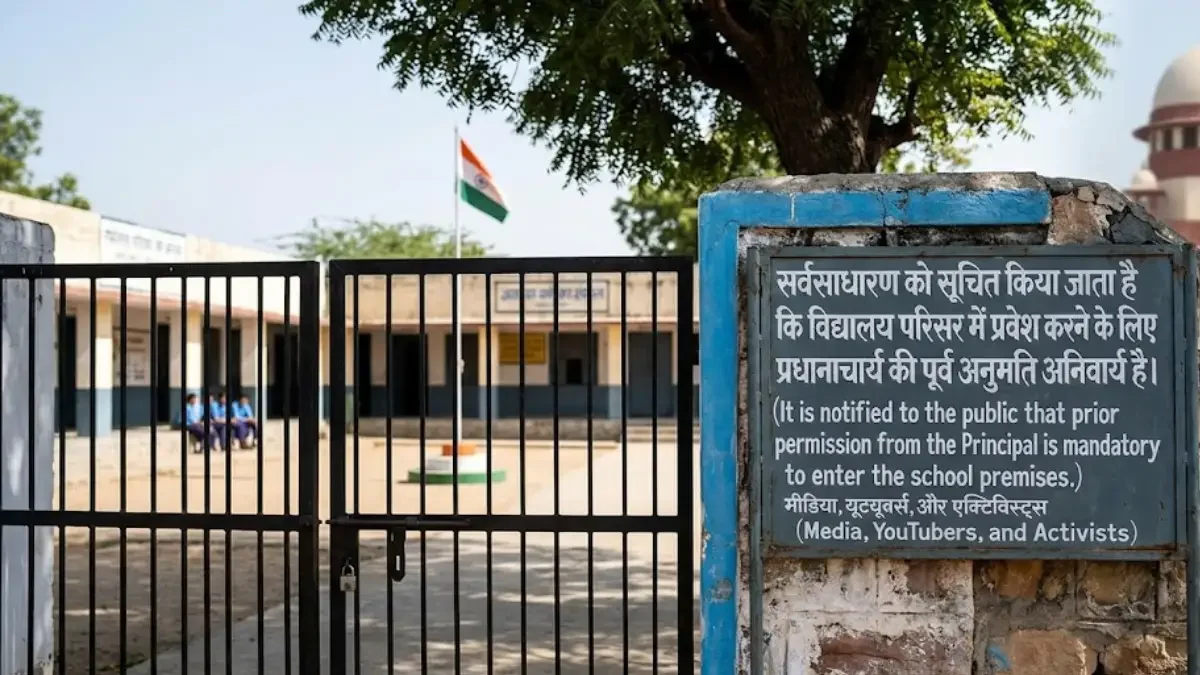
The Supreme Court of India has refused to entertain a Public Interest Litigation (PIL) that sought to quash restrictions imposed on journalists, social media creators, YouTubers, and civil society representatives entering government schools in Uttar Pradesh and Rajasthan. A bench comprising Chief Justice of India Surya Kant and Justices Joymalya Bagchi and V. Mohana indicated that while public scrutiny is vital, arbitrary access to educational premises cannot be allowed without proper administrative safeguards.
The petition challenged official state notifications—including an August directives issued by Rajasthan’s secondary education department—that mandate prior written permission from school principals before any external individual can document, conduct interviews, or film inside school premises.
Background and the ‘School Thik Karo’ Movement
The legal challenge gained widespread national attention following the launch of the "School Thik Karo" (Fix Our Schools) campaign organized by the Cockroach Janata Party (CJP). The initiative encouraged citizens, local youth, and activists to conduct social audits of rural educational infrastructure, uploading photos and videos highlighting broken buildings, non-functional toilets, lack of clean drinking water, and missing teaching staff.
As these public audits went viral, several state authorities issued guidelines citing the need to protect student safety, preserve classroom privacy, and prevent unauthorized disruptions during teaching hours. The petitioner argued that requiring approval from institutional heads—whose own administrative shortcomings might be exposed—creates a conflict of interest that hinders free reporting and transparency.
Balance Between Transparency and Protection
The debate centers on a delicate constitutional balance. On one side, public interest groups argue that independent documentation is the most effective tool to pressure administration into upgrading neglected rural schools. On the other side, government bodies maintain that unregulated access creates security risks for minors, infringes upon children's privacy, and destabilizes daily learning environments.
By declining to strike down the entry restrictions, the apex court's position preserves state oversight over who enters campus grounds. However, the broader discussion over basic infrastructure, teacher shortages, and mid-day meal quality across government schools continues to trigger student-led demonstrations and public policy debates nationwide.
Frequently Asked Questions (FAQ)
Q1: What did the Supreme Court decide regarding media entry into government schools?
The Supreme Court declined to entertain a plea seeking to overturn restrictions that require journalists, activists, and visitors to obtain prior permission before entering or filming inside government schools in Uttar Pradesh and Rajasthan.
Q2: What is the 'School Thik Karo' campaign?
The 'School Thik Karo' campaign is a public social audit drive launched by the youth-led Cockroach Janata Party (CJP) to document and expose deficient infrastructure, poor mid-day meals, and staff shortages in government schools across various states.
Q3: Why did state governments impose restrictions on outsiders entering schools?
State education departments cited concerns regarding student safety, child privacy protection, and preventing unauthorized disruptions to regular classroom teaching hours.
also read : Laptop Prices Are Surging in India: Here Is the Key Reason Behind the Price Hike