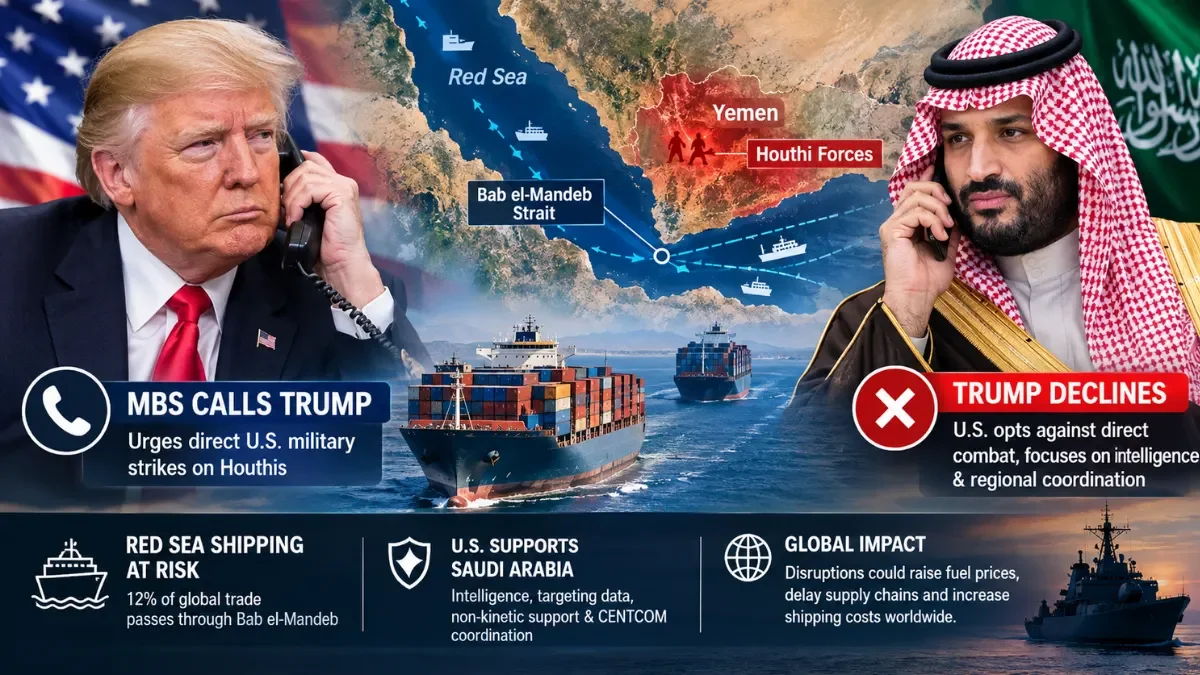
U.S. President Donald Trump has reportedly turned down urgent requests from Saudi Arabia’s Crown Prince Mohammed bin Salman (MBS) to launch direct American military strikes against Houthi forces in Yemen. According to reports citing U.S. officials, the Saudi leader placed two phone calls to Washington following a sharp deterioration of security along the Red Sea coast. While the White House has chosen to avoid opening a direct combat front in Yemen, the unfolding situation highlights growing anxieties over global trade and maritime security.
What Triggered the Saudi Request?
The diplomatic friction follows a major escalation in Yemen, where Iran-aligned Houthi militants launched a large-scale offensive, seizing the strategic coastal city of Mokha and advancing toward the Bab el-Mandeb Strait. This vital waterway connects the Red Sea to the Gulf of Aden, handling roughly 12% of global shipping traffic. As Saudi-backed government forces retreated, the Kingdom faced mounting pressure from Houthi blockades and drone or missile threats directed at infrastructure. Seeking immediate military backing, MBS directly urged President Trump to authorize U.S. kinetic strikes against the rebel group.
Why Did Trump Decline Direct Action?
President Trump rejected the appeal, with administration officials emphasizing that Washington’s primary objective is to keep key shipping channels open while empowering regional allies to take the lead on local defense. The U.S. directive aims to keep American military focus centralized on broader regional deterrence, specifically regarding Iran and safeguarding the Strait of Hormuz, rather than becoming entangled in another prolonged Middle Eastern ground conflict.
Instead of deploying combat forces, the U.S. is stepping up support through alternative means. Admiral Brad Cooper, commander of the U.S. Central Command (CENTCOM), traveled to Saudi Arabia for emergency coordination talks. Furthermore, Washington has committed to supplying Riyadh with vital intelligence, precise targeting data, and non-kinetic assistance to help Saudi forces manage the threat independently.
Impact on Global Shipping and Regional Stability
For ordinary citizens and international businesses, the security of the Red Sea remains a matter of immense economic consequence. Any prolonged disruption or blockade near the Bab el-Mandeb Strait threatens to delay supply chains, drive up fuel prices, and inflate shipping insurance costs worldwide. While Saudi Arabia handles the immediate military burden on the ground, the decision by Washington signals a shift toward a partner-led security model where regional actors shoulder frontline combat responsibilities.
As diplomatic and military dialogues continue between Riyadh and Washington, observers are closely monitoring whether the limited intelligence sharing will be sufficient to curb Houthi advances and restore stability to the vital commercial corridor.
Frequently Asked Questions (FAQ):
Why did Saudi Crown Prince Mohammed bin Salman call President Trump? MBS called President Trump twice to brief him on rapidly deteriorating conditions in Yemen and to urge direct U.S. military airstrikes against Houthi forces after they seized the strategic port city of Mokha.
Did the U.S. agree to launch strikes against the Houthis? No. President Trump declined the request for direct military intervention, maintaining that the administration does not intend to open a direct combat front in Yemen.
How is the U.S. supporting Saudi Arabia instead? While holding back from direct kinetic strikes, the U.S. is providing Saudi Arabia with critical intelligence, precise targeting data, non-kinetic support, and high-level military coordination through CENTCOM.
Why is the Red Sea region so critical for global trade? The Bab el-Mandeb Strait near the Red Sea handles approximately 12% of global maritime trade goods, making freedom of navigation essential for international shipping, energy supplies, and stable consumer prices.