Introduction
Search Engine Optimization (SEO) is the foundation of online visibility. Whether you're a blogger, business owner, affiliate marketer, or digital agency, understanding the difference between On-Page SEO and Off-Page SEO is essential for achieving higher rankings on Google and increasing visibility in AI-powered search engines.
In 2026, SEO is no longer limited to traditional search engines. With the rise of Answer Engine Optimization (AEO) and Generative Engine Optimization (GEO), websites must optimize both their content and authority signals to remain competitive.
This guide explains what On-Page SEO and Off-Page SEO are, their differences, and how they impact SEO, AEO, and GEO rankings.
What Is On-Page SEO?
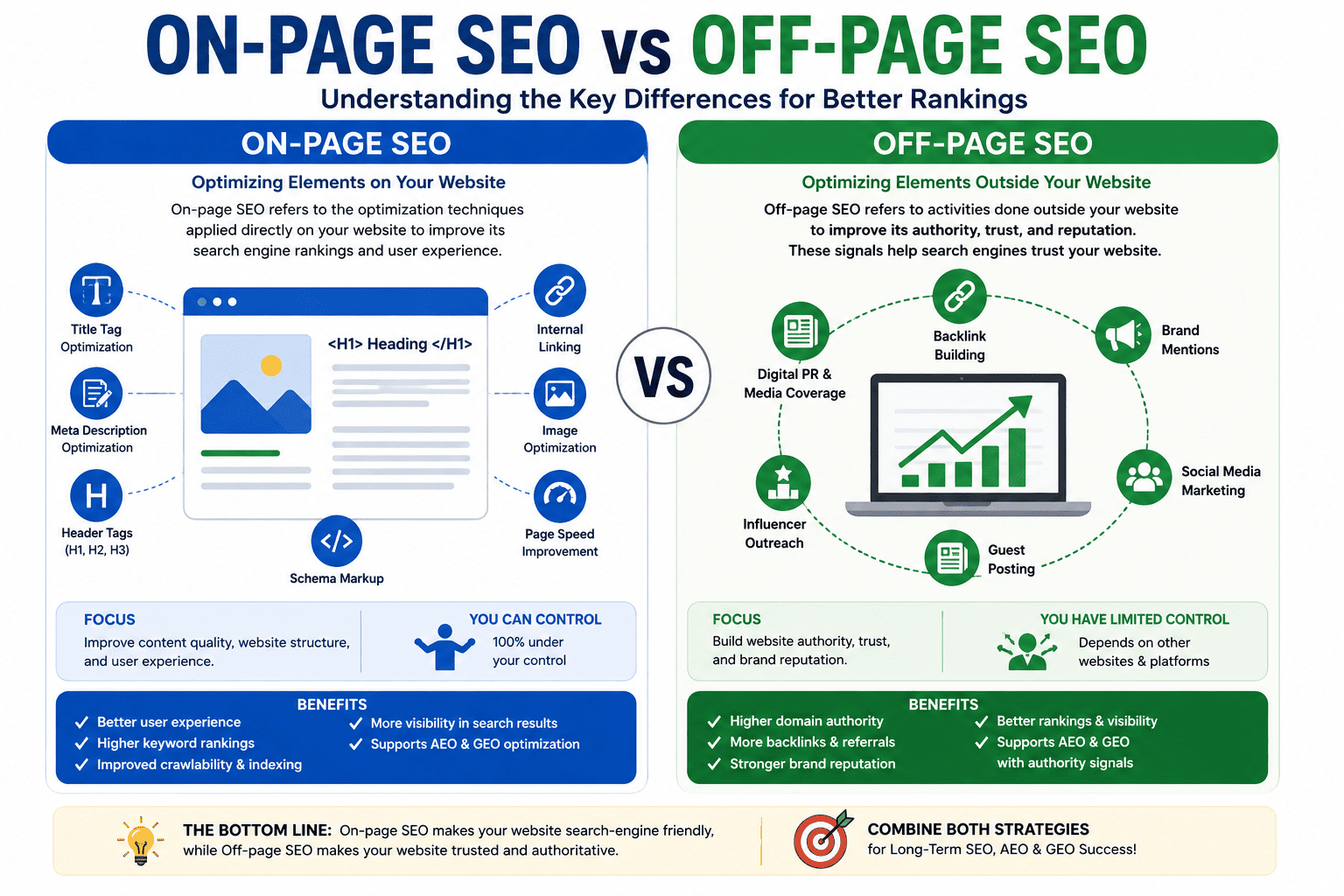
On-Page SEO refers to all optimization activities performed directly on your website to improve search engine rankings and user experience.
These optimizations help search engines understand your content and determine whether it is relevant to a user's query.
Examples of On-Page SEO
Keyword optimization
Title tag optimization
Meta descriptions
Header tags (H1, H2, H3)
Internal linking
Image optimization
URL structure
Content quality
Schema markup
Page speed improvements
Simply put:
On-Page SEO = Everything you control on your website.
What Is Off-Page SEO?
Off-Page SEO refers to activities performed outside your website that help improve its authority, trust, and reputation.
Search engines use these signals to determine how popular and credible your website is compared to competitors.
Examples of Off-Page SEO
Backlink building
Guest posting
Brand mentions
Social media marketing
Influencer outreach
Digital PR
Forum participation
Directory submissions
Local citations
Simply put:
Off-Page SEO = Everything happening outside your website that improves authority.
On-Page SEO vs Off-Page SEO
| Feature | On-Page SEO | Off-Page SEO |
|---|---|---|
| Location | Inside your website | Outside your website |
| Purpose | Improve relevance | Improve authority |
| Control | Fully controlled by you | Partially controlled |
| Focus | Content optimization | Reputation building |
| Ranking Signal | Relevance | Trust and authority |
| Examples | Keywords, content, schema | Backlinks, mentions, citations |
Both are equally important for long-term SEO success.
Important On-Page SEO Factors
1. High-Quality Content
Content remains the most important ranking factor.
Your content should:
Solve user problems
Provide accurate information
Be easy to read
Cover topics comprehensively
Google prioritizes helpful content over keyword-stuffed pages.
2. Title Tags
The title tag is one of the strongest ranking signals.
Good Example
"On-Page SEO vs Off-Page SEO: Complete Guide for Beginners"
Bad Example
"SEO Guide"
A descriptive title improves both rankings and click-through rates.
3. Meta Descriptions
Meta descriptions encourage users to click your result.
Example:
"Learn the difference between On-Page SEO and Off-Page SEO and discover how they impact rankings, backlinks, AEO, and GEO visibility."
4. Internal Linking
Internal links help:
Distribute authority
Improve crawlability
Increase time on site
Guide users through content
Example:
A backlink guide linking to a DA/PA guide.
5. Image Optimization
Optimize images by:
Compressing file sizes
Using descriptive filenames
Adding alt text
Choosing modern formats
This improves speed and accessibility.
6. Structured Data
Schema markup helps search engines understand content.
Examples include:
FAQ Schema
Article Schema
Breadcrumb Schema
Review Schema
Schema significantly improves AEO performance.
Important Off-Page SEO Factors
1. Backlinks
Backlinks remain the strongest Off-Page SEO signal.
When authoritative websites link to your content, search engines interpret it as a vote of confidence.
Benefits include:
Higher rankings
Better indexing
Increased trust
More referral traffic
2. Brand Mentions
Even when websites do not directly link to you, mentions of your brand can contribute to authority.
Examples:
News articles
Blog mentions
Podcast references
These signals are increasingly important for GEO.
3. Guest Posting
Publishing articles on reputable websites helps:
Build authority
Earn backlinks
Reach new audiences
Quality matters more than quantity.
4. Digital PR
Digital PR helps websites earn coverage from:
News publications
Industry websites
Online magazines
High-authority mentions can significantly improve rankings.
5. Social Signals
Although social media shares are not direct ranking factors, they can:
Increase visibility
Generate traffic
Attract backlinks
Improve brand recognition
Why On-Page SEO Matters
Without On-Page SEO:
Search engines cannot understand content properly.
Users may leave quickly.
Rankings may remain low despite strong backlinks.
Benefits include:
✔ Better user experience
✔ Improved keyword rankings
✔ Faster indexing
✔ Higher engagement
✔ Better AI understanding
Why Off-Page SEO Matters
Without Off-Page SEO:
Competitors may outrank you.
Authority remains low.
Trust signals are weak.
Benefits include:
✔ Increased Domain Authority
✔ Stronger rankings
✔ More backlinks
✔ Better brand reputation
✔ Higher trust signals
On-Page SEO and AEO
Answer Engine Optimization focuses on helping content appear in:
Google AI Overviews
Featured Snippets
Voice Search
AI-generated answers
Important AEO On-Page Factors
Question-based headings
FAQ sections
Structured data
Concise answers
Semantic optimization
AEO heavily depends on content quality and structure.
Off-Page SEO and AEO
AI systems evaluate source credibility before displaying answers.
Strong backlinks and authoritative mentions increase the likelihood of your content being selected as an answer source.
On-Page SEO and GEO
Generative Engine Optimization focuses on AI search systems such as:
ChatGPT Search
Google AI Mode
Perplexity AI
Microsoft Copilot
Gemini
For GEO, On-Page SEO should include:
Topical authority
Comprehensive coverage
Entity optimization
Structured content
Citation-friendly information
Off-Page SEO and GEO
Generative AI systems analyze:
Brand authority
Mentions across the web
Backlink quality
Source credibility
Websites with strong authority are cited more frequently in AI-generated responses.
Which Is More Important?
Many beginners ask:
"Should I focus on On-Page SEO or Off-Page SEO?"
The answer is:
You need both.
Think of it this way:
On-Page SEO
Creates a strong foundation.
Off-Page SEO
Builds trust and authority.
Without On-Page SEO, search engines cannot understand your content.
Without Off-Page SEO, search engines may not trust your content enough to rank it.
Best Strategy for 2026
Step 1
Create high-quality content optimized for users and AI systems.
Step 2
Implement proper On-Page SEO:
Titles
Meta descriptions
Schema markup
Internal links
Page speed
Step 3
Build Off-Page authority through:
Backlinks
Guest posts
Digital PR
Brand mentions
Step 4
Optimize content for AEO and GEO.
Step 5
Build topical authority by covering related subjects comprehensively.
Final Thoughts
On-Page SEO and Off-Page SEO are not competitors—they work together to improve visibility, rankings, and authority.
On-Page SEO helps search engines understand your content, while Off-Page SEO helps them trust it. In the era of AEO and GEO, both factors are more important than ever because AI-powered search engines rely on content quality and authority signals to determine which sources deserve visibility.
By mastering both On-Page and Off-Page SEO, businesses can improve traditional search rankings, increase AI citations, strengthen brand authority, and achieve sustainable growth in 2026 and beyond.