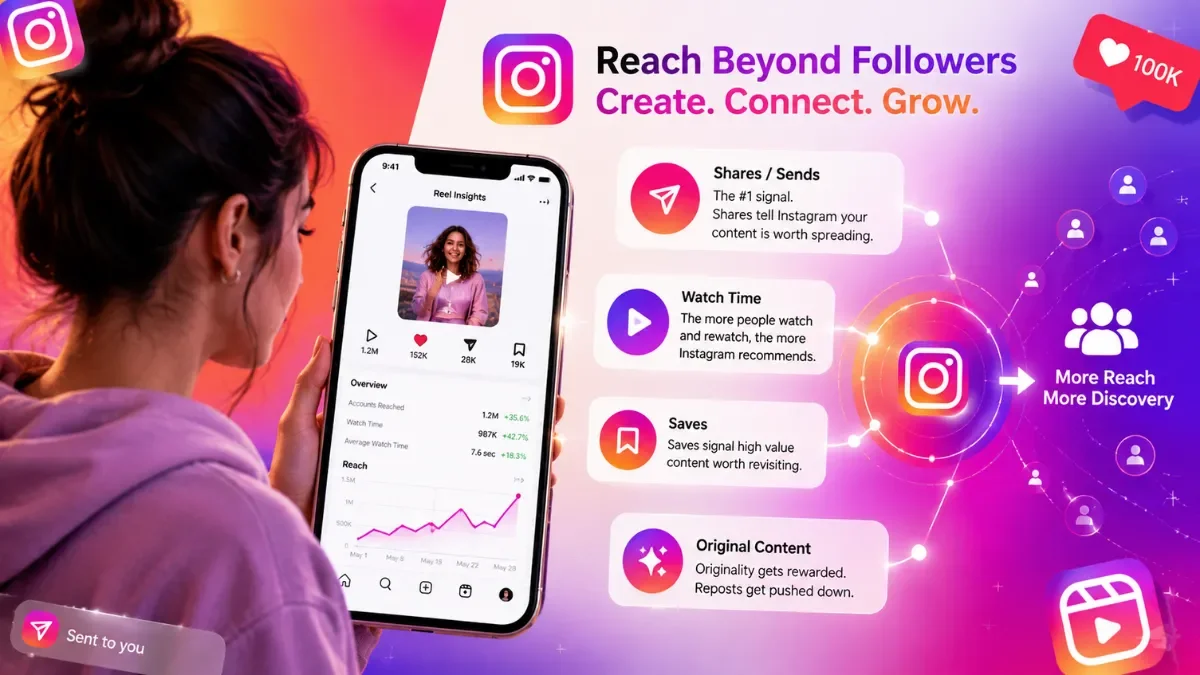
If your Instagram reach has changed dramatically in 2026, the first thing to understand is that there isn't one switch inside Instagram deciding whether your post “goes viral.”
Instagram uses different ranking and recommendation systems across parts of the app. Feed, Stories, Reels, Explore and Search have different jobs, so the signals used to decide what appears in each place are not identical.
For creators, that changes the question.
Instead of asking, “What does the Instagram algorithm like?”, it is more useful to ask: What is Instagram trying to learn from the way people respond to this piece of content?
That distinction explains why follower count alone cannot predict reach, why a Reel can travel far beyond an account's existing audience, and why a post with plenty of views can still fail to produce meaningful growth.
Instagram reach in 2026, explained simply
At a high level, Instagram's recommendation process can be thought of as four stages:
1. Is the content eligible to be recommended?
2. Which viewers are likely to care about it?
3. How do those viewers respond when they see it?
4. Is the response strong enough to justify showing it to more people?
Instagram has not published a single numerical formula that tells creators how much each signal is worth. So anyone claiming that a particular action represents an exact percentage of the algorithm is going beyond what the company has publicly disclosed.
What Instagram has disclosed is more useful: the company has identified several signals that matter substantially, and its recommendations are designed around predicting what individual users will find relevant or valuable.
There isn't one Instagram algorithm
The phrase “Instagram algorithm” is convenient, but technically misleading.
Instagram has explained that different parts of the app use different ranking systems because people use those surfaces differently.
Feed is primarily about keeping up with accounts and interests. Stories are closely tied to relationships and existing connections. Explore is designed around discovery. Reels is heavily oriented toward video discovery and entertainment. Search starts with something even more explicit: the user's query.
That means the same piece of content can perform differently depending on where it is being evaluated.
A Reel reaching non-followers is not necessarily competing under exactly the same conditions as a post being ranked for somebody who already follows its creator.
This is also why copying advice from a “Reels algorithm hack” and applying it to every part of Instagram can produce disappointing results.
Connected reach and unconnected reach are different problems
One of Instagram's most useful distinctions for creators is between connected and unconnected reach.
Connected reach refers broadly to people who already follow the account.
Unconnected reach comes from people who don't already follow it.
This distinction matters because the second category is where discovery-driven growth happens.
Instagram head Adam Mosseri said in January 2025 that, across these two broad types of ranking, the three signals creators should pay particular attention to are watch time, likes and sends. He also said likes are somewhat more important for connected content, while sends are somewhat more important for unconnected content.
That doesn't mean a creator can simply manufacture shares and expect unlimited reach.
The more useful interpretation is that Instagram is looking for evidence that content works for the audience it is being shown to.
What watch time tells Instagram
Watch time is straightforward: people have to actually consume the content for it to have a chance of generating meaningful distribution.
Instagram has provided creators with average and total watch-time metrics for Reels, along with retention information designed to show where viewers lose interest.
For a creator, average watch time is therefore more useful than simply knowing that someone technically started the Reel.
Imagine two videos:
Reel A attracts a large number of initial plays but most viewers leave quickly.
Reel B attracts fewer initial viewers but holds their attention substantially longer.
The second Reel may be giving Instagram stronger evidence that the content itself is satisfying once someone starts watching.
That does not mean there is a publicly disclosed watch-time threshold that guarantees recommendation.
There isn't.
It means watch time gives you a window into whether the content is actually holding attention.
The practical question
Don't ask:
“How do I make Instagram prefer longer watch time?”
Ask:
“Where did people lose interest, and what promise did my opening make that the rest of the video failed to deliver?”
That leads to better content decisions.
Why sends are particularly interesting for discovery
A like says, broadly, “I enjoyed this.”
A send can communicate something different:
“This is worth passing to another person.”
Instagram has explicitly highlighted sends as one of its major ranking signals, particularly for content reaching people who do not already follow the creator.
That makes sends especially relevant to discovery.
Meta's own data also shows how central messaging has become to Instagram's content-sharing behavior. In 2025, Meta said messaging had become the most popular way people share photos and videos on Instagram and that Reels were reshared more than 4.5 billion times a day across Meta platforms.
For creators, the lesson isn't “tell everyone to share this.”
The better question is:
Would someone naturally think of another person when they see this?
A useful checklist is:
Is the post genuinely useful to someone else?
Does it describe an experience people recognize?
Does it solve a small problem?
Does it make someone laugh?
Does it express something people struggle to say themselves?
Does it contain information someone would want a friend to know?
Shareability is usually an outcome of usefulness or relevance, not a substitute for it.
Likes still matter — but don't read too much into them
Likes are still among the three signals Mosseri publicly identified as especially important.
But the important metric isn't necessarily the raw number.
A Reel with 5,000 likes and 500,000 reach is a very different performance story from one with 5,000 likes and 20,000 reach.
This is why Instagram's own creator guidance has increasingly encouraged looking at rates and contextual metrics rather than treating a single absolute number as the answer.
For connected audiences, likes can be particularly useful because they indicate that people who already have some relationship with the account are responding positively.
For new audiences, sends have a somewhat greater role according to Mosseri's explanation.
Neither means that comments, saves or other actions are meaningless. It means creators should stop trying to turn every engagement type into a secret ranking hierarchy that Instagram has never published.
What about saves?
Saves are useful information for a creator even though Mosseri's 2025 “top three” explanation did not identify them as one of those three signals.
A save can indicate that somebody wants to return to a piece of content.
That makes saves particularly useful for evaluating content designed as a reference:
tutorials
recipes
checklists
travel ideas
product comparisons
educational carousels
workout instructions
templates
The editorial mistake is to turn that observation into “Instagram rewards saves more than comments.”
Instagram has not published such a universal rule.
Instead, use saves to understand what kind of value your audience is getting from the content.
Originality has become a bigger part of recommendation eligibility
This is one of the clearest developments creators need to understand in 2026.
Instagram has spent the past several years reducing the advantage enjoyed by accounts that simply redistribute content created by somebody else.
In 2024, Instagram introduced recommendation changes designed to give original creators a better opportunity to reach new audiences. Eligible content could be introduced to a small audience and then expanded as it demonstrated that people wanted to see it. Instagram also said identical reposts could be replaced in recommendations by the original piece of content.
The policy moved further in 2026.
In April, Instagram expanded its originality approach to photos and carousels, meaning accounts primarily built around reposting other people's work can lose recommendation eligibility for new audiences.
Meta said in January 2026 that original posts represented 75% of Instagram recommendations in the U.S. in Q4 2025, after a 10-percentage-point increase in the prevalence of original content during that quarter.
That is a significant strategic signal.
Instagram isn't simply asking:
“Did people engage with this?”
It also has to determine:
“Should this particular version of the content be the one we recommend?”
For creators, originality is therefore not just a branding issue. It can affect discovery eligibility.
Original doesn't mean you can't use trends
Originality does not mean every Reel needs to be filmed from scratch in isolation.
Creators can use:
popular formats
memes
trends
existing ideas
cultural references
third-party material
The important distinction is whether the creator has actually contributed something meaningful.
Instagram's 2026 approach specifically targets accounts that primarily repost material they did not create or meaningfully transform.
That makes a useful distinction:
Trend participation: “I'm using this format to express my own idea.”
Content copying: “I'm taking someone else's successful post and uploading it again.”
Those are not the same strategy.
Recommendation eligibility comes before ranking
This is one of the most overlooked parts of Instagram reach.
Creators often ask why a Reel isn't being recommended when the more fundamental question is whether the content is eligible for recommendation in the first place.
Instagram maintains Recommendation Guidelines that determine what content can be surfaced to people who don't already follow the account.
That creates an important separation:
Ranking asks: “Which eligible content should this person see?”
Eligibility asks: “Should this content be recommended to this person at all?”
If recommendation eligibility is restricted, improving the hook or increasing shares won't solve the underlying problem.
This is why creators experiencing an abrupt and persistent discovery collapse should check account and content status rather than immediately assuming the account has been “shadowbanned.”
Follower count is not a reach guarantee
A large following gives an account access to a large connected audience.
It does not guarantee that every post will be shown to every follower, nor does it guarantee strong recommendation performance among non-followers.
Instagram has actively worked to give smaller creators opportunities to reach new audiences.
Its 2024 recommendation changes were explicitly designed to reduce the advantage that large accounts and aggregators had gained in recommended content and give eligible creators a chance to be tested with audiences beyond their followers.
This creates an important reality:
A small account can produce a piece of content that is more discoverable than a much larger account's post.
But that does not mean follower count is irrelevant.
It still influences the connected audience available to the creator, the existing relationship between creator and audience, and the amount of initial attention a post can receive.
Feed, Reels, Explore and Search solve different problems
Feed
Feed is where Instagram balances content from accounts you follow with recommended material and other content it believes you may care about.
For a creator, this means your existing audience relationship remains important.
Reels
Reels is one of Instagram's strongest discovery surfaces.
A large portion of the opportunity here comes from people who don't already follow the creator, which is why signals associated with unconnected reach are particularly important.
Instagram's Trial Reels feature reflects this discovery-first environment: eligible creators can test a Reel with non-followers and review performance metrics before deciding whether to share it more broadly.
Explore
Explore is fundamentally a discovery environment.
The system is trying to connect users with content and creators outside their existing following graph based on their interests and activity.
Search
Search works differently again because the user tells Instagram what they are looking for.
Instagram has previously explained that the text entered into Search is a major signal, with the system matching queries against information such as usernames, bios, captions, hashtags and places. User activity and popularity signals can then help rank potential results.
That means Instagram SEO is not simply “add hashtags.”
It starts with making the subject of your content understandable.
Instagram SEO is about context, not just hashtags
Hashtags still have a place in Instagram's discovery ecosystem.
But treating them as the entire SEO strategy misses how Search works.
Think about three separate layers:
1. Search intent
What is the person actually trying to find?
For example:
“best cafes in Gurgaon”
is more useful than simply thinking:
#cafe
2. Keyword context
Your profile, captions and other textual information should make the topic clear.
A creator talking about skincare, for example, can naturally describe the product, skin concern, routine and intended audience.
3. Hashtags
Relevant hashtags can reinforce categorization and discovery.
But they should support the subject rather than replace it.
Instagram's publicly described Search guidance specifically recommends relevant keywords in profiles and captions alongside relevant hashtags.
The practical rule is simple:
Write so Instagram can understand the topic and a human can understand why the content is relevant.
Why your followers may see a post while non-followers don't
This is one of the most frustrating situations for creators.
Suppose:
follower reach looks normal;
non-follower reach is extremely low;
the account has not violated recommendation rules.
That doesn't automatically mean Instagram is suppressing the account.
It can mean the content has not produced enough evidence for broader recommendation, or that the topic is highly relevant to existing followers but less compelling outside that audience.
This is why creators should separate:
“My followers didn't respond.”
from:
“Instagram didn't find enough evidence to recommend this to strangers.”
They are different problems.
A practical low-reach diagnosis
Instead of changing five things at once, look at where the distribution problem begins.
Situation 1: Low views + very low non-follower reach
Investigate:
recommendation eligibility;
originality;
content packaging;
audience/topic fit;
whether the post is suitable for discovery.
This is a diagnostic framework, not an Instagram-published formula.
Situation 2: The Reel reaches people but watch time is weak
Investigate the content itself.
Look at:
the opening;
how quickly the topic becomes clear;
whether the visual changes are purposeful;
whether the payoff comes too late;
whether the video promises something it doesn't deliver.
The likely problem is not “the algorithm hates the account.”
The content may simply be losing viewers before the intended payoff.
Situation 3: Watch time is healthy but sends are weak
Ask whether the content is interesting enough to pass to somebody else.
A video can be enjoyable without being particularly shareable.
If the objective is broader discovery, consider whether the idea has:
utility;
relatability;
novelty;
humor;
emotional relevance;
conversation value.
Situation 4: Followers respond, but non-followers don't
This often points toward an audience-expansion problem.
Your existing audience may understand you because they already know your content.
A stranger doesn't have that context.
The content may need a clearer premise that makes sense without knowing the creator.
Situation 5: Views are high but profile visits and follows are weak
That is a different problem again.
The Reel may be succeeding as entertainment but failing as audience acquisition.
Ask:
“What reason did this Reel give a stranger to care about the account behind it?”
A viral clip and a strong creator strategy are not automatically the same thing.
Why reach can suddenly fall
A reach decline can have many explanations.
Audience interest changed
A topic that performed well last month may have weaker demand now.
Competition changed
Your audience is constantly receiving content from other creators.
Your content changed
Even subtle differences in hooks, pacing, topics or presentation can change viewer response.
The audience changed
As your account grows, the people encountering your content may become less homogeneous.
Recommendation eligibility changed
If content becomes ineligible for recommendation, non-follower discovery can be affected.
Originality changed
An account that increasingly relies on reposted material can face recommendation limitations under Instagram's current originality approach.
Viewer behavior changed
Instagram's recommendation systems personalize what people see based on their behavior and interests. Meta has continued expanding that personalization, including tools that allow users to reset or influence recommendations.
None of these automatically proves a shadowban.
What Instagram's recommendation changes mean for creators
The bigger shift is that Instagram increasingly behaves like an interest-discovery platform, not simply a follower feed.
That matters because creators can no longer build a growth strategy around:
“I have followers, so Instagram should show them my post.”
The more useful model is:
“Can Instagram understand who this content is for, and does the audience response justify showing it to more people?”
That is a much harder problem — but it is also more useful.
What creators should stop doing in 2026
Stop chasing supposed secret percentages
Instagram has not published a complete numerical ranking formula.
Stop treating every reach drop as a shadowban
Check eligibility, content performance and audience behavior first.
Stop assuming hashtags are the entire discovery strategy
Search depends on broader context.
Stop copying viral posts
Instagram's current originality direction makes content aggregation a weaker discovery strategy.
Stop optimizing for one metric
A Reel with high views but weak retention, shares or follower conversion may not be a strong growth asset.
Stop assuming follower count equals distribution
A large audience helps, but recommendations can expose eligible content to people who don't follow the creator.
What creators should focus on instead
The strongest approach in 2026 is not an “algorithm hack.”
It is a content-feedback loop:
Create → publish → inspect viewer behavior → identify the weak point → improve the next piece.
For Reels, pay particular attention to the metrics Instagram's leadership has highlighted:
average watch time;
likes per reach;
sends per reach.
Then add the metrics that matter to your own objective.
If you want discovery, look closely at non-follower reach.
If you want followers, examine profile visits and follows generated by content.
If you want sales, views alone are a poor measure of success.
If you want community, saves, replies, DMs and repeat interactions may tell you more about audience quality.
The metric should follow the goal.
What Instagram has not revealed
There is still a lot creators simply cannot know from public information.
Instagram has not published:
a universal percentage weight for every ranking signal;
a guaranteed watch-time threshold;
a guaranteed number of shares required for recommendation;
a universal viral score;
a fixed Reel length that guarantees distribution;
a posting time that guarantees reach;
a formula that predicts how many views a post will receive.
That uncertainty matters.
It means a creator should be suspicious of anyone presenting Instagram's ranking system as a neat equation.
Recommendation systems are dynamic, personalized and surface-specific.
The better way to think about Instagram reach in 2026
Instagram reach is not simply a reward for having followers.
It is the result of several systems trying to answer several questions:
Is this content eligible?
Who might care about it?
Did those people actually watch or engage with it?
Did they respond strongly enough to justify showing it elsewhere?
Is this original enough to deserve recommendation?
Does the content match what another user is interested in or searching for?
Those questions explain much more than a list of supposed algorithm hacks.
And they give creators something they can actually control.
You cannot control Instagram's ranking formula.
You can control whether the idea is clear, whether the opening earns attention, whether the content delivers value, whether it is genuinely yours, whether it makes sense to a stranger, and whether your analytics show that people are responding.
The takeaway
The Instagram algorithm isn't really the enemy creators need to beat.
The real challenge is making content that gives Instagram enough evidence to believe another person will want to see it.
In 2026, that means thinking beyond followers and likes.
Think about attention.
Think about relevance.
Think about originality.
Think about whether someone would send the content to a friend.
And most importantly, think about why a person who has never heard of you should care about the post in the first place.