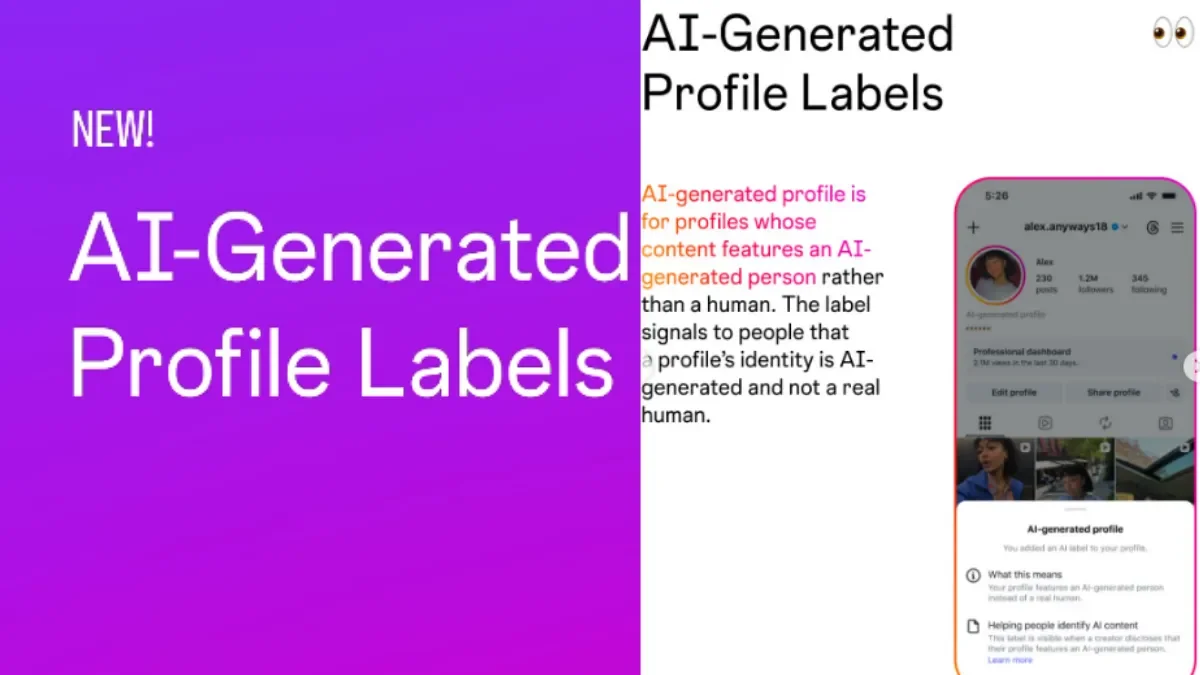
Instagram is changing one of its AI disclosure labels, but the important part isn't the name change itself.
The platform is narrowing the purpose of its former “AI creator” label and replacing it with “AI-generated profile” — a description aimed specifically at accounts whose featured person is created by artificial intelligence rather than a real human.
That distinction matters because Instagram is dealing with two very different things: people who use AI as a creative tool, and accounts built around a person who does not actually exist.
The latest change is designed to make that difference clearer. It also introduces a more consequential step: Instagram says profiles featuring AI-generated people that fail to use the appropriate label can face limits on their recommendation reach.
So, no, Instagram is not labeling every creator who uses AI. The change is much more targeted.
What Instagram actually changed
Instagram's previous account-level disclosure was called AI creator. It began testing that label in May 2026 for creators who regularly used AI to generate or modify their content. The label was optional and was designed to tell viewers that AI played a recurring role in the account's content.
Instagram has now changed the name to AI-generated profile and, more importantly, tightened what the label is meant to communicate.
The new wording is about the identity represented by the account.
In simple terms:
“AI creator” could describe how a creator makes content.
“AI-generated profile” tells you that the person represented by the profile is itself AI-generated.
That is a much more useful distinction for someone scrolling through Instagram.
What does “AI-generated profile” mean on Instagram?
An AI-generated profile is intended for an account where the person featured by the profile is an AI-generated individual rather than a real human.
Think of a virtual influencer whose face, body and apparent identity are generated digitally and whose Instagram presence is built around that synthetic persona.
The label is therefore not simply an announcement that an account occasionally uses generative AI.
A human creator can use AI to remove an object from a photograph, generate a background, alter an image, create visual effects or produce other content without becoming an “AI-generated person.”
Instagram's current explanation draws the line at the identity represented by the profile.
That is arguably the most important part of the update.
Why did Instagram move away from “AI creator”?
The old phrase was potentially ambiguous.
Imagine two Instagram accounts.
The first belongs to a real photographer who uses generative AI for backgrounds and post-production.
The second is operated around a completely artificial fashion model whose face and body are generated by AI.
Calling both accounts “AI creators” does not tell a viewer enough.
The creator in the first example is a human using an AI tool.
The person presented in the second example does not exist as a real human.
For users, those are fundamentally different circumstances.
Instagram's new terminology focuses on the second situation instead. The company says the change is intended to make the disclosure more precise and reduce the chance that users misunderstand what they are seeing.
The important distinction: AI-assisted creator vs AI-generated person
This is where the update can easily be misunderstood.
1. Human creator using AI
A real person remains behind the account, but AI is part of the creative workflow.
Example: A photographer uses an AI tool to expand a background.
That does not automatically make the person's Instagram profile an AI-generated profile.
2. AI-generated content
The individual content itself may be generated or substantially altered using AI.
Example: A real creator publishes an AI-generated landscape or an AI-created product concept.
This belongs to Instagram's wider content-labeling system.
3. AI-generated person
The human-looking individual appearing in the content is itself synthetic.
Example: A virtual fashion model whose face and body are generated by AI.
This is much closer to the situation the new profile label addresses.
4. AI-generated profile
The account is built around that artificial person as its identity.
That is the central target of Instagram's new AI-generated profile label.
The difference can be summarized like this:
| Situation | Is the person real? | Main issue |
|---|---|---|
| Human creator using AI tools | Yes | AI-assisted creation |
| Real creator posting an AI image | Yes | AI-generated content |
| AI-generated person in a post | No | Synthetic identity |
| Account built around an AI-generated person | No | AI-generated profile |
This is why saying “Instagram is labeling AI content” is too simplistic.
Instagram already has a separate system for AI-generated or AI-modified media.
How is this different from Instagram's “AI info” label?
Instagram's broader AI-labeling system operates at the content level.
Meta has explained that it can apply AI labels when it detects signals associated with AI-generated content, including industry-standard technical indicators. It has also used self-disclosure mechanisms and other detection approaches.
That system answers a question such as:
“Was this particular photo, video or piece of media created or modified with AI?”
The new profile-level label answers something different:
“Is the person represented by this account itself AI-generated?”
Those two disclosures can therefore coexist conceptually without meaning the same thing.
This distinction is particularly important as AI tools become good enough to produce realistic people.
Does this mean every Instagram creator using AI will get the label?
No.
A real creator who uses AI tools should not automatically assume that their profile will become an “AI-generated profile.”
Instagram's announcement specifically narrows the label to profiles featuring an AI-generated person rather than a human.
That means using AI as part of a creative process and being an AI-generated persona should not be treated as the same thing.
The distinction also matters for creators who use AI only occasionally.
An AI-generated background, AI-assisted editing or an AI-created image does not by itself establish that the account's identity is synthetic.
Those situations can instead fall under Instagram's separate content-level AI disclosure system.
Instagram is adding consequences for unlabeled AI personas
This is more significant than the rename.
Previously, the “AI creator” label was introduced as an optional disclosure. Instagram said at the time that enabling it would not affect how recommendations distributed the creator's content.
The new system changes the stakes for profiles that actually feature AI-generated people.
Instagram says accounts that feature an AI-generated person and fail to add the appropriate label may have their reach limited. Reporting on the update indicates that this can affect recommendation surfaces such as Reels and Explore, where content is shown to people who do not already follow the account.
That does not mean Instagram is banning AI influencers.
It means Instagram is making disclosure part of the conditions for maintaining normal recommendation eligibility for this particular type of account.
Creators who voluntarily add the label are not supposed to receive a reach penalty simply for identifying their account as AI-generated.
What happens to existing “AI creator” labels?
Accounts that previously used the older label are being moved into the new system, but the change in wording also means creators should reconsider whether the disclosure still describes their account.
That is logical because the two labels do not have exactly the same scope.
An account that used the old label because it regularly used AI-assisted production may not necessarily be an account featuring an AI-generated person.
Instagram has said existing labeled profiles can review the new status and remove the label if it no longer applies.
So the rename should not be interpreted as Instagram declaring that every person who previously used “AI creator” is now an AI-generated human.
How will Instagram identify an AI-generated profile?
This is one area where Instagram has not publicly provided enough technical detail to give users a definitive detection formula.
Meta already uses several approaches to identify AI-generated media. Its broader labeling work has involved industry-shared signals and technical standards intended to indicate when content was created using AI.
But that does not tell us exactly how Instagram determines that an entire profile features an AI-generated person.
Instagram has not publicly disclosed a complete list of signals, thresholds or detection methods for this new profile-level enforcement.
That means claims about exactly how Instagram “detects every AI influencer” would go beyond what the company has confirmed.
What if Instagram gets it wrong?
Instagram has accounted for that possibility.
Creators whose profiles are identified as AI-generated but who believe the decision is incorrect can check Account Status and appeal the restriction, according to reporting on Instagram's updated process.
That safeguard matters because AI detection is not perfect.
Meta itself has spent years changing its approach to AI labeling as detection technology and industry standards evolve. In 2024, the company acknowledged that identifying AI content across different tools requires cooperation around technical signals and standards.
For a profile-level system, false positives could be even more frustrating because the label affects the identity of the account rather than just one post.
Why AI influencers are the real focus
The update arrives at a point where AI-generated personalities are becoming much easier to create.
A convincing synthetic person can have a name, biography, photographs, videos, followers and a consistent visual identity. To someone scrolling quickly, there may be little obvious difference between that account and one belonging to a human creator.
That creates a different transparency problem from an AI-generated picture.
If an AI-generated image appears in a feed, the question is:
“Was this image made with AI?”
If an entire influencer persona is synthetic, the more fundamental question becomes:
“Who—or what—is this person?”
Instagram's new label is designed around that second question.
What does this mean for virtual influencers?
For virtual influencers, the practical implication is straightforward: transparency is becoming part of account management.
An AI-generated personality can still exist on Instagram. The new policy does not amount to a ban on synthetic creators.
But if the account is built around an AI-generated person, the platform expects that identity to be disclosed.
That could also change how virtual influencers are presented to audiences.
Instead of attempting to make an artificial personality indistinguishable from a human creator, operators may increasingly have an incentive to build the AI nature of the persona into the brand itself.
That is an important shift.
The disclosure does not necessarily have to destroy the appeal of a virtual influencer. For some brands, the artificial identity is the product.
What does this mean for brands and influencer marketing?
Brands should pay attention even if they never operate AI accounts themselves.
Influencer marketing depends heavily on audience trust. A campaign can involve a creator's personal story, appearance, recommendations and perceived experience with a product.
An AI-generated personality changes that relationship.
A brand working with a virtual influencer now has another transparency issue to consider: is the audience clearly aware that the person endorsing the product is synthetic?
Instagram's labeling change does not by itself create a complete legal framework for AI influencer advertising. Advertising disclosure, consumer-protection rules and local regulations can impose additional requirements.
But from a platform perspective, the direction is clear: AI-generated identity is becoming something that platforms expect users to disclose rather than leave viewers to discover for themselves.
Could AI-generated influencers still make money?
Nothing in Instagram's announcement says that AI-generated profiles are prohibited from earning money.
The update is about identification and recommendation eligibility, not an outright ban on monetization.
However, brands may treat transparency differently from before.
For a company, the question isn't simply whether an AI influencer can generate views. It may also ask:
Is the audience aware that the creator is synthetic?
Does the AI persona fit the brand?
Could the account create trust or reputational concerns?
Are the campaign disclosures clear?
Does the creator comply with Instagram's platform rules?
Are there additional advertising or consumer-protection requirements?
In other words, the label could become part of influencer due diligence.
What ordinary Instagram users should take away
For most users, the update can be understood through one simple rule:
An AI-generated profile label is not a warning that someone used AI. It is a signal that the person represented by the profile is AI-generated.
That distinction can help users interpret what they see.
A profile without the label is not automatically proof that every image is human-made. Instagram has separate AI-content labels and its detection systems are not a guarantee that every synthetic piece of media will be identified.
Likewise, seeing an AI-generated profile label does not necessarily mean the account is malicious or fraudulent.
It tells you something more specific: the apparent person at the center of the profile is not a real human being.
What Instagram's change does not mean
There are several conclusions users should avoid drawing from the announcement.
It does not mean Instagram is banning AI content
Meta continues to support generative AI tools and AI-assisted creation. Its existing labeling framework is designed partly to increase transparency around AI-generated media rather than prohibit it.
It does not mean every AI-edited photo requires an AI-generated profile label
The profile label has a much narrower purpose.
A real person can use AI tools without becoming an AI-generated profile.
It does not mean every unlabeled account is definitely human
Instagram's labeling and detection systems cannot be treated as a universal authenticity certificate.
The absence of a label does not prove that every element of an account is human-created.
It does not mean AI influencers are banned
The new approach is focused on disclosure and recommendation eligibility for profiles featuring AI-generated people.
What remains unclear
Instagram has clarified the basic policy but several implementation details remain less clear.
The company has not publicly provided a comprehensive explanation of exactly how it identifies AI-generated people at the profile level.
It has also not published a percentage figure showing how much reach an affected account will lose.
The precise pace of the rollout is another area to watch. Current reporting describes the restrictions as beginning to apply, while some language around enforcement indicates that affected accounts may see limits as the system rolls out.
Instagram has also not established through this announcement that the same profile-level enforcement is being introduced in exactly the same form across Facebook and Threads.
Those details should therefore be treated as open questions rather than filled in with assumptions.
The bigger change is about identity, not creativity
Instagram's decision is easy to describe as a label rename.
But that undersells what is happening.
The platform is drawing a line between AI as a tool and AI as the person being presented to an audience.
That is increasingly important because synthetic people are becoming realistic enough to participate in the same attention economy as human influencers.
For a human creator, AI may simply be another editing or production tool.
For a virtual influencer, AI can be the identity itself.
Instagram's new AI-generated profile label is designed to make that difference visible.
And that may ultimately be the more important direction for social platforms: not telling users that AI exists, but telling them when the person on the other side of the profile isn't actually a person.