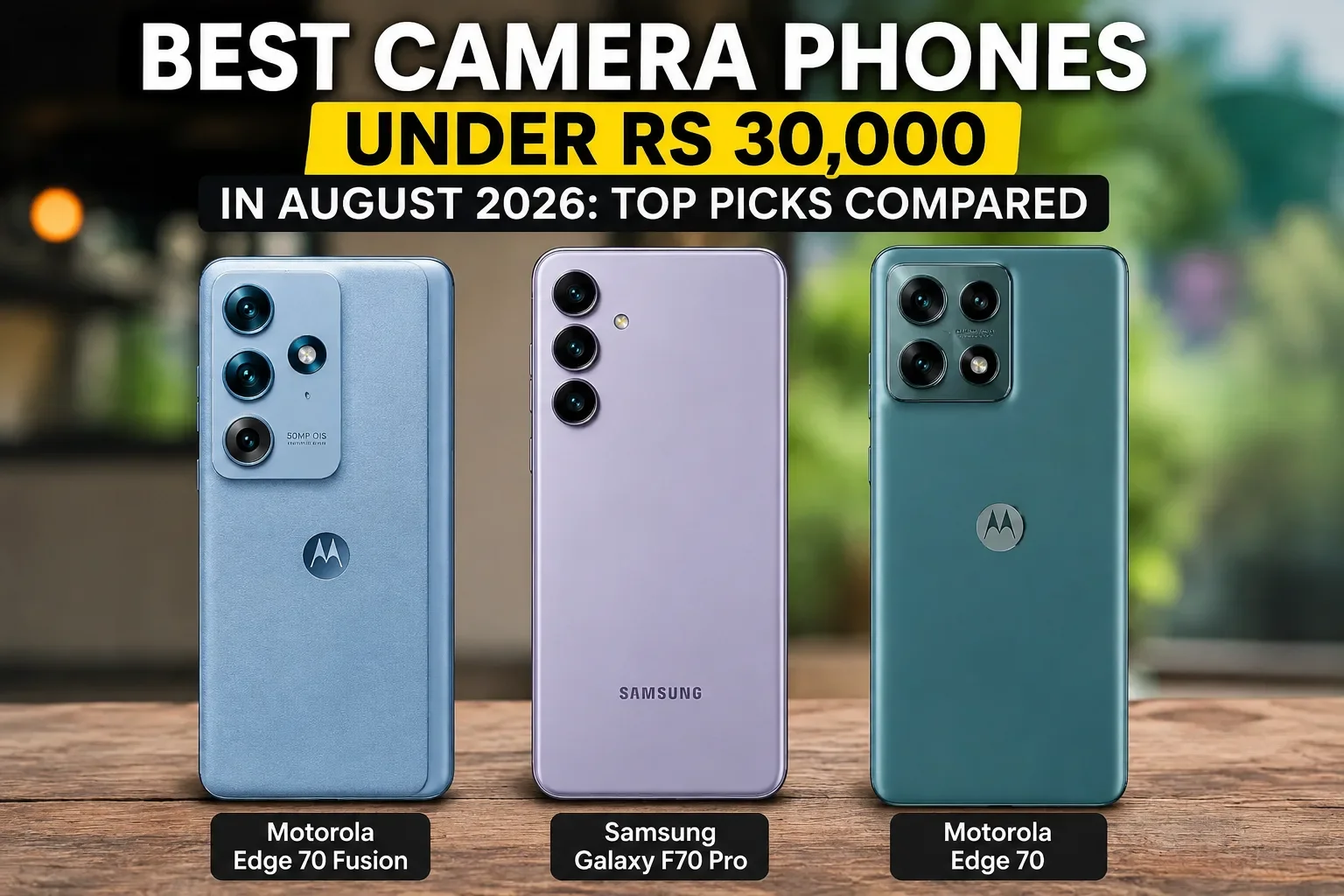
Buying a phone purely for photography used to mean spending upwards of Rs 50,000. That's changed fast. In 2026, the best camera phones under Rs 30,000 now pack large 1/1.5-inch-class sensors, optical image stabilization (OIS), and genuinely useful AI photography tools — features that were flagship-exclusive just a couple of years ago.
Three things have driven this shift: OIS trickling down into mid-range main cameras, computational imaging (AI-assisted night mode, portrait processing, and scene detection) getting good enough to matter, and brands aggressively competing on camera specs as a marketing differentiator in this exact price bracket.
After comparing specs, hardware, and real-world camera ratings from multiple review platforms, three phones stand out as the strongest camera phones under Rs 30000 August 2026: the Motorola Edge 70 Fusion, the vivo V50e, and the Redmi Note 15 Pro 5G. Each targets a slightly different kind of buyer — here's how they compare.
Quick Verdict
- Best overall camera phone: Motorola Edge 70 Fusion — the strongest all-round main camera, OIS, and display in this price bracket
- Best for selfies and video calls: vivo V50e — 50MP front camera with a built-in Aura ring light for low-light selfies
- Best for detail and cropping flexibility: Redmi Note 15 Pro 5G — 200MP main sensor with OIS, useful for high-resolution crops and 4K video
Best 3 Camera Phones Under Rs 30,000
1. Motorola Edge 70 Fusion
Overview Launched in India in March 2026, the Edge 70 Fusion is a Flipkart-exclusive device positioned squarely as a camera-first phone in this segment. It's available in three configurations: 8GB+128GB (Rs 26,999), 8GB+256GB (Rs 29,999), and 12GB+256GB (Rs 32,999) — meaning the sweet-spot variants for this list fall comfortably under Rs 30,000.
Camera Specifications
- Primary camera: 50MP Sony LYTIA 710 sensor, f/1.8 aperture, with OIS
- Ultra-wide: 13MP, 120° field of view, f/2.2, with macro support
- Selfie camera: 32MP, f/2.2
- OIS: Yes, on the primary sensor — a genuine standout at this price
- Video: 4K recording on both rear and front cameras, with motoAI-powered scene and processing enhancements
Performance The phone runs on the Snapdragon 7s Gen 4 chipset with 8GB or 12GB RAM and up to 256GB of UFS 3.1 storage. It handles day-to-day multitasking and moderate gaming comfortably, though it isn't built to compete with more performance-focused rivals on raw benchmark numbers.
Display A 6.8-inch quad-curved AMOLED panel with a 144Hz refresh rate, HDR10+, 10-bit color, 100% DCI-P3 coverage, and a claimed peak brightness of up to 5200 nits. Pantone-validated colors and skin-tone accuracy make it a strong screen for reviewing photos on the go.
Battery & Charging A large 7,000mAh silicon-carbon battery with 68W wired fast charging. No wireless charging on this model.
Pros
- Best-in-class main camera with OIS at this price
- Excellent, bright AMOLED display
- Very large battery for a camera-centric phone
Cons
- No telephoto lens — zoom relies on digital cropping
- Gaming performance is solid but not chart-topping
- No wireless charging
2. vivo V50e
Overview The vivo V50e launched in India in April 2025 and remains one of the most recommended camera phones under Rs 30,000 through 2026, with current pricing around Rs 28,999–29,999 depending on the storage variant and ongoing offers.
Camera Specifications
- Primary camera: 50MP Sony IMX882 sensor, with OIS
- Ultra-wide: 8MP
- Selfie camera: 50MP — one of the highest-resolution front cameras in this segment
- OIS: Yes, on the primary rear sensor
- Video: 4K recording supported; vivo's Aura Light assists both selfies and portrait shots in low light
Performance Powered by the MediaTek Dimensity 7300 chipset with 8GB RAM and up to 256GB storage. It's an average performer for gaming compared to some rivals, but more than adequate for everyday use, streaming, and content browsing.
Display A 6.77-inch AMOLED display with a 120Hz refresh rate, 1800 nits peak brightness, HDR10+ support, and a resolution of 2392 x 1080.
Battery & Charging A 5,600mAh battery with 90W fast charging — among the fastest charging speeds in this price bracket. No wireless charging.
Pros
- Exceptional 50MP selfie camera with genuinely useful ring light
- Very fast 90W charging
- IP68/IP69 rating for dust and water resistance
Cons
- No telephoto lens; ultra-wide resolution is modest at 8MP
- Dimensity 7300 lags behind rivals in raw gaming performance
- No NFC support on some variants
3. Redmi Note 15 Pro 5G
Overview Launched in India in early February 2026, the Redmi Note 15 Pro 5G starts at Rs 29,999 for the base 8GB+128GB variant, with the 8GB+256GB model priced at Rs 31,999. Bank card offers have brought the effective starting price down to around Rs 26,999–27,999 during launch promotions.
Camera Specifications
- Primary camera: 200MP sensor with OIS
- Ultra-wide/Macro: 8MP ultra-wide plus a dedicated 2MP macro lens
- Selfie camera: 20MP
- OIS: Yes, on the primary sensor
- Video: 4K video recording with AI Ultra-Clear Engine processing for dynamic shots and live photos
Performance Runs on the MediaTek Dimensity 7400 Ultra with a large vapour chamber cooling system, 8GB RAM, and up to 256GB UFS storage. Handles gaming and multitasking well for the segment, aided by the extra thermal headroom.
Display A 6.83-inch curved AMOLED display with 1.5K resolution, 120Hz refresh rate, up to 3200 nits peak brightness, HDR10+, and Dolby Vision support — genuinely premium specs for this price tier.
Battery & Charging A 6,580mAh silicon-carbon battery with 45W fast charging. Also carries an unusually robust IP66+IP68+IP69+IP69K water and dust resistance rating for a mid-range phone.
Pros
- Highest-resolution main camera in this list, useful for cropping and detail retention
- Excellent, bright display with Dolby Vision
- Strong build durability (Gorilla Glass Victus 2, multi-rating IP protection)
Cons
- Selfie camera resolution (20MP) trails the vivo V50e
- 45W charging is noticeably slower than the V50e's 90W
- Heavier than the other two phones at 210 grams
Camera Comparison Table
| Feature | Motorola Edge 70 Fusion | vivo V50e | Redmi Note 15 Pro 5G |
|---|---|---|---|
| Main camera | 50MP, Sony LYTIA 710, f/1.8 | 50MP, Sony IMX882 | 200MP, OIS-equipped |
| Selfie camera | 32MP | 50MP | 20MP |
| Night mode | Strong, AI-assisted | Good, aided by Aura Light | Good, AI Ultra-Clear processing |
| Portrait quality | Very good, natural skin tones | Very good, especially selfies | Good |
| Video recording | 4K (rear & front) | 4K | 4K |
| OIS | Yes | Yes | Yes |
| Zoom quality | Digital only, no telephoto | Digital only, no telephoto | Digital only, high-res crop advantage |
| AI features | motoAI scene/processing | AI portrait & Aura Light | AI Ultra-Clear Engine |
| Battery | 7,000mAh | 5,600mAh | 6,580mAh |
| Charging | 68W wired | 90W wired | 45W wired |
| Starting price | ~Rs 26,999–29,999 | ~Rs 28,999 | Rs 29,999 |
Which Phone Is Best For?
- Photography enthusiasts: Motorola Edge 70 Fusion, thanks to its larger sensor, OIS, and wider aperture main camera
- Selfies and video calls: vivo V50e, for its 50MP front camera and built-in ring light
- Video creators / 4K footage: Redmi Note 15 Pro 5G, for its high-resolution sensor and AI-assisted stabilization in 4K
- Gaming: Redmi Note 15 Pro 5G, thanks to its vapour chamber cooling and capable Dimensity 7400 Ultra chip
- Battery life: Motorola Edge 70 Fusion, with its massive 7,000mAh cell
- Overall value: vivo V50e, for buyers who prioritize fast charging and selfie quality without overspending
Buying Guide: What to Actually Look For
Why OIS matters Optical Image Stabilization physically compensates for hand shake, which dramatically improves low-light photos and video smoothness. All three phones here include OIS on their main camera — a genuine step up from budget phones that rely purely on software (EIS) stabilization.
AI camera features Look beyond marketing buzzwords. Useful AI features include noise reduction in night mode, accurate scene detection, and portrait edge-detection — all three phones offer these to varying degrees, though motoAI and Xiaomi's AI Ultra-Clear Engine tend to get the most consistent praise in reviews.
Display quality A good display isn't just about photos looking nice on-screen — accurate color reproduction helps you judge your actual shot quality before you post or print it. All three phones offer AMOLED panels with HDR10+, which is the right baseline to look for at this price.
Software updates Longer software support means your camera app keeps getting AI improvements over time. Check each brand's stated update policy (Redmi and Motorola have both improved their update commitments in recent generations) before buying.
Storage options If you shoot a lot of 4K video, favor the 256GB variant where available — 4K footage eats storage fast, and none of these phones support wireless-only cloud-first workflows by default.
Battery life Camera-heavy use (frequent shooting, editing, and video calls) drains batteries faster than typical browsing. The Motorola Edge 70 Fusion's 7,000mAh cell gives the most buffer for heavy shooting days.
Final Verdict
All three phones prove that the best camera phone under 30000 doesn't mean settling for compromised hardware anymore. The Motorola Edge 70 Fusion is the strongest all-rounder, combining OIS, a genuinely large sensor, and the best display of the three. The vivo V50e is the one to pick if selfies, video calls, or content creation for social platforms are your priority. And the Redmi Note 15 Pro 5G makes the most sense if you want maximum resolution for cropping flexibility, along with the best gaming performance and build durability of the group.
Whichever you choose, all three represent genuinely strong value in the best Android phone under 30000 category — the days of needing a flagship budget just to get a capable camera are firmly behind us.
Also Read: Samsung Galaxy F70 Pro 5G Could Be Samsung's Most Exciting Mid-Range Phone Yet
Frequently Asked Questions
1. Which is the best camera phone under Rs 30,000?
The Motorola Edge 70 Fusion currently offers the strongest overall camera performance in this price bracket, thanks to its larger sensor, wide aperture, and OIS.
2. Which phone has the best selfie camera under Rs 30,000?
The vivo V50e, with its 50MP front camera and built-in Aura ring light for low-light selfies.
3. Is OIS important for smartphone photography?
Yes. OIS significantly reduces blur from hand shake, especially in low light and video recording, and is one of the biggest differentiators between budget and capable mid-range cameras.
4. Which phone records the best 4K videos?
The Redmi Note 15 Pro 5G and Motorola Edge 70 Fusion are closely matched, both offering 4K recording with AI-assisted processing; the Edge 70 Fusion also supports 4K on its front camera.
5. Which smartphone offers the best night photography?
The Motorola Edge 70 Fusion, owing to its larger sensor and wider f/1.8 aperture, which lets in more light for cleaner night shots.
6. Which phone has the best battery life under Rs 30,000?
The Motorola Edge 70 Fusion, with its 7,000mAh battery, offers the longest expected battery life among the three.