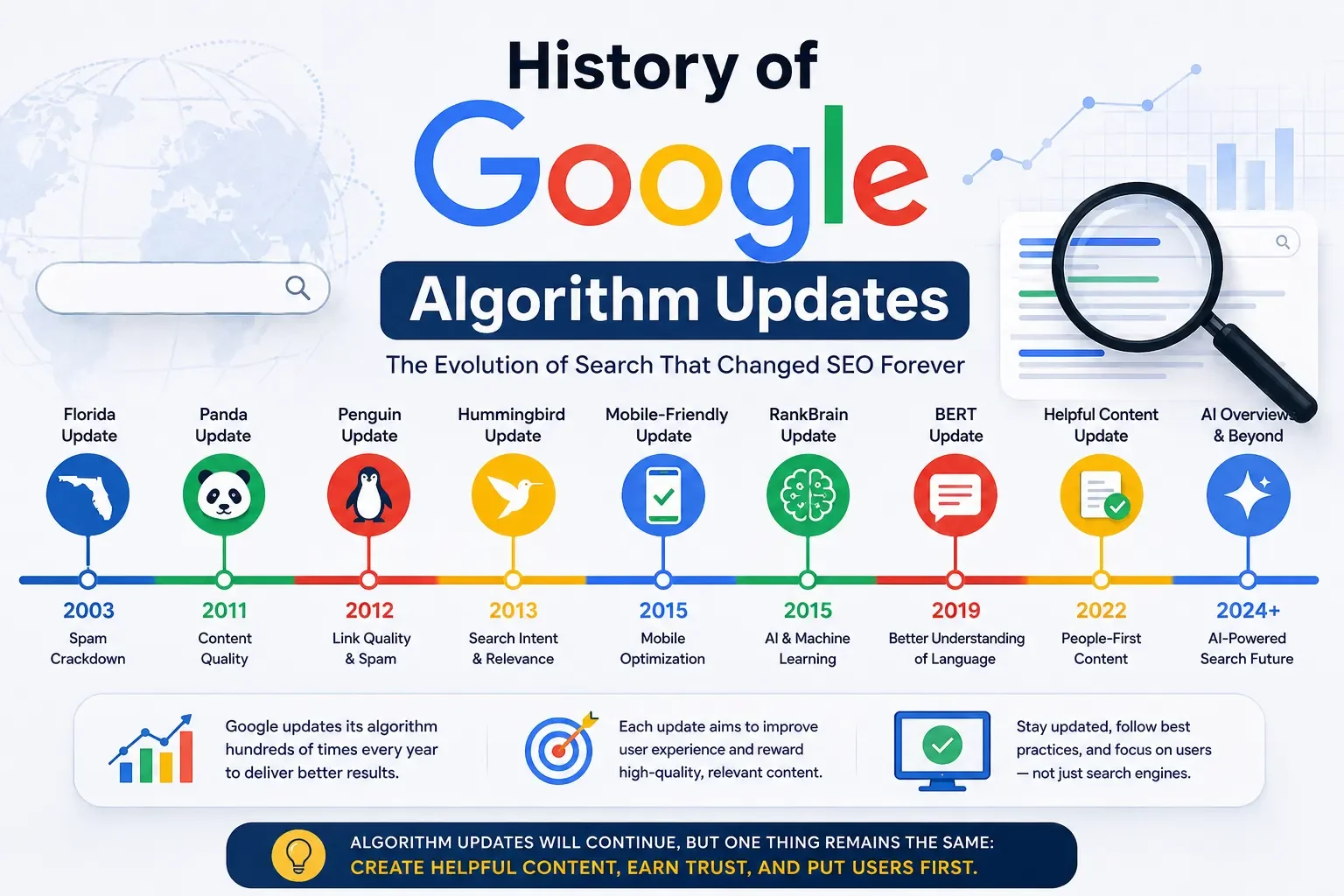
Every time you type a query into Google, you're relying on a system that has been rewritten, refined, and re-engineered thousands of times over the past two decades. Google doesn't just tweak its search engine occasionally — it makes thousands of changes every year, ranging from tiny quality tweaks to seismic shifts that redraw the entire search landscape overnight. Understanding the history of Google algorithm updates isn't just a trivia exercise for SEO nerds; it's essential context for anyone who depends on organic traffic to grow a business, publish content, or run an online store.
Each major update tells a story about what Google values at that moment — whether it's punishing spammy backlinks, rewarding fast mobile pages, or now, understanding search intent through AI. In this guide, we'll walk through the complete history of Google algorithm updates, explain why each major update happened, and show you how to build an SEO strategy that survives — and even thrives — through future changes.
What Are Google Algorithm Updates?
Google's search algorithm is the enormous, constantly evolving set of rules and machine-learning systems that decide which pages appear, and in what order, for any given search query. It weighs hundreds of ranking signals — content relevance, backlinks, page speed, mobile usability, and increasingly, factors like expertise and trustworthiness — to serve the most helpful results possible.
Google releases updates because the web itself never stops changing. New spam tactics emerge, user behavior shifts, devices evolve, and content quality varies wildly across billions of pages. Without continuous updates, search quality would stagnate and manipulative tactics would eventually dominate the results.
It helps to understand the difference between core updates and targeted updates. Core updates are broad, sitewide reassessments of how Google evaluates content quality and relevance — they don't target a specific tactic, but rather refine the overall ranking system. Targeted updates, on the other hand, address a specific problem, such as thin affiliate content, manipulative backlinks, or slow mobile pages. Both types are central to the history of Google algorithm updates, and both can significantly move the needle on your organic traffic.
Why Google Updates Its Algorithm
Google's motivations behind every update generally fall into a few consistent categories:
- Better search quality: Ensuring the most accurate, relevant, and trustworthy pages rank at the top.
- Fighting spam: Cracking down on manipulative tactics like keyword stuffing, link schemes, and cloaking.
- Improving user experience: Rewarding fast-loading, easy-to-navigate, ad-light pages.
- Mobile-first indexing: Reflecting the shift toward mobile browsing as the primary way people search.
- AI-powered search: Using machine learning to better understand language, context, and intent.
- Helpful content: Prioritizing content written for real people rather than content engineered purely to rank.
These themes recur throughout the history of Google algorithm updates, even as the specific technology behind them has changed dramatically.
Complete Timeline of Google Algorithm Updates
| Year | Update Name | Purpose | Impact on Websites |
|---|---|---|---|
| 2003 | Florida | Curb keyword stuffing and manipulative optimization | Many e-commerce sites lost rankings overnight |
| 2005 | Jagger | Target unnatural and paid link schemes | Sites with spammy backlink profiles dropped sharply |
| 2006 | Big Daddy | Infrastructure overhaul for indexing and URL handling | Improved canonicalization; some sites saw indexing issues |
| 2009 | Vince | Boost visibility of well-known brands | Established brands gained a ranking advantage |
| 2010 | Caffeine | Faster, fresher indexing infrastructure | Enabled near real-time content indexing |
| 2011 | Panda | Penalize thin and low-quality content | Content farms and duplicate-heavy sites lost major traffic |
| 2012 | Penguin | Penalize manipulative link-building | Sites with spammy backlinks saw steep ranking drops |
| 2012 | Pirate | Demote sites with repeated copyright violations | Piracy-heavy sites lost visibility |
| 2012 | Exact Match Domain (EMD) | Reduce ranking boost from exact-match domain names | Low-quality EMD sites lost their unfair advantage |
| 2013 | Hummingbird | Improve understanding of search intent and natural language | Keyword-stuffed pages became less effective |
| 2014 | Pigeon | Improve local search relevance | Local businesses saw ranking shifts in map and local results |
| 2014 | HTTPS Update | Encourage secure website encryption | HTTPS sites gained a slight ranking boost |
| 2015 | Mobile-Friendly Update | Reward mobile-optimized websites | Non-mobile-friendly sites dropped in mobile search results |
| 2015 | RankBrain | Use machine learning to interpret ambiguous queries | Helped Google handle never-before-seen searches |
| 2016 | Possum | Diversify and refine local search results | Local businesses near boundary lines saw ranking shifts |
| 2017 | Fred | Target sites prioritizing ads and revenue over content quality | Ad-heavy, low-value content sites lost traffic |
| 2018 | Mobile-First Indexing | Use the mobile version of a site as the primary index | Sites without responsive design were disadvantaged |
| 2018 | Medic Update | Improve trust signals for health, finance, and YMYL content | Many health and wellness sites saw major fluctuations |
| 2019 | BERT | Better understand natural language and context in queries | Long-tail, conversational queries returned more accurate results |
| 2020 | Passage Ranking | Rank specific passages within a page, not just the whole page | Long-form content gained new visibility opportunities |
| 2021 | Page Experience Update | Incorporate Core Web Vitals into rankings | Slow, poorly designed pages lost competitive edge |
| 2021 | Product Reviews Update | Reward in-depth, original product review content | Thin affiliate review pages lost rankings |
| 2022 | Helpful Content Update | Prioritize people-first, genuinely useful content | AI-generated and SEO-first content saw drops |
| 2022–2026 | Spam Updates (ongoing) | Combat link spam, scaled content abuse, and site reputation abuse | Manipulative and low-effort spam sites de-indexed |
| 2023–2026 | Core Updates (ongoing, quarterly cadence) | Broadly reassess content quality and relevance | Widespread ranking volatility across nearly every industry |
| 2024 | AI Overviews | Integrate AI-generated summaries directly into search results | Some informational queries saw reduced click-through to websites |
| 2025–2026 | Recent Core & AI-Driven Updates | Refine "information gain," E-E-A-T signals, and AI Overview accuracy | Sites with original data and firsthand expertise gained visibility |
The Most Important Google Updates Explained
Panda (2011)
What changed: Panda introduced a system to identify and demote low-quality, thin, or duplicate content sitewide. Why it was introduced: Content farms were flooding search results with mass-produced, low-value articles. Who was affected: News aggregators, content farms, and sites with excessive duplicate or ad-heavy pages. Recovery tips: Remove or consolidate thin pages, eliminate duplicate content, and focus on original, well-researched material. Long-term lesson: Content quality, not quantity, has remained a foundational ranking principle ever since.
Penguin (2012)
What changed: Penguin specifically targeted manipulative link-building practices, including paid links and link farms. Why it was introduced: Backlinks were being gamed at scale, distorting search rankings. Who was affected: Sites relying heavily on unnatural, exact-match anchor text and low-quality link networks. Recovery tips: Conduct a backlink audit, disavow toxic links, and focus on earning links through genuinely valuable content. Long-term lesson: Link quality matters far more than link quantity.
Hummingbird (2013)
What changed: Hummingbird overhauled how Google interpreted the meaning behind a search query, rather than just matching keywords. Why it was introduced: Users were increasingly typing conversational, natural-language queries. Who was affected: Pages optimized purely around exact-match keywords lost some advantage. Recovery tips: Write naturally, focus on topics and intent rather than exact keyword repetition. Long-term lesson: Semantic relevance became just as important as keyword matching.
Mobile-Friendly Update (2015) and Mobile-First Indexing (2018)
What changed: Google began favoring mobile-optimized sites, then eventually switched to indexing the mobile version of websites by default. Why it was introduced: Mobile search volume had overtaken desktop. Who was affected: Sites without responsive or mobile-friendly design saw ranking declines. Recovery tips: Implement responsive design, test mobile usability regularly, and ensure content parity between desktop and mobile versions. Long-term lesson: Mobile experience is no longer optional — it's the default lens through which Google evaluates your site.
Medic Update (2018)
What changed: This broad core update placed heavier emphasis on trust and authority, particularly for Your Money or Your Life (YMYL) topics like health and finance. Why it was introduced: Google wanted to reduce the risk of harmful or inaccurate information ranking for sensitive queries. Who was affected: Health, wellness, and finance sites without strong credentials or citations. Recovery tips: Add author bios with real credentials, cite authoritative sources, and strengthen overall site trustworthiness. Long-term lesson: This update was an early signal of what would later formalize into E-E-A-T (Experience, Expertise, Authoritativeness, Trustworthiness).
BERT (2019)
What changed: BERT improved Google's ability to understand context and nuance in natural language, especially prepositions and conversational phrasing. Why it was introduced: Roughly one in ten searches were being misunderstood due to language complexity. Who was affected: Content that answered questions clearly and naturally benefited; keyword-stuffed content did not. Recovery tips: Write for humans, structure content clearly, and directly answer the questions your audience is asking. Long-term lesson: Natural, well-structured writing consistently outperforms mechanical, keyword-driven copy.
Helpful Content Update (2022)
What changed: This update introduced a sitewide signal that downranked content created primarily to attract search traffic rather than genuinely help readers. Why it was introduced: The rise of low-effort and AI-assisted content mills threatened search quality. Who was affected: Sites publishing shallow, unoriginal, or SEO-first content across entire categories. Recovery tips: Audit your content for genuine usefulness, remove or rewrite low-value pages, and prioritize firsthand expertise. Long-term lesson: Google increasingly evaluates websites holistically, not just page by page.
How Google Algorithm Updates Have Changed SEO
Looking across the full history of Google algorithm updates, a clear evolution emerges. Early SEO was largely mechanical — stuff keywords, build backlinks, exploit domain names. Modern SEO is holistic and human-centered.
- Content quality has replaced content volume as the primary ranking driver.
- E-E-A-T (Experience, Expertise, Authoritativeness, Trustworthiness) now shapes how Google evaluates credibility, especially for YMYL topics.
- User experience, including page layout and intrusive ads, directly affects rankings.
- Backlinks still matter, but quality and relevance now outweigh sheer quantity.
- Technical SEO — crawlability, structured data, and site architecture — remains foundational.
- Page speed and Core Web Vitals are now measurable ranking factors.
- Mobile optimization is the default standard, not an afterthought.
- AI-generated content is acceptable to Google in principle, but only when it meets the same quality and helpfulness bar as human-written content.
- Search intent now dictates content structure far more than exact keyword placement.
Common SEO Mistakes That Trigger Ranking Drops
Even with two decades of algorithm history to learn from, many websites still make the same mistakes:
- Thin content: Pages with little substance or original value.
- Keyword stuffing: Unnatural repetition of target keywords.
- Low-quality backlinks: Links from spammy, irrelevant, or paid link networks.
- Duplicate content: Repeated or near-identical content across pages or domains.
- Poor user experience: Intrusive pop-ups, slow load times, or confusing navigation.
- Spam tactics: Cloaking, doorway pages, or scaled content abuse designed to manipulate rankings.
How to Recover After a Google Algorithm Update
If your traffic drops following an update, a calm, methodical response works far better than panic:
- Audit your content to identify pages with weak performance, thin depth, or outdated information.
- Improve quality by adding original insights, data, examples, or expert commentary.
- Fix technical SEO issues like broken links, slow load times, and crawl errors.
- Strengthen E-E-A-T by showcasing author credentials, citing credible sources, and building a transparent brand presence.
- Monitor Google Search Console closely for indexing issues, manual actions, and ranking trends.
- Update outdated pages regularly rather than letting them stagnate for years.
- Build authoritative backlinks through genuine outreach, partnerships, and high-value content rather than shortcuts.
Recovery rarely happens overnight — most sites need one to three months of consistent improvement before seeing meaningful recovery.
Future of Google Search
The next chapter in the history of Google algorithm updates is being written right now, and it's heavily shaped by artificial intelligence. AI Overviews now appear directly in search results for many queries, summarizing information without requiring a click-through. Google's Gemini models increasingly power features across Search, including the Search Generative Experience, which aims to answer complex, multi-step questions conversationally.
Beyond text, voice search and visual search are steadily growing, pushing websites to optimize for spoken queries and image-based discovery, not just typed keywords. Through all of this change, one principle remains constant: Google continues to reward content built around genuine user needs. A user-first content strategy — clear, original, well-structured, and trustworthy — is the closest thing to a future-proof approach to SEO.
Final Thoughts
The history of Google algorithm updates is really the history of the web maturing — from a keyword-matching experiment into a sophisticated, AI-assisted system trying to understand human intent. Every major update, from Florida to AI Overviews, reflects Google's ongoing effort to reward genuinely useful content and push back against manipulation.
For website owners and SEOs, the lesson is consistent across two decades: chasing algorithm loopholes offers only short-term gains, while creating high-quality, helpful, people-first content remains the most sustainable long-term strategy. Staying informed about how Google's algorithm evolves isn't optional anymore — it's simply part of doing business online.
Note: Some details about very recent 2025–2026 updates reflect ongoing industry analysis and observed ranking patterns reported by SEO publications, as Google does not always disclose the full technical details of every update. Where possible, refer to Google's official Search Central blog for confirmed announcements.
Also Read: Google Introduces Gemini Spark: Meet Your 24/7 AI Agent in India
FAQs
1. What is the history of Google algorithm updates?
The history of Google algorithm updates spans over two decades, starting with early updates like Florida in 2003 and evolving through Panda, Penguin, Hummingbird, BERT, and today's AI-driven core updates.
2. Why does Google update its algorithm so often?
Google updates its algorithm to improve search quality, fight spam, adapt to mobile and AI trends, and ensure users get the most helpful, relevant results.
3. What was the first major Google algorithm update?
The Florida update in 2003 is widely regarded as one of the first major updates in the history of Google algorithm updates, targeting keyword stuffing and manipulative optimization.
4. What is the difference between a core update and a targeted update?
Core updates broadly reassess overall content quality and relevance, while targeted updates address specific issues like spammy links or thin content.
5. How can I recover from a Google algorithm update?
Focus on improving content quality, strengthening E-E-A-T, fixing technical SEO issues, and monitoring Google Search Console for insights.
6. What is E-E-A-T and why does it matter in the history of Google algorithm updates?
E-E-A-T stands for Experience, Expertise, Authoritativeness, and Trustworthiness — a framework Google uses to evaluate content credibility, especially since the Medic Update.