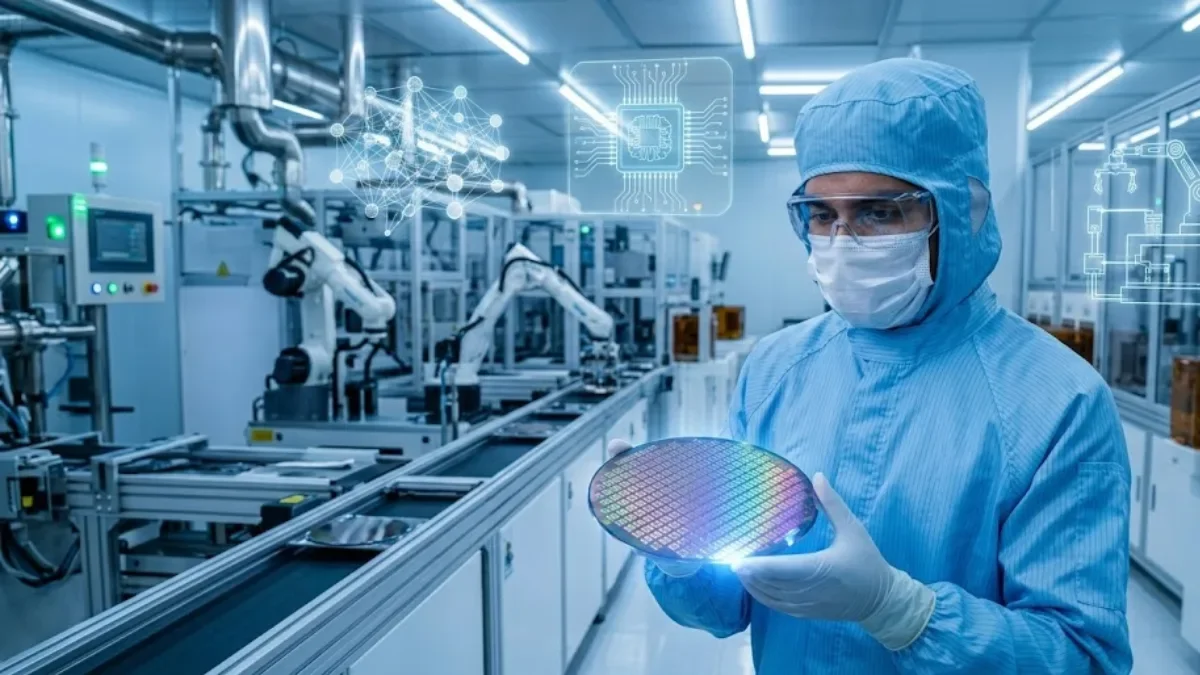
India is orchestrating a structural transformation in its technology landscape, shifting away from standard software services toward high-stakes deep-tech sectors. Anchored by long-term government initiatives—including the newly expanded India Semiconductor Mission (Semicon 2.0), the ₹10,372 crore IndiaAI Mission, and the National Quantum Mission—the country is building an ecosystem designed to secure domestic technological sovereignty.
Rather than relying purely on foreign technology transfers, domestic private enterprises, academic institutions, and startups are building critical IP locally.
India Deep-Tech Funding Growth
2024: $0.53B (H1 Equity Capital)
2025: $2.96B (Full Year Record)
2026: $0.99B+ (H1 Momentum)
Semiconductors, Foundational AI, and Quantum Horizons
The primary catalyst for this acceleration is the semiconductor sector. The Union Cabinet's rollout of Semicon 2.0 focuses on critical upstream capabilities: manufacturing semiconductor equipment, developing raw materials, and funding fabless chip design startups. Early stages under the Design-Linked Incentive (DLI) scheme have already seen Indian startups complete advanced chip tape-outs down to 12nm nodes. Commercial operations are now commencing across new Assembly, Testing, Marking, and Packaging (ATMP) and Outsourced Semiconductor Assembly and Test (OSAT) facilities in Gujarat and Odisha.
Simultaneously, the IndiaAI Mission is addressing hardware bottlenecks by establishing a public-private compute infrastructure exceeding 10,000 GPUs. This compute capacity powers indigenous Large Multimodal Models (LMMs), such as BharatGen, designed to process complex datasets across India's regional languages for priority applications in governance, health, and agriculture. Furthermore, researchers at academic hubs like IIT Madras are pushing the boundaries of quantum sensing and robotics to complement defence and space capabilities.
Why Deep-Tech Sovereignty Matters
Critical digital infrastructure—from electric grids and 5G networks to defence hardware and space observation—relies directly on advanced chips and autonomous systems. Developing indigenous deep-tech capabilities protects national supply chains against global trade disruptions and export restrictions.
For the general public and domestic workforce, this shift generates high-value engineering roles, attracts substantial venture capital, and drives down the end-user cost of local healthcare and agricultural tech solutions. Over the next decade, India's deep-tech evolution will determine whether the nation remains a consumer of foreign innovation or emerges as an exporter of strategic technology.