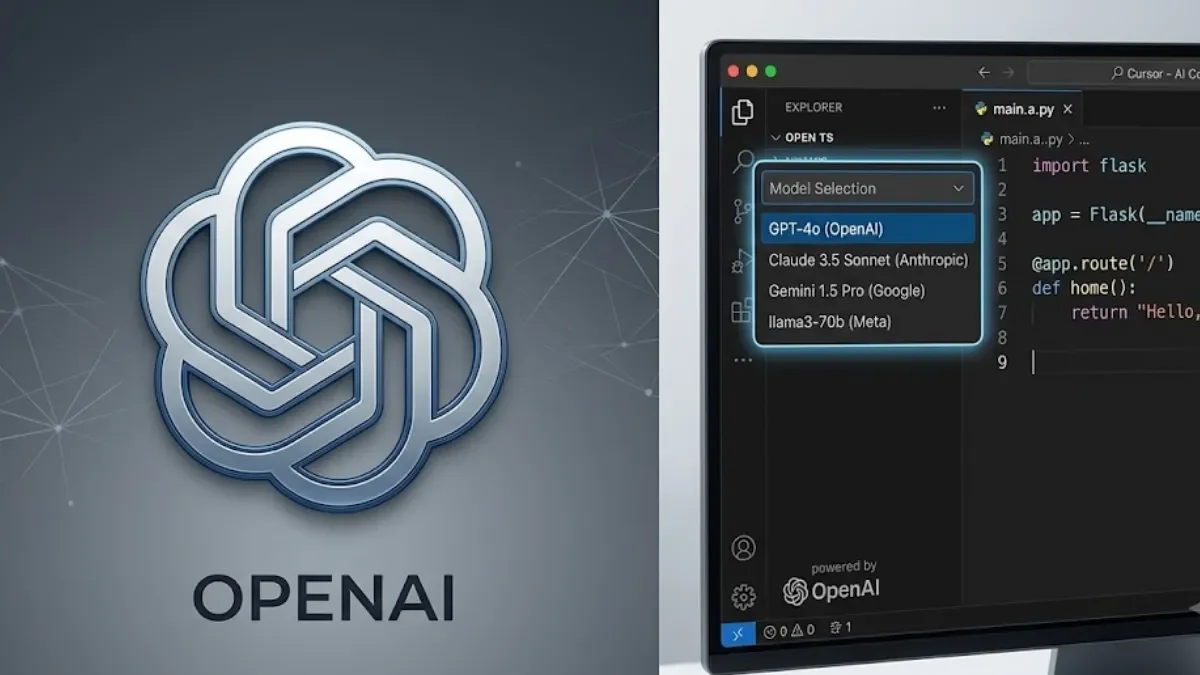
OpenAI announced on August 28 that it intends to wind down its contract providing AI models to Cursor, the popular AI-powered code editor recently acquired by SpaceX. The company proposed a shutoff date of November 12, 2026, giving developers approximately 10 weeks to transition their workflows to alternative models.
The decision marks the latest escalation in the long-running dispute between OpenAI and Elon Musk, but it also raises practical questions for the hundreds of thousands of developers who rely on Cursor for AI-assisted coding. Here's what happened, why it matters, and what you need to know if you're a Cursor user.
What OpenAI Announced
In a blog post published August 28, OpenAI stated it notified SpaceX of its intention to end the contract that allows Cursor to serve OpenAI models to its users. The company said it is providing the maximum notice period allowed under its custom agreement with Cursor following a "change of control" — the contractual term triggered when a company is acquired.
Key points from OpenAI's announcement:
Proposed shutoff date: November 12, 2026
Current models: Will continue working in Cursor until the shutoff date
Future models: OpenAI will not provide any new models (including its upcoming "Astra" model) to Cursor during the wind-down period
Reasoning: OpenAI cited concerns about SpaceX's compliance with its terms of service
"We are making this choice because we cannot be confident that SpaceX will use our technology within our terms of service, based on our experience with Elon Musk's companies violating contracts," OpenAI wrote in its statement.
The company specifically pointed to two incidents:
X (formerly Twitter, now part of SpaceX) breached OpenAI's contract terms after Musk acquired the platform
Musk admitted under oath earlier in 2026 that xAI (also now part of SpaceX) violated OpenAI's terms of service by using OpenAI data to train Grok models
OpenAI added that it has "enormous respect" for Cursor's team and product, and that the decision was "incredibly tough" because the company cares about its models being broadly available to developers.
Why SpaceX's Acquisition Changed Everything
The trigger for OpenAI's decision was SpaceX's $60 billion acquisition of Anysphere, Cursor's parent company. The deal was first announced on June 16, 2026, and completed on August 14 — just two weeks before OpenAI's announcement.
This wasn't a typical startup acquisition. The $60 billion all-stock transaction is the largest acquisition of a venture-backed startup in history, surpassing every previous tech or AI acquisition. SpaceX exercised an option it had negotiated with Anysphere in April 2026, which gave it the right to acquire the company at a predetermined valuation.
For OpenAI, the acquisition created a contractual and strategic problem. Its custom agreement with Cursor included a "change of control" clause — a standard provision in enterprise contracts that allows the provider to reassess the relationship when a customer is acquired by another company, particularly a competitor or a company with conflicting interests.
OpenAI's post explained: "Our custom agreement with Cursor gives us a limited time window to cancel it after a change of control. As AI capabilities advance, we also have a new level of accountability to ensure our upcoming model, Astra, is being used in accordance with our terms."
In practical terms, this means OpenAI had a contractual right to exit the relationship once SpaceX took ownership — and it chose to exercise that right rather than negotiate a new agreement with SpaceX.
What Cursor Says About the Dispute
Cursor's response has been notably more conciliatory than Musk's. Michael Truell, Cursor's co-founder and now a SpaceX executive, posted on X that the company is actively speaking with OpenAI to resolve the issue.
Truell's key points:
OpenAI models account for approximately 5% of Cursor's user traffic
Cursor was "one of the very first users of OpenAI" and has worked closely with the team for years
The company has trusted OpenAI's platform as "neutral infrastructure" for its business
Cursor is "speaking with the OpenAI team to resolve this"
The 5% figure is significant. It suggests that while OpenAI models are important for some Cursor users, the majority of Cursor's traffic already flows through other models — primarily Anthropic's Claude models, but also Google's Gemini and Cursor's own Composer models.
Truell's tone stood in stark contrast to Musk's response, positioning Cursor as a long-standing partner seeking an amicable resolution rather than escalating the conflict.
What Elon Musk Said About OpenAI's Decision
Musk responded to the news early on August 29 with a characteristically blunt post on X, writing: "I couldn't care less."
He went further, calling OpenAI CEO Sam Altman and OpenAI President Greg Brockman "utterly untrustworthy assholes who stole an open source nonprofit" — a reference to his long-standing claim that OpenAI abandoned its original nonprofit mission for commercial gain.
This exchange is the latest chapter in a dispute that dates back to 2018, when Musk left OpenAI's board citing potential conflicts of interest with Tesla's AI work. The feud intensified in 2024 when Musk sued OpenAI, Altman, and Brockman for $150 billion, alleging they had "stolen a charity" by converting OpenAI from a nonprofit research lab into a for-profit company.
In May 2026, a federal jury ruled against Musk, finding that he had filed the lawsuit too late — beyond the three-year statute of limitations. The jury did not rule on whether Altman and Brockman actually breached a charitable trust; it only determined that Musk waited too long to bring the case. Musk has said he plans to appeal the decision.
During the trial, Musk's lawyer stated that Musk and other witnesses had testified that Altman was a liar, while OpenAI argued that Musk had sought control of the company. Musk also admitted under oath that xAI had "partly" distilled OpenAI's models to train Grok — an admission OpenAI cited in its Cursor announcement as evidence of terms of service violations.
What Happens to Cursor Users?
This is the question most developers care about. Here's what actually changes:
What Stays the Same
Cursor itself is not shutting down. The AI code editor will continue operating normally.
Non-OpenAI models continue working. Claude (Anthropic), Gemini (Google), and Cursor's own Composer models remain available.
Current OpenAI models work until November 12. If you're using GPT-5.6 Sol, Luna, or other OpenAI models in Cursor today, they'll keep working for approximately 10 weeks.
What Changes
No new OpenAI models. Any OpenAI model released between now and November 12 will not be available in Cursor.
After November 12, direct access to OpenAI models ends. Cursor will no longer be able to serve OpenAI models to its users unless a new agreement is reached.
Developers using OpenAI models need to plan migration. If your workflows depend heavily on OpenAI models, you'll want to test alternatives (Claude, Gemini, etc.) before the deadline.
What You Should Do
If you're a Cursor user who relies on OpenAI models:
Don't panic. You have roughly 10 weeks to transition.
Test alternative models now. Try Claude Opus 5, Claude Sonnet 5, or Gemini 3.7 Flash in Cursor to see how they perform on your typical tasks.
Review your workflows. Identify which specific tasks depend on OpenAI models and whether alternatives can handle them.
Monitor for updates. Truell's comment about "speaking with OpenAI to resolve this" suggests negotiations may still be ongoing. The November 12 date is "proposed," not necessarily final.
What Anthropic's Response Means for Cursor
Within hours of OpenAI's announcement, Anthropic — the company behind Claude models and a competitor to both OpenAI and SpaceX's xAI — said it would increase compute support for Claude models in Cursor.
Tom Brown, Anthropic's co-founder, stated that Cursor has been "a trusted partner since Sonnet 3.5" and that the company plans to expand capacity to support Cursor users migrating from OpenAI models.
This is significant for several reasons:
Anthropic already powers most of Cursor's traffic. With OpenAI models at ~5%, Claude models likely account for the majority of Cursor's AI usage.
Anthropic is positioning itself as the reliable alternative. While OpenAI exits due to trust concerns about SpaceX, Anthropic is explicitly committing to continue support.
Model diversity is standard for AI coding tools. Cursor, like GitHub Copilot and other AI coding assistants, has always supported multiple model providers to give users choice and reduce dependency on any single provider.
For developers, this means the practical impact of losing OpenAI models may be less severe than it initially appears — especially if you're already using Claude or are willing to test it.
The Bigger Picture: What This Means for AI Coding Tools
The OpenAI-Cursor split highlights a structural tension in the AI coding tool market that's been building for years: what happens when coding platforms become dependent on model providers who are also competitors?
The Multi-Model Standard
Most AI coding tools — Cursor, GitHub Copilot, Windsurf, Codeium, and others — support multiple model providers. This isn't accidental. It's a risk-mitigation strategy that protects both the coding tool and its users from exactly this kind of disruption.
GitHub Copilot, for example, supports OpenAI's GPT models, Anthropic's Claude models, Google's Gemini models, and Microsoft's own MAI models. In August 2026, Microsoft made its MAI-Code-1-Flash model the default for Copilot, reducing reliance on external providers.
Cursor's architecture is similar: it integrates Claude, GPT, Gemini, and its own Composer models, allowing users to switch between them based on task requirements, cost, and performance.
The Acquisition Problem
The SpaceX-Cursor acquisition created a scenario that model providers like OpenAI find untenable: SpaceX now owns both a major AI coding platform (Cursor) and a competing AI model developer (xAI, creator of Grok).
From OpenAI's perspective, continuing to provide models to a competitor-owned platform creates several risks:
SpaceX could use OpenAI's models to train or improve xAI's competing models (the "distillation" concern Musk admitted under oath)
SpaceX could prioritize xAI's Grok models in Cursor, marginalizing OpenAI's models
SpaceX could gain competitive intelligence from how OpenAI's models are used in production coding environments
These aren't hypothetical concerns. OpenAI cited specific instances where Musk's companies violated its terms of service, including X's contract breach and xAI's admission of distilling OpenAI data.
What This Means for the Industry
The OpenAI-Cursor split is likely to accelerate several trends:
More vertical integration. AI coding tool developers may invest more heavily in their own models (as Cursor has with Composer, and Microsoft has with MAI) to reduce dependency on external providers.
More explicit contractual protections. Model providers will likely strengthen change-of-control clauses and usage restrictions in future contracts with coding platforms.
More model diversity as a selling point. Coding tools that support multiple providers will emphasize this as a risk-mitigation feature for enterprise customers.
Potential consolidation. If model providers become unwilling to work with coding platforms owned by competitors, we may see further M&A activity as companies seek to control both the model and the application layer.
For developers, the lesson is clear: diversify your model usage. Don't build workflows that depend entirely on one provider's models. Test multiple models, understand their strengths and weaknesses, and design your workflows to be portable across providers.
What Happens Next?
Several scenarios are possible:
Scenario 1: Negotiated Resolution (Most Likely)
Truell's comment about "speaking with OpenAI to resolve this" suggests negotiations are ongoing. Possible outcomes:
OpenAI agrees to continue providing models under stricter terms (e.g., enhanced monitoring, usage restrictions)
SpaceX agrees to contractual safeguards addressing OpenAI's concerns
The November 12 date is extended or made contingent on specific conditions
Scenario 2: Clean Break (Also Plausible)
If negotiations fail:
OpenAI models stop working in Cursor on November 12 (or shortly thereafter)
Cursor users migrate to Claude, Gemini, or other models
Cursor emphasizes its multi-model architecture as a feature, not a limitation
Scenario 3: Escalation (Less Likely)
If the dispute becomes more public and acrimonious:
OpenAI could take stronger public positions on SpaceX's trustworthiness
SpaceX/xAI could retaliate in ways that affect the broader AI ecosystem
Other model providers could face pressure to choose sides
Most likely outcome: A negotiated resolution or a clean break with minimal disruption to Cursor users, given that OpenAI models represent only ~5% of Cursor's traffic and Anthropic has committed to expanding support.
Key Facts at a Glance
| Fact | Detail |
|---|---|
| Announcement date | August 28, 2026 |
| Proposed shutoff date | November 12, 2026 |
| OpenAI's stated reason | Cannot be confident SpaceX will comply with terms of service |
| SpaceX acquisition value | $60 billion (all-stock) |
| Acquisition completion | August 14, 2026 |
| OpenAI models' share of Cursor traffic | ~5% (per Michael Truell) |
| Cursor's status | Continuing operations; not shutting down |
| Alternative models | Claude (Anthropic), Gemini (Google), Composer (Cursor) |
| Anthropic's response | Will increase compute support for Claude in Cursor |
| Musk's response | "I couldn't care less" on X |
Frequently Asked Questions
Is OpenAI shutting down Cursor?
No. OpenAI is ending its contract to provide AI models to Cursor. Cursor itself is not shutting down and will continue operating with other models like Claude and Gemini.
When will OpenAI models stop working in Cursor?
OpenAI has proposed November 12, 2026 as the shutoff date. Current OpenAI models will continue working until then, but no new OpenAI models will be added to Cursor.
Why is OpenAI ending its Cursor agreement?
OpenAI says it "cannot be confident that SpaceX will use our technology within our terms of service," citing past contract violations by X (Twitter) and xAI, both now part of SpaceX.
What did SpaceX's acquisition have to do with this?
OpenAI's contract with Cursor included a "change of control" clause that allowed it to cancel the agreement after Cursor was acquired by SpaceX. OpenAI chose to exercise this right rather than negotiate a new contract with SpaceX.
Can Cursor still use Claude or other models?
Yes. Cursor supports multiple AI models including Anthropic's Claude, Google's Gemini, and its own Composer models. Anthropic has announced it will increase compute support for Claude in Cursor.
What percentage of Cursor users rely on OpenAI models?
According to Cursor co-founder Michael Truell, OpenAI models account for approximately 5% of Cursor's user traffic.
What should Cursor users do if they rely on OpenAI models?
Test alternative models (Claude, Gemini, etc.) now to ensure your workflows can transition smoothly. You have roughly 10 weeks before the proposed November 12 shutoff date.
Is the November 12 date final?
OpenAI describes it as a "proposed" shutoff date. Cursor's Michael Truell said the company is "speaking with the OpenAI team to resolve this," suggesting negotiations may still be ongoing.
What did Elon Musk say about OpenAI's decision?
Musk posted on X: "I couldn't care less," and called Altman and Brockman "untrustworthy assholes who stole an open source nonprofit."
What is the OpenAI-Musk lawsuit about?
Musk sued OpenAI for $150 billion in 2024, alleging it abandoned its original nonprofit mission. In May 2026, a federal jury ruled against Musk, finding he filed the lawsuit too late (beyond the statute of limitations). Musk has said he plans to appeal.
Will Cursor build its own models to replace OpenAI?
Cursor already has its own Composer models. The company's multi-model architecture means it can continue operating with Claude, Gemini, and its own models even without OpenAI.
What does this mean for GitHub Copilot or other AI coding tools?
The situation highlights the importance of model diversity. GitHub Copilot already supports multiple providers (OpenAI, Anthropic, Google, Microsoft). Developers should avoid building workflows that depend entirely on one model provider.