Quick Summary
What Happened: US real estate technology giant Opendoor completely wound down its India-based operations, laying off nearly 250 employees.
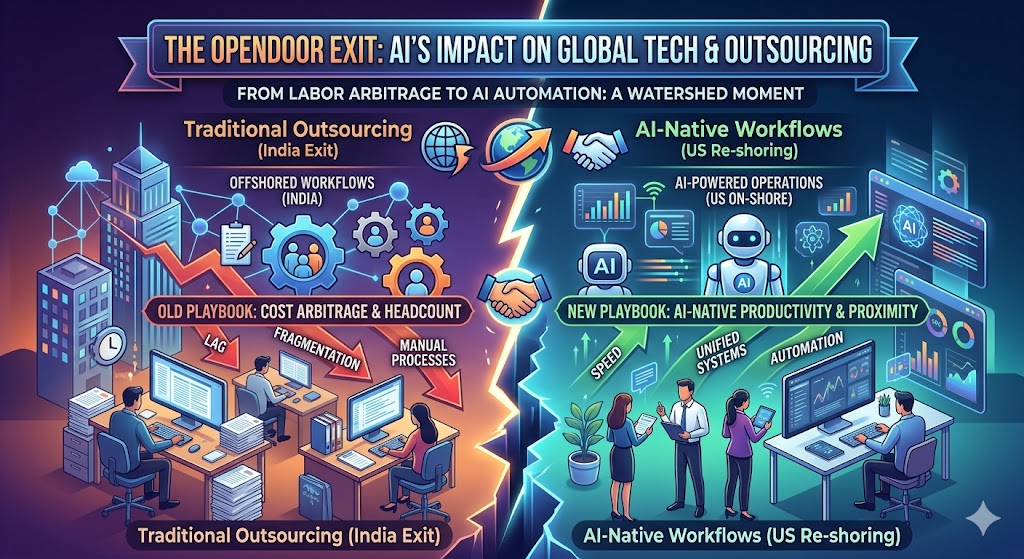
The Reason: Opendoor transitioned to "Opendoor 2.0," unifying fragmented data systems and replacing manual backend workflows with automated, AI-native systems deployed on-shore in the United States.
The Big Picture: Industry experts view this as a watershed moment in AI Operations (AIOps), proving that frontier AI models are starting to destroy the traditional labor cost-arbitrage model that fueled offshore tech hubs for decades.
1. Why Did Opendoor Exit India?
In an internal memo delivered by Opendoor executive Kaz Nejatian, the digital real estate platform finalized the closure of its entire Indian division, moving the remaining responsibilities back to the United States.
Historically, Opendoor relied on a team of approximately 250 professionals in India to manage fractured, manual workflows across multiple isolated legacy systems. However, the launch of Opendoor 2.0 completely overhauled this blueprint. By unifying their backend architecture onto a single platform, the company eliminated the friction points that originally required offshore human labor.
"Our customers are in America, and the operational work we do for them is best done close to them. Opendoor 2.0 will become a much smaller company by headcount, but a much larger company by impact." > — Kaz Nejatian, Opendoor Executive
Instead of relying on a massive offshore footprint, Opendoor is shifting its structural bet onto smaller, highly productive, AI-native customer-facing teams based domestically.
2. Shift from Labor Arbitrage to AI Automation
For over thirty years, the global tech industry operated on a simple economic formula: Labor Cost Arbitrage. Silicon Valley companies offshored routine information processing, data entry, and manual QA workflows to tech hubs like India to save money.
AI has flipped this script. When an enterprise replaces fragmented software solutions with a unified AI ecosystem, two things happen:
The Cost Per Task Drops Exponentially: Relying on API calls to frontier AI models is cheaper than maintaining physical operations, even in low-cost labor markets.
Context and Proximity Matter More Than Headcount: Because AI agents handle the tedious data-crunching, the remaining human workforce needs deep cultural and geographical proximity to the actual consumer.
The Structural Shift: Old Playbook vs. New AI Playbook
| Vector | Traditional Outsourcing Playbook | The New AI-Native Playbook |
| Workforce Strategy | Heavy headcount, operationally intensive | Nimble, hyper-productive, smaller teams |
| Geographic Focus | Offshore (Cost-efficient hubs) | On-shore (Proximate to the customer) |
| System Design | Disparate point solutions with manual workarounds | Unified core platforms with baked-in AI routing |
| Competitive Edge | Low cost-per-hour human labor | Instant, automated data synthesis |
3. Is This a Watershed Moment for the Global IT Sector?
While a single corporate restructuring does not collapse an entire sector overnight, prominent venture capitalists and tech analysts are pointing to Opendoor as an early indicator of a massive macro trend.
Tech analysts note that earlier waves of AI layoffs resulted in partial organizational downsizing. What makes Opendoor’s move unique is the total dissolution of an entire international wing in favor of a lean, AI-augmented domestic core.
When frontier AI models can process natural language documents, extract structured real estate data, track a home's buying-to-selling journey, and draft legal filings instantly, the traditional rationale for offshoring disappears. The routine, repetitive informational tasks that were once the easiest to send overseas are now the exact tasks most effectively managed by autonomous AI agents.
Frequently Asked Questions
What is an AI-native team?
An AI-native team is a small corporate unit that utilizes artificial intelligence tools at the core of its operational workflows. Instead of manually moving data between platforms, team members use AI to automate routine tasks, allowing fewer people to manage significantly larger workloads.
How is AI impacting tech jobs in India?
AI is shifting the demand away from mass hiring for routine backend management and basic data analysis. Top tier firms are moving away from brute-force scale. Growth is shifting toward complex AI system integration, custom localized model development, and high-value software engineering.
Will re-shoring become a wider tech trend?
Yes. As individual employee productivity escalates through AI copilots and agents, companies can afford to bring operations closer to their core customer base (re-shoring). This eliminates cross-timezone communication barriers and cultural gaps without incurring the massive labor costs historically associated with onshore teams.