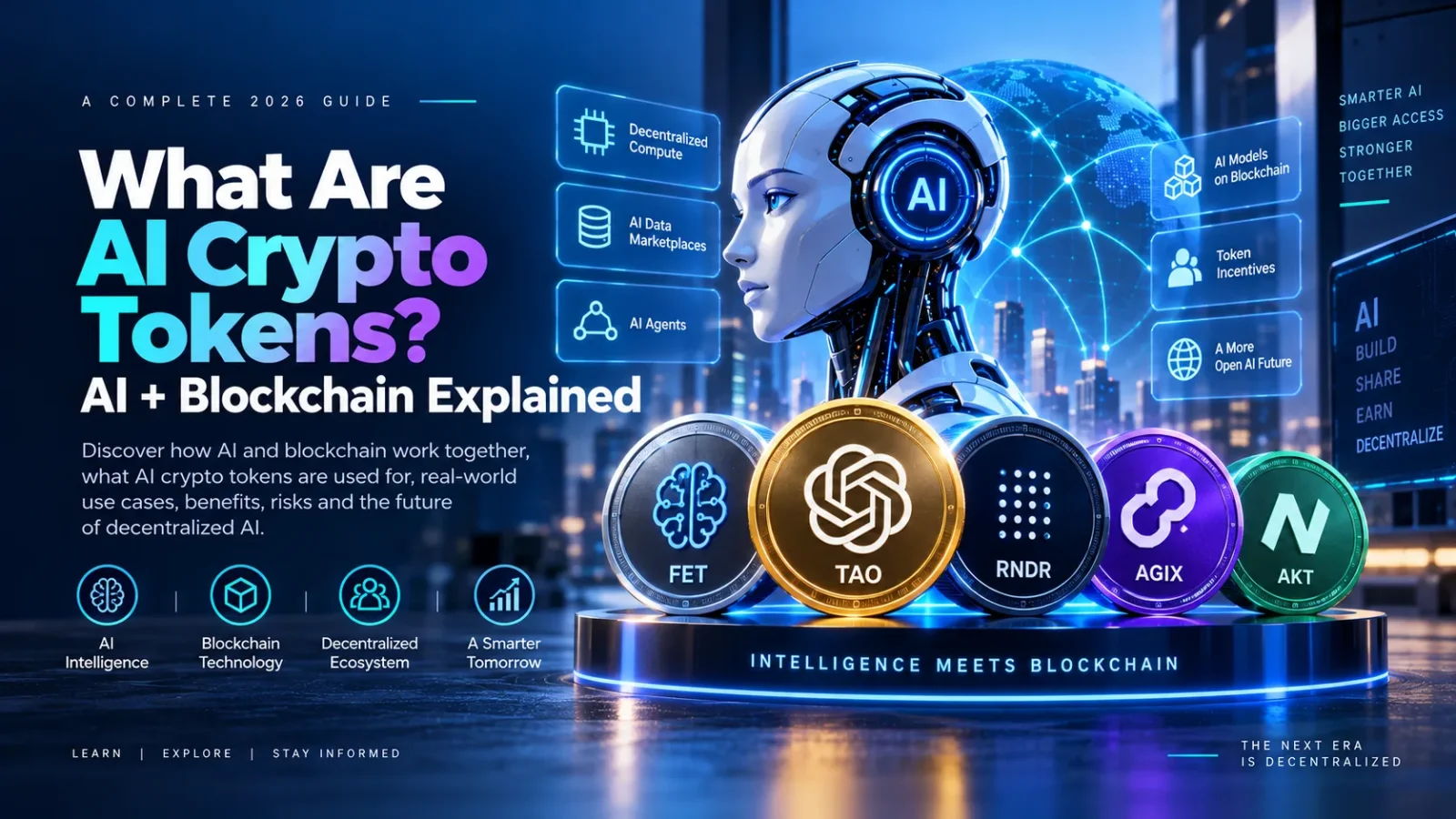
Artificial intelligence and blockchain are two major technologies shaping today's digital economy. Increasingly, projects are combining them to create decentralized AI networks, computing marketplaces, data platforms and autonomous AI agents.
This has also created a growing category of digital assets commonly called AI crypto tokens.
But what exactly makes a cryptocurrency an “AI token”?
AI crypto tokens are blockchain-based digital tokens associated with projects that use artificial intelligence, provide infrastructure for AI, enable access to AI-related services, coordinate decentralized computing or data, or support AI agents and applications.
The important point is that an AI crypto token is not artificial intelligence itself.
The token typically serves an economic or governance function within a blockchain ecosystem, while AI provides services such as machine learning, inference, autonomous decision-making, data processing or intelligent automation.
This guide explains what AI crypto tokens are, how AI and blockchain work together, common AI-token use cases, decentralized AI, AI agents, benefits, limitations and risks.
What Is an AI Crypto Token?
An AI crypto token is a digital asset used within a blockchain ecosystem that incorporates artificial intelligence or provides infrastructure, data, computing resources or services related to AI.
Depending on the project, the token might be used to:
Pay for AI services
Purchase computing power
Access datasets
Reward network participants
Pay AI agents
Participate in governance
Compensate model developers
Purchase AI inference
Coordinate decentralized resources
There is no single technical standard that makes something an “AI token.”
Instead, the term describes a broad category of crypto projects operating at the intersection of AI and blockchain technology.
AI Crypto Tokens in Simple Words
Imagine an online marketplace where people around the world can provide:
GPUs + AI models + data + storage + computing power
Other users need those resources to build or operate AI applications.
Blockchain can provide the payment and coordination layer connecting them.
An AI crypto token could then be used to pay participants providing those resources.
In simplified form:
AI resource → Decentralized network → User requests service → Token payment → Provider rewarded
The actual architecture varies considerably between projects.
How Do AI Crypto Tokens Work?
AI crypto tokens generally combine two technological layers:
Artificial Intelligence
AI performs tasks such as:
Machine learning
Language processing
Image generation
Prediction
Data analysis
Automation
AI inference
Autonomous decision-making
Blockchain
Blockchain can provide:
Digital payments
Ownership records
Token incentives
Smart contracts
Governance
Transparent transaction records
Decentralized coordination
Together, these technologies can create systems where AI services and resources are exchanged through blockchain networks.
A simplified architecture looks like:
User → Blockchain application → AI service/model → Result → Token payment
However, not every part of the AI computation necessarily occurs directly on a blockchain.
AI workloads can require substantial computing resources, so many systems perform the computationally intensive work off-chain while using blockchain for payments, verification, ownership or coordination.
Why Combine AI With Blockchain?
AI and blockchain solve different problems.
AI focuses primarily on:
Intelligence and automation
Blockchain focuses primarily on:
Coordination, ownership and value transfer
Combining them can enable applications where independent participants contribute resources to an AI ecosystem without relying entirely on one centralized provider.
For example, a decentralized AI network might involve:
GPU owners → provide computing power
Developers → provide AI models
Data providers → provide datasets
Users → purchase AI services
Blockchain → coordinates payments and incentives
This creates a marketplace rather than requiring one organization to own every part of the infrastructure.
What Are AI Crypto Tokens Used For?
The term covers several different use cases.
1. Decentralized AI Computing
Training and operating modern AI models requires significant computing power.
High-performance GPUs are particularly important.
Blockchain-based computing marketplaces can allow individuals or organizations with unused computing resources to offer them to developers.
A simplified process could be:
GPU provider → Decentralized compute network → AI developer
The network's token may be used for payments, rewards or coordination.
This approach aims to create an alternative marketplace for computing resources.
2. AI Model Marketplaces
AI models themselves can potentially be offered through decentralized marketplaces.
Developers may publish models that perform tasks such as:
Text generation
Image recognition
Financial analysis
Translation
Prediction
Data classification
Users can request services from those models and potentially pay using blockchain-based tokens.
This creates a possible marketplace:
AI developer → AI model → Marketplace → User → Token payment
The developer can then receive compensation when the model is used.
3. Decentralized Data Marketplaces
AI systems require data.
Blockchain technology can potentially help create marketplaces where participants contribute datasets while ownership, access and payments are tracked digitally.
A simplified model could be:
Data provider → Data marketplace → AI developer
The associated token could facilitate payment or incentives.
Data quality, consent, privacy and intellectual-property rights remain major considerations.
4. AI Agents
One of the most discussed intersections between AI and crypto involves AI agents.
An AI agent is software designed to perform tasks with some degree of autonomy.
Depending on its capabilities, an agent might:
Search for information
Analyze data
Use software tools
Make API requests
Execute predefined workflows
Interact with other agents
Initiate blockchain transactions
Blockchain potentially gives AI agents access to a digital economic system.
For example:
AI agent → Needs computing service → Pays service → Receives result → Continues task
This could allow software agents to purchase services or exchange value without requiring a traditional payment process for every individual transaction.
5. Machine-to-Machine Payments
Traditional financial infrastructure was primarily designed for humans and organizations.
AI agents introduce the possibility of software independently requesting and paying for digital resources.
Imagine an AI agent that needs:
Data → $0.05
Compute → $0.20
API access → $0.02
Storage → $0.01
Blockchain-based payments can potentially support these small digital transactions.
This is sometimes described as the emerging machine economy or agent economy.
6. AI Network Governance
Some AI blockchain projects use tokens for governance.
Token holders may be able to participate in decisions involving:
Network upgrades
Incentive structures
Treasury allocation
Protocol parameters
Resource allocation
This does not necessarily mean every token holder has equal influence.
Governance structures differ substantially between projects.
7. Rewarding AI Contributors
Decentralized AI networks may involve many contributors.
For example:
Model developers
GPU providers
Data providers
Validators
Researchers
Users
Tokens can potentially provide an incentive mechanism for rewarding participants whose resources contribute value to the network.
What Is Decentralized AI?
Decentralized AI refers broadly to AI systems in which infrastructure, data, models, governance or economic incentives are distributed across multiple participants rather than controlled entirely by a single centralized organization.
Traditional AI services often work like:
User → One company → Company's servers → Company's AI model
A decentralized architecture might instead involve:
User → Open network → Multiple compute/model providers → AI service
Blockchain is one technology that can help coordinate these participants.
However, “decentralized AI” is a broad term.
A project may decentralize payments while keeping its AI models centralized, or decentralize computing while relying on centralized data sources.
Users should therefore examine what part of a system is actually decentralized.
AI Crypto vs Traditional AI
| AI Crypto / Decentralized AI | Traditional Centralized AI |
|---|---|
| May use blockchain | Usually does not require blockchain |
| Token incentives may coordinate participants | Company typically controls payments/resources |
| Resources may come from multiple providers | Infrastructure generally managed centrally |
| Governance may be distributed | Company controls major decisions |
| Crypto wallets may provide identity/payment | Traditional accounts/payment methods |
| Services may interact with smart contracts | Services generally use conventional APIs |
Neither model is automatically superior.
Centralized AI can provide simplicity, performance and integrated infrastructure.
Decentralized approaches may provide alternative ownership, coordination and economic models.
AI Tokens vs Regular Cryptocurrencies
AI tokens and cryptocurrencies such as Bitcoin can both exist on blockchain networks, but they can have very different purposes.
| AI Token | Bitcoin |
|---|---|
| Associated with AI-related ecosystem | Native asset of Bitcoin network |
| May pay for AI services | Primarily blockchain-native monetary asset |
| May reward compute/data/model providers | Rewards Bitcoin miners |
| May support AI applications | Does not provide AI services |
| Utility depends on specific project | Utility relates to Bitcoin network |
| Token design varies | Fixed protocol-defined monetary rules |
Calling a token an “AI token” does not make it fundamentally safer, more valuable or technologically advanced than another cryptocurrency.
Its value and utility depend on the underlying project.
AI Tokens vs AI Stocks
AI crypto tokens should also not be confused with shares of AI companies.
Buying shares in an AI company generally represents an ownership interest in that corporation.
Buying an AI crypto token usually does not mean owning the company or project behind it.
| AI Crypto Token | AI Stock |
|---|---|
| Blockchain-based asset | Corporate security |
| May provide ecosystem utility | Represents company ownership |
| May provide governance rights | May provide shareholder voting rights |
| Usually doesn't represent company equity | Represents equity |
| Crypto-market risk | Equity-market/company risk |
This distinction is important when evaluating any AI-related digital asset.
Examples of AI Crypto Projects
Several blockchain projects are commonly associated with AI or decentralized computing.
Examples include ecosystems focused on:
Decentralized Computing
These projects create marketplaces where participants can provide computing resources that may be used for AI and other workloads.
Decentralized Machine Intelligence
Some networks incentivize participants to contribute machine-learning models or intelligence.
AI Agent Networks
These ecosystems explore autonomous software agents that can communicate, coordinate or transact.
AI/Data Marketplaces
Other projects focus on making datasets or AI-related resources available through decentralized infrastructure.
The category changes quickly, and the label “AI crypto” should not itself be interpreted as an endorsement of a particular token or project.
What Are AI Agent Tokens?
AI agent tokens are generally crypto assets associated with ecosystems built around autonomous or semi-autonomous AI agents.
An agent might have access to:
AI model
Wallet
Tools/APIs
Blockchain
This combination could allow an agent to perform digital tasks and potentially make payments.
For example:
Goal assigned
↓
Agent analyzes task
↓
Agent purchases required data
↓
Agent uses computing resources
↓
Agent performs task
↓
Agent returns result
The blockchain can serve as the economic and transaction layer underneath the agent.
Can AI Agents Own Crypto Wallets?
Technically, software can control blockchain addresses and initiate transactions when provided with appropriate cryptographic permissions.
This makes it possible to design AI-driven systems capable of interacting with wallets.
However, this creates significant security questions.
An autonomous agent with unrestricted wallet access could potentially make unintended transactions.
Secure systems therefore need mechanisms such as:
Spending limits
Permission controls
Transaction policies
Human approval
Smart-contract restrictions
Key-management systems
Giving AI access to financial assets introduces risks beyond those of an ordinary chatbot.
Can AI Run Directly on a Blockchain?
Some AI-related processes can interact directly with smart contracts, but running large AI models entirely on-chain is often impractical.
Modern AI models can require enormous amounts of computation.
Blockchains are generally optimized for distributed verification and consensus, not massive machine-learning workloads.
A more practical architecture can be:
Blockchain → Coordination / payments / ownership
Off-chain infrastructure → AI computation
Blockchain → Verification / settlement
This division allows each technology to perform tasks for which it is better suited.
What Are DePIN and AI?
AI crypto also overlaps with DePIN, or Decentralized Physical Infrastructure Networks.
DePIN projects use blockchain incentives to coordinate physical infrastructure contributed by participants.
Examples can include:
GPUs
Storage
Wireless networks
Sensors
Computing servers
AI requires enormous computing infrastructure.
This creates a potential connection:
DePIN provides infrastructure → AI consumes infrastructure
A decentralized GPU marketplace, for example, could potentially provide computing resources to AI developers.
How Can Blockchain Help AI?
Blockchain may provide several capabilities to AI ecosystems.
Digital Payments
AI services and agents can potentially exchange value using blockchain-based assets.
Ownership
Blockchain can record ownership of certain digital assets, models or access rights.
Incentives
Tokens can reward people contributing computing resources, models or data.
Transparency
Public blockchains can create auditable transaction records.
Smart Contracts
Automated agreements can coordinate payments and resource access.
Provenance
Blockchain can potentially help establish records concerning the origin or ownership history of certain digital content and data.
However, blockchain does not automatically guarantee that AI-generated information is accurate.
How Can AI Help Blockchain?
The relationship works in the opposite direction as well.
AI can potentially improve blockchain-related applications through:
Fraud detection
Smart-contract analysis
Transaction monitoring
Blockchain analytics
Security analysis
User interfaces
Automated trading tools
Wallet assistance
Network optimization
AI can make complex blockchain information easier to analyze.
But AI systems can also make mistakes, so important financial or security decisions should not depend blindly on automated outputs.
What Are the Benefits of AI Crypto Tokens?
Potential benefits include:
Decentralized Access to AI Resources
Developers may gain access to computing, models or datasets from multiple independent providers.
Incentives for Contributors
Tokens can provide economic incentives for participants contributing resources.
Global Payments
Blockchain infrastructure can enable digital payments between participants across different locations.
Programmable Transactions
Smart contracts can automate payments and access to services.
AI Agent Commerce
Autonomous agents may potentially buy and sell digital services.
Alternative AI Infrastructure
Decentralized marketplaces can provide alternatives to relying exclusively on large centralized cloud providers.
These are potential advantages, not guaranteed outcomes.
What Are the Risks of AI Crypto Tokens?
The AI crypto category also carries substantial risks.
1. Market Volatility
AI tokens are crypto assets and can experience extreme price fluctuations.
A token's price can rise or fall independently of the usefulness of its underlying technology.
2. AI Hype
Artificial intelligence attracts enormous attention.
Projects may use terms such as:
AI-powered
Machine learning
Autonomous AI
AI agent
without AI being central to their actual product.
Users should investigate what role AI genuinely plays.
3. Token Utility Risk
A project may have useful technology but a token that is not essential to that technology.
Ask:
Why does this network need a token?
If the product could function almost identically without one, the token's long-term utility may be questionable.
4. Smart Contract Risk
Vulnerabilities in blockchain applications can lead to lost or stolen assets.
5. AI Model Risk
AI systems can generate incorrect, biased or unreliable outputs.
Blockchain cannot automatically fix these problems.
6. Data Privacy
AI systems require data.
Combining sensitive information with transparent blockchain infrastructure requires careful privacy design because blockchain records can be difficult to modify or erase.
7. Security Risks From AI Agents
Giving autonomous software permission to execute transactions creates new security challenges.
A compromised or poorly designed AI agent could potentially misuse funds.
8. Regulatory Uncertainty
Both artificial intelligence and cryptocurrency are evolving regulatory areas.
Projects combining the two may need to navigate rules concerning:
Digital assets
Securities
Data privacy
AI governance
Consumer protection
Anti-money laundering
Requirements vary by jurisdiction.
How to Evaluate an AI Crypto Project
Instead of focusing solely on token price, examine the underlying system.
Ask:
Does the project actually use AI?
Look beyond marketing terminology.
What problem does it solve?
A legitimate project should have a clear use case.
Why does it need blockchain?
Blockchain should provide a meaningful advantage rather than being included only to create a token.
Why does it need a token?
Understand exactly what the token does.
Who uses the product?
Actual adoption can be more informative than social-media attention.
Where does AI computation happen?
Determine whether AI runs on-chain, off-chain or through third-party infrastructure.
How decentralized is it?
“Decentralized” can mean different things.
Is the code secure?
Smart-contract security and audits can be important.
How are tokens distributed?
Token concentration among insiders can affect governance and market behavior.
Are AI Crypto Tokens a Good Investment?
There is no universal answer.
AI crypto tokens are highly speculative digital assets whose risks vary substantially between projects.
The combination of two popular technologies—AI and blockchain—does not guarantee commercial success or token value.
Investors should distinguish between:
Interesting technology
and
A good investment
They are not necessarily the same thing.
A network could have innovative technology while its token performs poorly.
Conversely, a token can temporarily increase in price despite having limited practical utility.
Are AI Crypto Tokens Safe?
AI crypto tokens should not be considered inherently safe.
Their risks can include:
Crypto volatility
Smart-contract vulnerabilities
AI model failures
Token economics
Regulatory uncertainty
Project execution risk
Cybersecurity threats
Users should understand both the AI system and the blockchain/token structure before interacting with a project.
AI Crypto and the Future of Autonomous Payments
One of the most interesting long-term applications involves giving AI systems the ability to participate in digital commerce.
Today's AI can already:
Understand instructions → Search information → Generate content → Use software tools
Blockchain potentially adds:
Own/use wallet → Make payment → Receive payment → Execute smart contract
Together, these capabilities could produce software systems capable of carrying out more complex economic activities.
For example, an autonomous AI service might:
Receive a task.
Determine what resources it needs.
Purchase computing power.
Purchase access to specialized data.
Complete the analysis.
Pay service providers.
Return the result.
This concept remains an evolving area, but it illustrates why AI agents and blockchain payments are increasingly discussed together.
Will AI Crypto Replace Traditional AI?
Probably not.
Centralized AI infrastructure provides major advantages, including enormous computing capacity, integrated services and established enterprise platforms.
Decentralized AI networks may instead complement traditional AI.
A future AI ecosystem could contain:
Centralized cloud AI
Open-source models
Decentralized computing
Blockchain-based payments
Autonomous AI agents
Rather than one technology replacing another, different architectures may coexist.
Why AI + Blockchain Matters
The most important idea behind AI crypto is not necessarily the creation of more cryptocurrencies.
It is the possibility of building an economic layer for AI systems.
AI provides intelligence.
Blockchain can provide ownership, incentives and payments.
Smart contracts provide automation.
Together:
AI + Blockchain + Smart Contracts = Programmable intelligent digital economies
Whether this becomes widely adopted will depend on cost, scalability, security, regulation and whether decentralized systems provide meaningful advantages over conventional infrastructure.
Frequently Asked Questions About AI Crypto Tokens
What are AI crypto tokens?
AI crypto tokens are blockchain-based digital assets associated with projects that use artificial intelligence or provide AI-related computing, data, models, agents or infrastructure.
How do AI tokens work?
Their function varies. Some pay for AI services, while others reward computing providers, provide access to datasets, coordinate AI agents or enable governance.
Is Bitcoin an AI token?
No. Bitcoin is a decentralized blockchain-native digital asset, but artificial intelligence is not its primary function.
Is Ethereum an AI token?
No. Ether is the native asset of Ethereum. However, AI-related applications and tokens can be built on the Ethereum network.
What is decentralized AI?
Decentralized AI distributes some combination of AI models, computing, data, governance or incentives across multiple network participants instead of relying entirely on one centralized organization.
What is an AI agent in crypto?
An AI agent is software capable of performing tasks with some autonomy. When connected to blockchain infrastructure, agents may potentially interact with smart contracts, wallets and digital payments.
Can AI agents use cryptocurrency?
Software can be designed to control blockchain addresses and initiate transactions under predefined permissions. Secure implementation requires careful key management and transaction controls.
Are AI tokens the same as AI stocks?
No. An AI stock generally represents equity ownership in a company. An AI crypto token usually provides a function within a blockchain ecosystem and normally does not represent ownership of the company behind it.
Can AI run on blockchain?
Some AI-related logic can run on-chain, but large AI models usually require significantly more computing power than blockchains can efficiently provide. Many systems therefore combine off-chain AI computation with on-chain coordination and payments.
What is the connection between DePIN and AI?
DePIN networks can coordinate decentralized physical infrastructure such as GPUs and storage. These resources can potentially be used to support AI workloads.
Why does AI need blockchain?
AI does not inherently need blockchain. Blockchain can be useful when an AI ecosystem benefits from decentralized payments, ownership, incentives, shared records or coordination between independent participants.
Does blockchain make AI trustworthy?
Not automatically. Blockchain can provide verifiable transaction or ownership records, but it cannot guarantee that an AI model's output is accurate.
Are AI crypto tokens risky?
Yes. Risks include crypto volatility, project failure, smart-contract vulnerabilities, misleading AI claims, regulatory uncertainty and security problems.
Will AI crypto grow in the future?
AI and blockchain integration is an active area of experimentation, particularly around decentralized computing, AI agents, data marketplaces and machine-to-machine payments. However, which technologies and projects achieve widespread adoption remains uncertain.
Final Thoughts
AI crypto tokens sit at the intersection of artificial intelligence, blockchain and digital economics.
Their purpose extends beyond simply attaching the word “AI” to a cryptocurrency.
Well-designed AI blockchain ecosystems may use tokens to coordinate real economic resources:
Computing power
AI models
Data
Storage
AI agents
Digital services
Blockchain can provide the payment, ownership and incentive infrastructure connecting these resources, while artificial intelligence provides the intelligence and automation.
One particularly important emerging idea is the AI agent economy, in which autonomous software can potentially request services, pay for resources and interact with other digital systems.
However, AI crypto also attracts considerable speculation.
Not every project marketed as “AI-powered” meaningfully uses artificial intelligence, and not every AI product needs blockchain or a crypto token.
Understanding AI crypto therefore requires asking three separate questions:
What does the AI actually do?
Why is blockchain necessary?
What genuine purpose does the token serve?
Projects that can answer all three clearly have a stronger technological foundation than those relying primarily on AI-related marketing.
As AI systems become increasingly autonomous and blockchain infrastructure becomes more programmable, the intersection between the two technologies may become an important part of the digital economy.
But the future of AI crypto will ultimately depend on real utility, security, adoption and sustainable economics—not simply the popularity of AI or cryptocurrency.
Disclaimer: This article is for educational and informational purposes only. It does not constitute financial, investment, tax or legal advice. Crypto assets can be highly volatile and involve substantial risk.