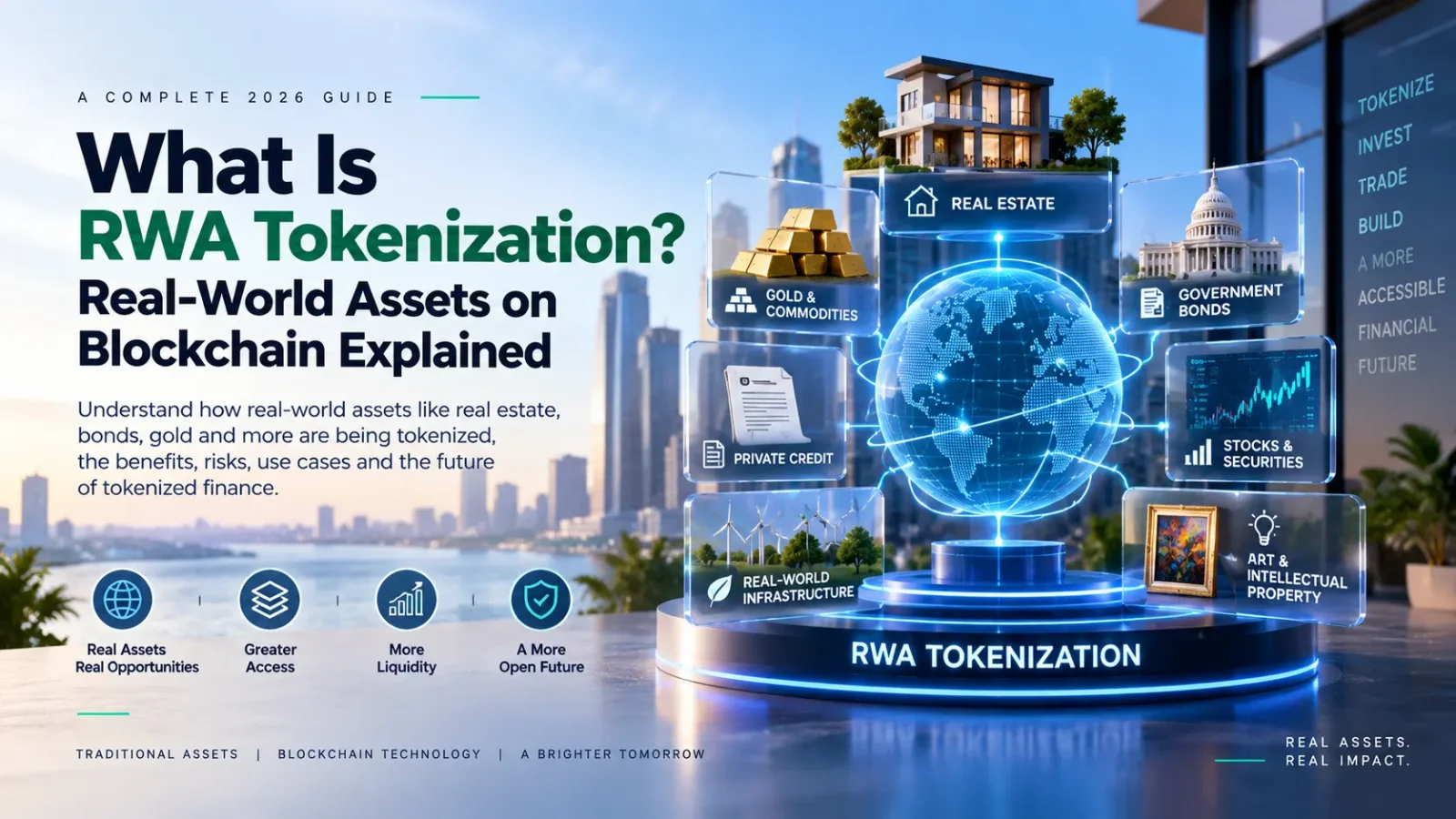
Real estate, government bonds, gold, private credit and other traditional assets have historically existed outside blockchain networks. Real-world asset (RWA) tokenization aims to connect these assets with blockchain-based financial infrastructure.
In simple terms, RWA tokenization is the process of representing ownership, economic interests or other rights associated with a real-world asset as digital tokens on a blockchain or similar programmable ledger.
A commercial property, for example, could potentially be represented by digital tokens. Depending on the legal structure, each token might represent a defined economic or ownership interest connected to that property.
The concept is increasingly relevant in 2026 as financial institutions explore tokenized securities, funds, deposits and other assets.
But tokenization does not magically turn a physical building, gold bar or bond into cryptocurrency.
The blockchain token generally represents rights or claims associated with the underlying asset, and those rights ultimately depend on legal agreements, custody arrangements, regulation and the structure of the token.
This guide explains what RWA tokenization is, how it works, which assets can be tokenized, its potential benefits and risks, and why tokenization is becoming an important topic in global finance.
What Does RWA Mean in Crypto?
RWA stands for Real-World Asset.
In blockchain and crypto terminology, an RWA generally refers to an asset or financial claim originating outside the blockchain ecosystem that is represented or managed using blockchain technology.
Real-world assets can include:
Real estate
Government bonds
Treasury bills
Corporate bonds
Private credit
Stocks and other securities
Gold and precious metals
Commodities
Investment funds
Intellectual property
Invoices and receivables
Collectibles
Some RWAs are physical assets, such as property or gold.
Others are financial or intangible assets, such as bonds, shares, credit agreements or intellectual-property rights.
The common idea is that blockchain tokens can be used to represent certain rights associated with these assets.
What Is RWA Tokenization?
RWA tokenization is the process of creating blockchain-based digital tokens that represent ownership, economic rights or claims connected to real-world assets.
The underlying asset may exist outside the blockchain while its ownership or economic interests are represented digitally.
Consider a simplified example.
Suppose a commercial property is valued at:
$1,000,000
Instead of treating the property as one indivisible investment, an appropriate legal structure could potentially divide certain economic interests into:
10,000 digital tokens
If the structure allocated the value evenly:
1 token could represent 0.01% of the relevant economic interest.
However, owning such a token does not automatically mean someone legally owns that percentage of the physical building.
The actual rights depend on the legal structure behind the token.
That distinction is extremely important.
RWA Tokenization in One Sentence
RWA tokenization uses blockchain technology to digitally represent transferable rights or interests associated with assets that exist in the traditional financial or physical world.
How Does RWA Tokenization Work?
Although implementation differs depending on the asset and jurisdiction, RWA tokenization generally involves several stages.
Step 1: Select the Real-World Asset
The process begins with an asset.
It could be:
Real estate
Gold
A government bond
Private credit
A fund
A financial security
or another asset capable of being represented through an appropriate legal and technical structure.
Step 2: Establish Ownership and Legal Structure
This is one of the most important parts of tokenization.
The project needs to determine:
Who legally owns the underlying asset?
What exactly does the token represent?
What rights does the token holder receive?
Can the token be redeemed?
Who holds the underlying asset?
Which country's laws apply?
Can the token legally be transferred?
For some structures, an entity such as a company, trust or special-purpose vehicle may hold the underlying asset.
Tokens may then represent defined interests connected to that entity or asset.
Blockchain code alone cannot answer these legal questions.
Step 3: Determine the Asset's Value
The underlying asset may need to be valued before tokens are created.
For example:
Property value: $5 million
Tokens issued: 50,000
Theoretical value represented per token:
$100
This is only a simplified example.
Actual market prices can differ from the value of the underlying asset because of liquidity, demand, fees, restrictions and other factors.
Step 4: Create the Digital Tokens
A smart contract or similar blockchain system can be used to create the tokens.
The smart contract may define rules such as:
Total token supply
Transfer restrictions
Ownership records
Distribution rules
Compliance requirements
Redemption conditions
The token is then recorded on a blockchain or other distributed ledger.
Step 5: Link the Token to the Underlying Asset
The digital token needs a reliable legal and operational connection to the real-world asset.
For example:
Physical property → Legal entity → Ownership/economic rights → Blockchain token
or:
Government bond → Custodian → Tokenized claim → Blockchain token
Without a credible connection between the blockchain token and the underlying asset, the token may have little practical meaning.
Step 6: Tokens Are Issued to Eligible Holders
Depending on the asset and applicable regulations, tokens can then be distributed to eligible investors or users.
Identity verification and compliance processes may be required.
Certain tokenized assets can fall under securities laws and therefore cannot simply be distributed like ordinary cryptocurrency tokens.
Step 7: Tokens Can Potentially Be Transferred
Once issued, compatible blockchain infrastructure can enable token transfers.
Depending on the design, smart contracts could automatically enforce rules regarding:
Who can own tokens
Where they can be transferred
Transaction restrictions
Settlement
Distributions
This programmability is one of the characteristics that distinguishes tokenization from simply maintaining a conventional digital database.
Simple Example of RWA Tokenization
Imagine an office building valued at $10 million.
A legally compliant structure is created around the property.
It creates:
100,000 blockchain tokens
For illustration:
$10,000,000 ÷ 100,000 = $100 represented value per token
Instead of one investor purchasing the entire building, eligible investors could potentially acquire smaller economic interests through tokens.
If the structure distributes rental income to token holders, smart contracts might also assist in automating those distributions.
But the exact ownership, income and voting rights would be determined by the legal documents—not simply by the existence of the token.
What Assets Can Be Tokenized?
Many different assets could potentially be represented on blockchain infrastructure.
1. Real Estate
Real estate is one of the most intuitive examples of RWA tokenization.
Potentially tokenized assets include:
Residential properties
Commercial buildings
Hotels
Warehouses
Land
Real-estate investment vehicles
Tokenization could make it possible to represent smaller interests in assets that traditionally require significant capital.
2. Government Bonds and Treasury Securities
Government debt is another important area of tokenization.
Tokens can represent interests in government securities or funds holding those securities.
Tokenized Treasury products are particularly significant because they connect traditional fixed-income markets with blockchain-based financial systems.
3. Private Credit
Loans and other private-credit instruments can potentially be represented on-chain.
Blockchain systems may be used to track:
Loan ownership
Interest payments
Repayment schedules
Collateral
Transfers
This could improve transparency and automation in certain private-credit markets.
4. Gold and Precious Metals
Physical gold can be held by a custodian while blockchain tokens represent specified claims against that gold.
For example, a token might represent a defined quantity of physical gold.
Users can then transfer the token without physically moving the gold itself.
5. Stocks and Securities
Shares, bonds and investment-fund interests can also be represented using blockchain technology.
These are often called tokenized securities or digital securities.
Importantly, putting a security on a blockchain does not necessarily change its legal status.
A tokenized stock can still be a security and remain subject to applicable securities regulations.
6. Commodities
Other commodities could potentially be tokenized, including:
Silver
Agricultural products
Energy-related assets
Industrial metals
Custody and verification become particularly important because the physical commodity still exists outside the blockchain.
7. Intellectual Property
Certain economic rights related to:
Music royalties
Patents
Licensing
Film revenue
Digital media
could potentially be represented using tokens.
Again, the legal agreement determines what rights actually belong to the token holder.
Traditional Asset vs Tokenized Asset
| Traditional Asset | Tokenized Representation |
|---|---|
| Ownership recorded through traditional systems | Rights may also be recorded on blockchain |
| Often relies on several intermediaries | Some processes may be automated |
| Settlement may involve multiple stages | Potential for faster/atomic settlement |
| Assets can be difficult to divide | Tokens can potentially represent smaller units |
| Limited trading hours in many markets | Blockchain infrastructure can operate continuously |
| Records may exist across institutions | Shared ledgers can provide synchronized records |
Tokenization does not automatically eliminate intermediaries.
Custodians, regulators, brokers, administrators and legal entities may still be necessary.
Their roles may simply change.
What Is Fractional Ownership in RWA Tokenization?
One frequently discussed benefit of tokenization is fractionalization.
Some traditional assets are expensive.
Consider a commercial property worth:
$20 million.
Few individual investors could purchase it directly.
If the appropriate legal ownership interest were divided into 200,000 tokens, smaller units could theoretically become available.
This could lower the minimum amount required to gain exposure to certain assets.
However:
Fractionalization does not automatically create liquidity.
An asset can be divided into thousands of tokens and still be difficult to sell if there are few buyers or regulatory restrictions on transfers.
Why Is RWA Tokenization Becoming Important?
Tokenization addresses several characteristics of traditional financial infrastructure.
Traditional financial transactions often involve multiple systems.
For example:
Investor → Broker → Exchange → Clearing → Custodian → Settlement
Different institutions may maintain separate records that need to be reconciled.
Blockchain-based systems can potentially create a shared programmable ledger.
This could allow certain processes to occur together rather than sequentially.
The IMF describes three particularly important characteristics of tokenized finance:
Programmability
Smart contracts can automatically execute predefined financial rules.
Shared Ledgers
Participants can work from synchronized ownership records rather than maintaining multiple independent databases.
Atomic Settlement
The transfer of an asset and the corresponding payment can potentially happen simultaneously.
These capabilities could change how financial markets perform trading, clearing, settlement and asset servicing.
What Is Atomic Settlement?
Atomic settlement means two linked parts of a transaction occur together.
Consider buying a tokenized bond.
Traditional systems may process:
Trade execution → Clearing → Payment → Asset delivery → Reconciliation
With appropriate tokenized infrastructure, the system could potentially execute:
Payment ↔ Asset transfer
simultaneously.
Either both sides of the transaction occur or neither occurs.
This could reduce certain types of settlement and counterparty risk.
However, near-instant settlement can also remove some liquidity-management buffers used in traditional financial markets.
Faster is therefore not automatically safer in every circumstance.
Benefits of RWA Tokenization
RWA tokenization has several potential advantages.
1. Fractionalization
High-value assets can potentially be represented in smaller digital units.
This may reduce minimum investment sizes in some markets.
2. Faster Settlement
Blockchain-based transactions can potentially reduce settlement times.
Some processes that traditionally require several stages could potentially happen much faster.
3. Programmability
Smart contracts can automate actions such as:
Payments
Distributions
Compliance checks
Ownership transfers
Collateral management
Redemption
4. Transparency
Blockchain systems can provide transparent and auditable transaction records.
However, transparency about the token does not automatically provide transparency about the physical asset behind it.
Reliable off-chain information is still necessary.
5. Potentially Broader Market Access
Tokenization may allow eligible participants to access assets through digital platforms with smaller transaction sizes.
Actual accessibility depends heavily on regulation.
6. Reduced Reconciliation
Financial institutions currently maintain separate databases and reconcile records between them.
A shared ledger could reduce some duplication.
7. Improved Asset Utility
Tokenized assets may potentially interact with other blockchain applications.
For example, certain tokenized assets could potentially be used as collateral in blockchain-based financial systems where legally and technically permitted.
Does Tokenization Make Illiquid Assets Liquid?
Not automatically.
This is one of the biggest misconceptions about RWA tokenization.
Turning a building into 100,000 tokens does not guarantee that 100,000 people want to buy those tokens.
Liquidity still requires:
Buyers
Sellers
Market infrastructure
Price discovery
Regulatory permission
Investor confidence
Tokenization can potentially reduce barriers to transfer, but it cannot manufacture market demand.
What Are the Risks of RWA Tokenization?
RWA tokenization introduces several risks that investors and institutions need to understand.
1. Legal Ownership Risk
The most important question is:
What does the token legally represent?
Holding a token does not necessarily mean owning the underlying asset directly.
The token could represent:
Direct ownership
Beneficial ownership
A contractual claim
A security entitlement
Debt
Revenue rights
Exposure to the asset's price
These structures have very different legal consequences.
2. Custody Risk
A blockchain may show that you own a token.
But who controls the underlying asset?
For physical assets such as gold or property, someone still needs to maintain custody or legal control.
If the custodian fails, the token could face problems regardless of how securely the blockchain operates.
3. Smart Contract Risk
Programming errors, exploits or vulnerabilities could affect tokenized assets.
Blockchain transactions can also be difficult or impossible to reverse.
4. Regulatory Risk
Different jurisdictions treat tokenized assets differently.
Tokenized stocks, bonds and investment products may remain subject to existing securities regulations.
Regulatory frameworks are also evolving.
5. Liquidity Risk
Some tokenized assets may have limited secondary-market activity.
Users may find it difficult to sell tokens at the expected price.
6. Valuation Risk
Determining the value of assets such as real estate, art or private credit can be difficult.
A blockchain records transactions.
It does not automatically determine the correct economic value of an off-chain asset.
7. Oracle and Data Risk
Blockchain applications sometimes need external information.
For example:
Did a borrower repay a loan?
What is the current value of a property?
Does the gold actually exist?
External data providers and verification mechanisms are needed to bring this information onto the blockchain.
Incorrect information can create significant problems.
RWA Tokenization vs Cryptocurrency
RWA tokens and cryptocurrencies are not necessarily the same thing economically.
| RWA Token | Cryptocurrency such as Bitcoin |
|---|---|
| Connected to an underlying asset/right | Native blockchain asset |
| May represent property, bonds or commodities | Does not represent an external asset |
| Often relies on legal structures | Primarily governed by blockchain protocol |
| May involve custodians | Bitcoin has no central custodian |
| Regulation depends on underlying asset | Regulatory classification differs |
| Value may relate to underlying asset | Market determines value |
The blockchain infrastructure may be similar, but the economic and legal characteristics can be very different.
RWA Tokenization vs Stablecoins
Stablecoins and RWAs overlap conceptually but serve different purposes.
A stablecoin generally aims to maintain a stable value relative to a reference asset such as the U.S. dollar.
RWA tokenization is a broader concept.
It can include tokenized:
Real estate
Treasuries
Bonds
Gold
Funds
Private credit
and many other assets.
Stablecoins can therefore be considered part of the broader movement toward representing traditional financial value on blockchain infrastructure, but not every RWA token is a stablecoin.
RWA Tokenization vs NFTs
Both can use blockchain tokens, but they are not synonymous.
NFTs are generally unique or non-fungible tokens.
RWA tokens can be fungible or non-fungible depending on the asset structure.
For example:
A unique property deed could theoretically be represented by a unique token.
Fractional economic interests in the same property could instead use fungible tokens where each token represents equivalent rights.
The technology chosen depends on what needs to be represented.
Are Tokenized Assets Legally Recognized?
There is no universal answer.
Legal recognition depends on:
Country
Asset type
Token structure
Ownership arrangement
Securities laws
Property laws
Contract law
Licensing requirements
A critical principle is:
Tokenization does not automatically change the legal nature of an asset.
If a traditional financial instrument qualifies as a security, putting it on a blockchain generally does not make securities law disappear.
The legal rights associated with a token should therefore be understood separately from its technical design.
What Are Tokenized Securities?
Tokenized securities are securities whose ownership or representation is maintained wholly or partly using blockchain or similar distributed-ledger technology.
Examples can include:
Tokenized stocks
Tokenized bonds
Tokenized fund interests
Tokenized money-market fund shares
Certain tokenized real-estate investments
Tokenized securities can take different forms.
Issuer-Sponsored Tokenization
The issuer itself creates or authorizes a blockchain representation of its security.
Third-Party Tokenization
Another organization creates a token linked to a security issued by someone else.
These structures can provide very different rights.
Investors should therefore not assume that buying a token carrying a company's name means they own the same rights as conventional shareholders.
What Role Do Smart Contracts Play?
Smart contracts are programs that execute rules on a blockchain.
In RWA tokenization, they can potentially automate:
Ownership transfers
Interest payments
Dividend distributions
Compliance rules
Collateral management
Redemptions
For example, a tokenized bond could potentially have rules that automatically distribute scheduled payments to eligible token holders.
This is one reason tokenization is often described as programmable finance.
Why Are Financial Institutions Interested in Tokenization?
Financial institutions are exploring tokenization because it could potentially improve financial-market infrastructure rather than simply create another category of cryptocurrency.
Potential applications include:
Securities settlement
Treasury management
Collateral
Investment funds
Bonds
Private markets
Cross-border transactions
Tokenized deposits
In 2026, the IMF characterized tokenization as potentially more than a marginal efficiency improvement, arguing that it could represent a structural change in financial architecture.
That distinction matters.
The long-term significance of RWA tokenization may therefore come less from speculative crypto trading and more from changing how traditional assets are issued, transferred, settled and managed.
Can RWA Tokens Be Used in DeFi?
Potentially, yes.
Tokenized real-world assets can connect traditional finance with decentralized finance.
For example, a token representing an eligible financial asset could potentially be used as:
Collateral → Borrowing → Lending → Liquidity → Settlement
This creates the possibility of combining traditional financial assets with programmable blockchain applications.
However, integrating regulated financial assets into DeFi introduces significant questions around identity, compliance, custody and investor eligibility.
Is RWA Tokenization the Same as Digitization?
No.
Traditional financial assets have already been digital for decades.
Most people do not receive paper stock certificates when purchasing shares.
Their ownership is stored electronically.
Tokenization goes further by placing assets or their representations on programmable, potentially shared digital ledgers.
The difference can be summarized as:
Digitization = paper record → electronic record
Tokenization = asset/right → programmable digital token
Programmability is one of the important distinctions.
What Could RWA Tokenization Change?
If tokenization develops successfully, it could affect several areas of finance.
Capital Markets
Stocks, bonds and funds could increasingly use blockchain-based infrastructure.
Real Estate
Fractional structures could potentially reduce minimum participation sizes.
Private Markets
Private credit and private assets could become easier to administer and transfer under suitable regulatory frameworks.
Collateral
Assets could potentially move more efficiently between financial institutions.
Settlement
Asset delivery and payment could occur simultaneously.
Asset Management
Smart contracts could automate parts of fund administration and distributions.
The outcome, however, depends heavily on regulation, interoperability and whether tokenized markets develop sufficient liquidity.
Is RWA Tokenization Safe?
RWA tokenization can improve certain aspects of financial infrastructure, but tokenized assets are not automatically safe investments.
Their risk depends on several layers:
Underlying asset risk
Issuer risk
Legal-structure risk
Custody risk
Blockchain risk
Smart-contract risk
Liquidity risk
A secure blockchain cannot make a poor-quality underlying investment safe.
Likewise, a valuable underlying asset cannot compensate for a token that provides weak or unclear legal rights.
Both the technology and the legal-economic structure matter.
The Future of RWA Tokenization
RWA tokenization is still developing.
The important question is not simply whether every physical asset will eventually become a blockchain token.
A more meaningful question is:
Which financial activities become significantly better when assets operate on programmable shared ledgers?
Government securities, investment funds, collateral and settlement infrastructure may prove especially suitable because these markets already depend heavily on recordkeeping and transfers between financial institutions.
Other assets may see less benefit.
The future is therefore unlikely to involve putting everything on a blockchain simply because it is technically possible.
Tokenization is more likely to grow where it produces measurable improvements in settlement, programmability, transparency, accessibility or operational efficiency.
Frequently Asked Questions About RWA Tokenization
What is RWA tokenization in simple terms?
RWA tokenization is the process of representing rights or interests associated with real-world assets, such as property, bonds or gold, as digital tokens on a blockchain.
What does RWA mean in crypto?
RWA stands for Real-World Asset. It generally describes traditional financial or physical assets represented or integrated with blockchain infrastructure.
What are examples of RWA assets?
Examples include real estate, Treasury securities, government bonds, private credit, gold, commodities, investment funds, stocks and intellectual property.
Is Bitcoin an RWA?
No. Bitcoin is a native digital asset created by its blockchain protocol. It does not represent ownership of an external real-world asset.
Is a stablecoin an RWA?
Some definitions and market classifications include fiat-backed stablecoins within the broader real-world asset ecosystem because they represent or reference off-chain financial value. However, stablecoins are usually discussed as a distinct category because their primary purpose is maintaining a stable reference value.
Can real estate be tokenized?
Yes, rights or economic interests associated with real estate can potentially be represented using blockchain tokens. The legal structure determines what token holders actually own.
Does an RWA token mean I own the physical asset?
Not necessarily. A token might represent direct ownership, beneficial ownership, a contractual claim, debt, a security entitlement or another economic interest. The legal documents governing the token determine the holder's actual rights.
What is fractional RWA ownership?
Fractionalization involves dividing economic or ownership interests into smaller units. Blockchain tokens can potentially represent these units, allowing participants to acquire smaller portions rather than an entire asset.
What blockchain is used for RWA tokenization?
Different public and private blockchain networks can support tokenized assets. The appropriate network depends on factors such as security, regulation, transaction costs, privacy, interoperability and institutional requirements.
Are tokenized assets regulated?
They can be. Regulation depends on the underlying asset, token structure and jurisdiction. Tokenizing a regulated security generally does not remove its existing regulatory obligations.
Can RWA tokens lose value?
Yes. Their value can decline because of changes in the underlying asset, market demand, liquidity, credit quality, issuer problems or other risks.
What is the biggest benefit of RWA tokenization?
There is no single benefit applicable to every asset. Potential advantages include programmability, fractionalization, faster settlement, shared recordkeeping and automation.
What is the biggest risk of RWA tokenization?
One major risk is a mismatch between what investors believe a token represents and the rights they legally possess. Custody, smart contracts, liquidity and regulation create additional risks.
Final Thoughts
Real-world asset tokenization connects traditional assets with programmable blockchain infrastructure.
Rather than creating an entirely new asset from nothing, RWA tokenization generally creates a digital representation of rights or interests associated with an existing asset.
The concept can apply to everything from government bonds and investment funds to real estate, gold and private credit.
Its potential benefits are significant.
Tokenization could enable faster settlement, fractional ownership structures, automated financial transactions and shared ownership records.
But blockchain technology solves only part of the problem.
Real-world assets still exist within the real world.
Property requires legal ownership. Gold requires custody. Loans require borrowers to repay. Securities remain subject to financial regulations. Smart contracts require reliable code and external data.
For that reason, successful RWA tokenization requires technology, law, custody, regulation and financial infrastructure to work together.
In 2026, tokenization is increasingly moving beyond a crypto-only concept and into mainstream discussions about the future architecture of financial markets.
Whether it ultimately transforms finance will depend not simply on how many assets can be tokenized, but on whether tokenization can make ownership, settlement and financial transactions meaningfully more efficient while preserving legal certainty, security and investor protection.
Disclaimer: This article is for educational and informational purposes only and does not constitute financial, investment, legal or tax advice. Tokenized assets and cryptocurrencies can involve significant risks, and regulations differ between jurisdictions.