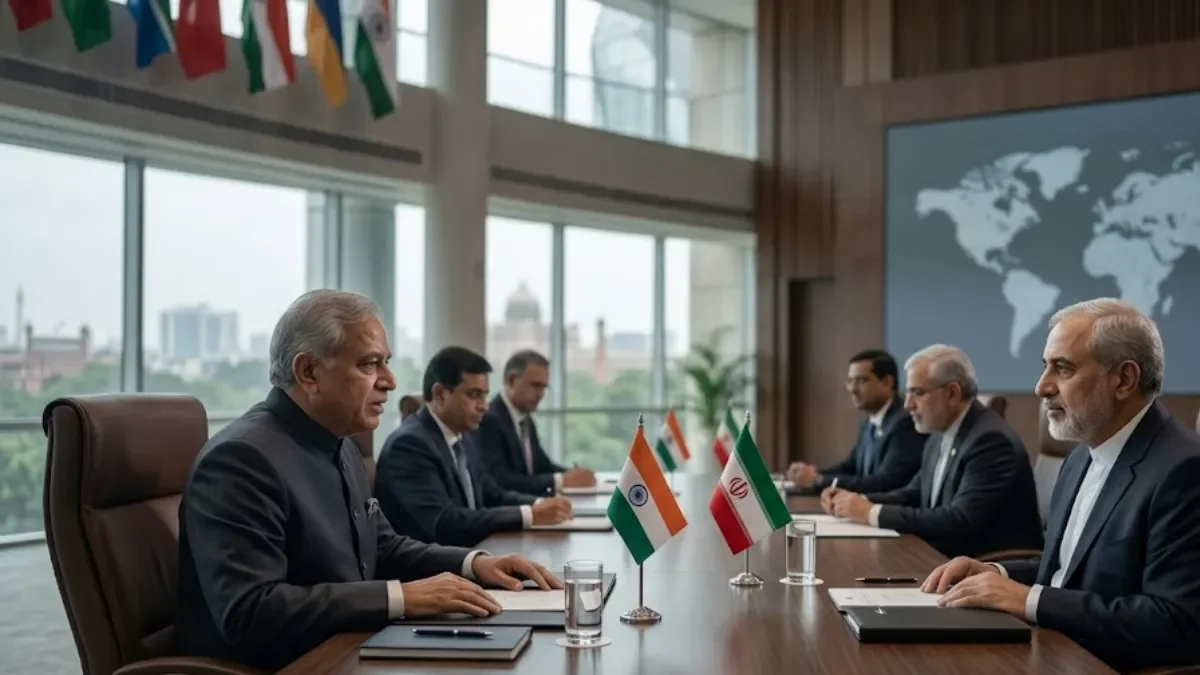
Iranian President Masoud Pezeshkian is visiting India for the 18th BRICS Summit, marking the first visit by an Iranian president to the country in more than eight years. His trip comes at a particularly sensitive moment, with the West Asia war putting Iran’s relations with the US, Israel and regional countries under intense scrutiny.
Pezeshkian’s visit also gives India an important diplomatic opportunity as New Delhi tries to maintain relationships with Iran, the Gulf countries, Russia and Western powers at the same time.
Why is Masoud Pezeshkian visiting India?
Pezeshkian is in New Delhi to participate in the 18th BRICS Leaders’ Summit, which India is hosting at Bharat Mandapam on September 12 and 13, 2026.
Iran is one of the 11 full BRICS members participating in the summit. The grouping also includes Brazil, Russia, India, China, South Africa, Egypt, Ethiopia, Indonesia, Saudi Arabia and the UAE.
The Iranian president’s participation is significant because the summit is taking place against the backdrop of the ongoing West Asia conflict. Regional security, trade routes, energy supplies and diplomacy are therefore expected to feature prominently around the meetings.
Why is Pezeshkian’s India visit significant after eight years?
The last Iranian president to visit India was Hassan Rouhani in February 2018. Pezeshkian’s trip therefore represents the first visit by an Iranian president to India in more than eight years. [NEEDS SOURCE: Exact arrival/visit date confirmation if publication is updated after the summit.
For Pezeshkian, the visit is also his first trip to India since becoming Iran’s president in 2024.
India and Iran have maintained relations across trade, connectivity, energy and regional diplomacy. The Chabahar Port project remains one of the most important areas of cooperation because it gives India a route toward Afghanistan and Central Asia.
What does the West Asia war mean for the visit?
The timing of Pezeshkian’s trip is perhaps its most important feature.
Iran is currently involved in a major regional conflict involving the United States and Israel, while the wider crisis has affected shipping, energy markets and security across West Asia. The conflict has also created complicated diplomatic positions inside BRICS because Iran and the UAE are themselves on different sides of some regional issues.
The Indian government has repeatedly called for dialogue and diplomacy while stressing the need to protect civilians, commercial shipping and freedom of navigation.
Prime Minister Narendra Modi and Pezeshkian had already met on August 31 on the sidelines of the Shanghai Cooperation Organisation summit in Bishkek. That meeting focused on bilateral relations and developments in the West Asia conflict, with Modi stressing dialogue, diplomacy and regional stability.
What will Modi and Pezeshkian discuss?
Their discussions are expected to cover both bilateral relations and the wider regional situation.
Key areas include:
| Issue | Why it matters |
|---|---|
| West Asia war | India wants de-escalation and regional stability |
| Chabahar Port | Important for India's connectivity with Afghanistan and Central Asia |
| Trade | Conflict and sanctions create challenges for commercial ties |
| Energy | West Asian instability can affect supplies and prices |
| Maritime security | Shipping routes and Indian seafarers have been affected |
| BRICS cooperation | Iran is a full member of the expanded grouping |
| Regional diplomacy | India maintains ties with Iran as well as Gulf countries |
The two leaders are also likely to discuss ways to keep India-Iran economic and connectivity cooperation moving despite geopolitical pressure.
What is the Chabahar Port connection between India and Iran?
Chabahar is one of the most important strategic links between India and Iran.
India has been involved in developing and operating the Shahid Beheshti terminal at Chabahar Port. The port provides India with an alternative connectivity route toward Afghanistan and Central Asia without depending entirely on routes through Pakistan.
In May 2024, India Ports Global Limited and Iran’s Port and Maritime Organization signed a long-term contract for the development and operation of the Shahid Beheshti terminal.
The project has therefore remained an important part of India's engagement with Tehran even as geopolitical tensions have increased.
Could the Iran-UAE divide affect the BRICS summit?
Yes. This is one of the more complicated diplomatic issues surrounding the summit.
Iran and the UAE are both BRICS members, but the ongoing West Asia conflict has created differences between their positions. Indian Express reported that the two countries had not yet reached a common position on the diplomatic language being discussed for the BRICS Delhi Declaration ahead of the summit.
Indian diplomats and BRICS negotiators have therefore been working to find language that can accommodate different positions among members.
This matters because BRICS has expanded considerably since its original five-member format. The wider the grouping becomes, the harder it can be to reach consensus on highly sensitive geopolitical questions.
Is India taking Iran's side in the West Asia war?
India's position should not be described simply as taking Iran's side.
New Delhi has maintained diplomatic relations with Iran while also maintaining important relationships with Israel, the United States and Gulf countries. India's stated approach has focused on de-escalation, dialogue, diplomacy and the protection of civilians and commercial shipping.
That balancing act is particularly important during the BRICS summit because Iran, Russia, China, the UAE and other countries have different positions on the conflict.
India therefore has to engage Tehran without turning its BRICS diplomacy into an alignment with any single side of the West Asia conflict.
Why does Iran care about BRICS?
For Tehran, BRICS provides a platform for deeper economic and diplomatic engagement with major emerging economies.
Before leaving for India, Pezeshkian described BRICS as an opportunity to expand economic, trade, industrial and scientific cooperation between member states. He has also argued that the grouping can contribute to a more multilateral international system.
Iran formally became a full BRICS member in January 2024 along with Egypt, Ethiopia, Saudi Arabia and the UAE.
Its participation has become even more significant as Tehran faces pressure from Western countries and seeks stronger economic relationships outside traditional Western markets.
What is India trying to achieve at BRICS 2026?
India is hosting the summit under the theme “Building for Resilience, Innovation, Cooperation and Sustainability.”
The 2026 chairship is also important because BRICS marks 20 years of institutionalised cooperation this year.
India's agenda includes issues such as:
- Strengthening multilateral cooperation.
- Improving trade and investment between member countries.
- Increasing supply-chain resilience.
- Expanding technology and innovation cooperation.
- Discussing energy and food security.
- Improving financial and digital-payment cooperation.
- Addressing global conflicts and regional instability.
The Iran situation adds another layer to this agenda because the West Asia conflict affects energy, shipping, trade and wider global economic stability.
How important is Pezeshkian’s visit for India-Iran relations?
The visit could give both countries an opportunity to move beyond crisis management and discuss longer-term economic cooperation.
India has historically viewed Iran as an important partner for connectivity to Central Asia, while Iran sees India as a major Asian economic partner with which it has longstanding cultural and commercial links.
The challenge is that sanctions, regional conflict and disruptions to shipping can make economic cooperation considerably more difficult.
Pezeshkian’s presence in New Delhi therefore matters not only because of the BRICS meeting itself, but because it creates space for direct India-Iran discussions at a time when both sides have strong reasons to keep communication open.
What happens next at the BRICS Summit?
The 18th BRICS Leaders’ Summit begins at Bharat Mandapam on September 12 and continues through September 13.
The first day is focused on BRICS member-country discussions, including inclusive global governance and strengthening multilateralism. Leaders are also scheduled to participate in events connected with India's BRICS chairship.
The second day will include engagement with BRICS partner countries and outreach invitees, with discussions linked to resilience, innovation, cooperation and sustainable development.
Pezeshkian’s bilateral discussions with Modi will be closely watched alongside other high-level meetings, particularly those involving China and Russia.
Why does Pezeshkian’s visit matter beyond India and Iran?
The visit demonstrates how the West Asia conflict is increasingly intersecting with broader global diplomacy.
Iran is simultaneously dealing with a major regional conflict while participating in a grouping that includes countries with very different relationships with Washington, Moscow, Beijing and the Gulf.
For India, the challenge is even more complex. New Delhi has to protect its economic and security interests while maintaining diplomatic space with competing powers.
That makes Pezeshkian’s first presidential visit to India in eight years one of the more closely watched bilateral moments around BRICS 2026
FAQ
Why is Iran's President visiting India in 2026?
Masoud Pezeshkian is visiting New Delhi to attend the 18th BRICS Leaders’ Summit. It is also his first visit to India as Iran’s president.
When did an Iranian president last visit India?
Hassan Rouhani was the last Iranian president to visit India, in February 2018.
Why is Pezeshkian’s visit important during the West Asia war?
The visit comes amid a major regional conflict involving Iran and creates an opportunity for India and Iran to discuss regional stability, trade, connectivity and diplomacy.
Is Iran a BRICS member?
Yes. Iran became a full BRICS member in January 2024 as part of the group's expansion.