Will UPI Become Paid? Here's What Actually Changed
Millions of Indians woke up to headlines claiming that UPI payments may soon attract charges after the Lok Sabha passed amendments related to the Payment and Settlement Systems Act, 2007.
The news quickly sparked concern because UPI has become India's preferred digital payment system for everything—from buying groceries and paying electricity bills to shopping online and transferring money between friends.
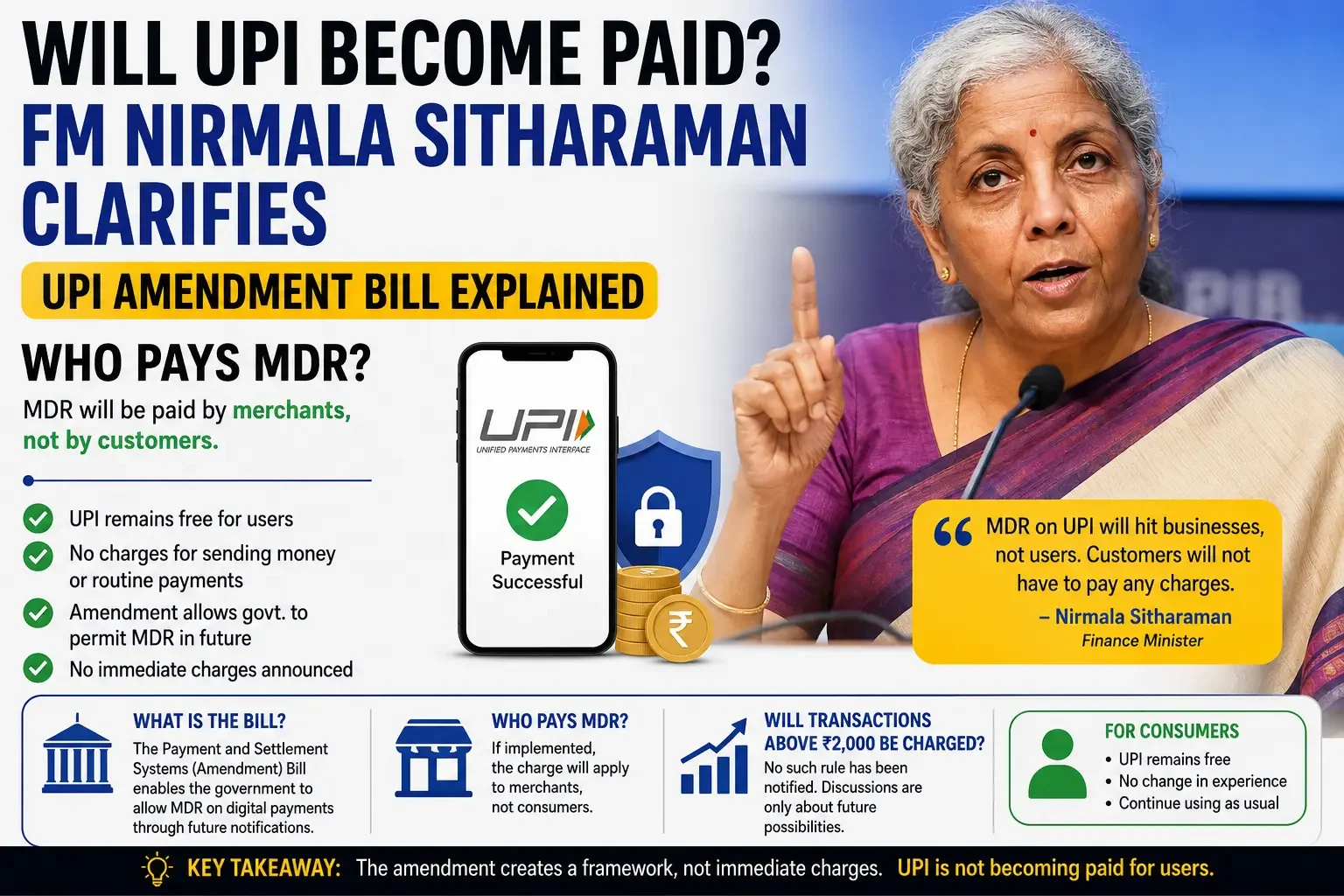
However, Finance Minister Nirmala Sitharaman clarified that ordinary UPI users will not be charged. The discussion revolves around Merchant Discount Rate (MDR)—a fee paid by merchants to payment providers—not a fee charged directly to consumers.
This article explains:
- What the UPI Amendment Bill actually does
- Whether UPI will become paid
- Who pays MDR
- Whether transactions above ₹2,000 will be affected
- How businesses, banks and payment apps may be impacted
- What consumers should expect next
What is the UPI Amendment Bill?
The recently passed legislation amends provisions of the Payment and Settlement Systems Act, 2007.
Its objective is not to introduce immediate UPI charges.
Instead, it removes the existing legal restriction that prevented banks and payment service providers from levying Merchant Discount Rate (MDR) on notified electronic payment systems, allowing the government to authorize such charges through future notifications if it chooses.
That means:
- No charges start automatically.
- Banks cannot suddenly charge everyone.
- The government would need to separately notify any implementation.
What Did Nirmala Sitharaman Clarify?
Finance Minister Nirmala Sitharaman addressed concerns circulating on social media after claims suggested that citizens would have to pay to use UPI.
Her clarification was straightforward:
- MDR is borne by merchants, not customers.
- Consumers will continue to use UPI without paying transaction fees unless future policy explicitly changes.
- The amendment only enables a legal framework; it does not itself impose charges.
This clarification significantly reduced confusion created by viral posts suggesting that "UPI will become paid."
What is Merchant Discount Rate (MDR)?
Merchant Discount Rate (MDR) is a fee merchants pay to banks and payment service providers whenever they accept digital payments.
It typically compensates:
- Acquiring banks
- Payment gateways
- Card networks (where applicable)
- Payment processors
For card payments, MDR has existed for years.
UPI, however, has largely operated without MDR after government policy removed merchant charges to encourage digital adoption.
The amendment simply allows the possibility of reintroducing MDR under specified circumstances in the future.
Does This Mean Customers Will Pay?
No.
For ordinary users:
✔ Sending money remains free.
✔ Paying friends remains free.
✔ Paying shopkeepers remains free today.
✔ Bank-to-bank UPI transfers remain unchanged.
The proposed discussion concerns merchant settlement charges, not consumer transaction fees.
Why Is the Government Considering MDR?
India's UPI ecosystem has grown into one of the world's largest real-time payment infrastructures.
However, operating this ecosystem requires continuous investment in:
- Payment infrastructure
- Banking systems
- Fraud prevention
- Cybersecurity
- Cloud infrastructure
- Customer support
- Innovation
Since MDR on UPI was removed several years ago, banks and payment companies have argued that maintaining the ecosystem without sustainable revenue is increasingly difficult. Supporters of the amendment argue that allowing MDR for certain commercial transactions could help fund continued investment while preserving free consumer payments.
Are UPI Payments Above ₹2,000 Going to Be Charged?
This is one of the biggest questions currently being asked.
Current Position
No government notification has introduced charges.
However, policy discussions have referenced the possibility that certain higher-value merchant transactions could be considered if MDR is permitted in the future. Most everyday consumer transactions, which are below ₹2,000, would remain unaffected under the proposals discussed so far.
Consumer vs Merchant: Who Pays?
| Transaction | Customer Pays? | Merchant Pays? |
|---|---|---|
| Personal UPI Transfer | No | No |
| Paying Friend | No | No |
| Grocery Purchase | No | Possibly in future if notified |
| Restaurant Payment | No | Possible under future rules |
| Large Business Payment | No | Could be eligible if government notifies MDR |
Timeline of Events
| Date | Event |
|---|---|
| UPI introduced | Free digital payment ecosystem expands |
| MDR removed | Government promotes digital adoption |
| 2026 | Amendment Bill introduced |
| Lok Sabha | Bill passed |
| FM clarification | Consumers will not pay MDR |
| Future | Government may issue separate notifications if required |
Why Is This Amendment Important?
The amendment matters because it gives policymakers greater flexibility.
Instead of permanently prohibiting MDR, the government can decide:
- whether to introduce charges,
- where they apply,
- which merchants are covered,
- and under what conditions.
That flexibility could allow targeted policies rather than a one-size-fits-all approach.
Impact on Different Stakeholders
Consumers
- No immediate impact
- UPI remains free
- No action required
Small Businesses
Many small merchants may continue to receive exemptions if future rules follow the policy direction currently discussed.
Large Businesses
Larger commercial entities could potentially become subject to MDR if the government notifies specific categories in the future.
Banks
Banks may receive an additional revenue stream to support payment infrastructure.
Payment Apps
Companies like PhonePe, Google Pay, Paytm and others could benefit from a more sustainable payments ecosystem if merchant fees are introduced for selected commercial use cases.
Why Has This Become Controversial?
The controversy emerged because many social media posts interpreted the amendment as meaning:
"UPI is no longer free."
That is inaccurate.
The amendment creates legal authority, not immediate charges.
Whether charges are introduced depends on future government decisions.
Will UPI Lose Popularity?
Probably not.
UPI has become deeply integrated into India's economy because it offers:
- Instant transfers
- Bank interoperability
- QR payments
- No wallet dependency
- Strong security
- Wide merchant acceptance
Even if merchant MDR returns for some categories, the consumer experience could remain unchanged.
Expert Perspective
Digital payment systems require continuous investment in infrastructure, fraud monitoring, and reliability. Many countries fund these systems through merchant fees rather than direct consumer charges. If India adopts a similar approach for selected commercial transactions while keeping person-to-person payments free, it could improve long-term sustainability without reducing consumer adoption.
Frequently Asked Questions
Is UPI becoming paid?
No. Consumers are not being charged.
Does the Bill introduce UPI charges immediately?
No. It only enables the government to permit charges in the future.
Who pays MDR?
Merchants, not customers.
Will Google Pay charge users?
No announcement has been made requiring payment apps to charge consumers.
Will PhonePe become paid?
There is no notification making consumer UPI payments paid.
Will payments above ₹2,000 attract charges?
No such rule has been notified. Discussions have focused on potential merchant MDR for certain higher-value commercial transactions.
What is MDR?
Merchant Discount Rate is a fee paid by merchants to payment service providers.
Is cash better now?
UPI remains one of the fastest and most convenient payment methods for consumers.
Has the Bill become law?
The Lok Sabha has passed the relevant amendments; further legislative steps and notifications determine implementation.
Should consumers worry?
Based on current government clarification, no.
People Also Ask
Will UPI become chargeable in India?
No announcement has been made charging consumers.
What is the UPI Amendment Bill?
It amends the legal framework governing digital payment systems and allows the government to authorize MDR on notified payment modes in the future.
Who pays UPI charges?
If MDR is introduced, it is intended to be paid by merchants rather than consumers.
Will Google Pay and PhonePe remain free?
For users, yes—under the current policy position.
Final Verdict
The UPI Amendment Bill has generated widespread discussion because it opens the legal possibility of allowing Merchant Discount Rate (MDR) on specified digital payment modes in the future. However, it is important to separate legal authorization from actual implementation.
As Finance Minister Nirmala Sitharaman has clarified, the proposal is not about charging ordinary UPI users. Instead, it focuses on creating a framework under which merchants could bear transaction-related costs if the government later decides to introduce MDR for certain categories of digital payments.
For now, consumers can continue using UPI as they always have. Any future changes would require separate government notifications and are likely to be accompanied by detailed implementation guidelines. The broader policy debate is about finding a balance between keeping digital payments affordable for users and ensuring that banks and payment providers have a sustainable model to maintain and improve India's rapidly growing digital payments infrastructure.
Source - The Times Of India